
Palace Picture House · Programme note
Sallie Gardner at a Gallop 1878
Twelve cameras, a row of threads and a rich man's question: for a fraction of a second, does a galloping horse have all four feet off the ground?
By HertzyPertzy · Updated · 5 minute read
In short
Sallie Gardner at a Gallop is the name given to a card of twelve photographs taken by Eadweard Muybridge at Leland Stanford's farm at Palo Alto, California, on 19 June 1878, and published as The Horse in Motion. They showed, for the first time to anyone's satisfaction, that a galloping horse has all four hooves off the ground at one point in its stride. It is a set of still photographs, not a film, but Muybridge later copied them onto glass discs and projected them in motion with a machine of his own, which is why they are counted among the ancestors of cinema.
Watch the film
There is no clean free copy to play or link to here.
Sallie Gardner at a Gallop
1878
- Also known as
- The Horse in Motion, the title of the cards as published
- Made by
- Eadweard Muybridge (1830 to 1904), for Leland Stanford, former governor of California
- Taken
- 19 June 1878, at Stanford's Palo Alto stock farm, California; cards registered for copyright on 15 July 1878
- Subject
- The horse Sallie Gardner, owned by Stanford, at a 1:40 gait: a mile in one minute forty seconds
- Equipment
- A battery of twelve cameras beside the track, each shutter tripped as the horse or her sulky passed (threads or wires, sources differ)
- Frames
- Twelve on the card, from a run of well under a second
- What came next
- In 1879, 24 cameras at Palo Alto; the zoopraxiscope, a projector for discs of painted images, shown privately in autumn 1879 and publicly in 1880
- Copyright
- Public domain: photographs published in 1878 by a man who died in 1904. Wikimedia Commons hosts the Library of Congress's copy under a public-domain mark
The question
Does a galloping horse ever have all four feet off the ground? In the 1870s Americans argued about it, and the argument had a name, "unsupported transit". The eye cannot settle it. Opponents said a horse would collapse without at least one leg on the ground. Leland Stanford, a railroad man and former governor of California who bred trotting horses at Palo Alto, took the other side and wanted proof. He hired a photographer.
The story that he bet $25,000 on the answer is famous, and probably untrue. Historians who have gone looking for evidence of a wager have found none, and one calls the tale apocryphal.
The photographer
Eadweard Muybridge was born Edward Muggeridge at Kingston upon Thames in 1830. He went to America in 1852 and made his name in San Francisco with views of Yosemite. Stanford hired him in 1872, by one account for $2,000, and Muybridge at first called the job impossible. By 1873 (sources give 1872 or 1873) he had a fuzzy picture of Stanford's trotter Occident, taken in Sacramento. No copy of it survives, and the "instantaneous photograph" that was sent to newspapers in 1877 was a retouched painting.
Then the work stopped. In October 1874 Muybridge shot and killed Harry Larkyns, a man he believed to be his wife's lover. At his trial in February 1875 the jury accepted a plea of justifiable homicide and acquitted him. He spent about a year in Central America, and came back to Stanford's job.
19 June 1878
At Palo Alto, along the track, Muybridge set up a battery of twelve cameras in a row, with shutters that opened and closed in about a thousandth of a second, by his own claim. Each camera was tripped as the horse passed, by a thread or wire across the track: sources use both words. By one account a sulky wheel broke each wire in turn. By another the horse herself broke the threads. Either way, twelve pictures were taken in under half a second.
Turfmen and newspapermen came to watch. On 15 June a trotter, Abe Edgington, had been driven past the cameras by the trainer Charles Marvin. On 19 June it was the turn of Sallie Gardner, a horse of Stanford's, running at a gait of a mile in 1:40. One account names her rider as G. Domm. A saddle girth broke as she went by, and the camera caught it. Muybridge is said to have developed the plates within twenty minutes, and the press reported it as a success.
What it proved
All four feet do leave the ground. But not where artists had put them. Painters had shown the airborne horse stretched out like a rocking-horse, forelegs forward and hind legs back. In Muybridge's frames the horse is off the ground with her legs gathered under her body, around the middle of the stride. Artists began to consult the pictures. Stanford had the answer he wanted, and by one account lost interest in the photographs once they had confirmed his theory.
The twelve frames were printed on cabinet cards about 22 by 14 centimetres, sold by a San Francisco gallery at $1.50 each and registered for copyright at the Library of Congress on 15 July 1878. They went out as The Horse in Motion. In 1882 Stanford paid for a book of the same name, written by his physician J. D. B. Stillman, in which Muybridge's name did not appear on the title page.
The zoopraxiscope
Muybridge went on, with 24 cameras at Palo Alto in 1879 and later at the University of Pennsylvania, where the work was published in 1887 as Animal Locomotion, 781 plates. For the pictures to move he built a machine, the zoopraxiscope, which threw images from a glass disc on to a screen in quick succession. He showed it to Stanford and friends in the autumn of 1879 and to the public in San Francisco in 1880.
The images on the discs were not photographs but painted copies of them, redrawn and stretched so that they would look right on a screen. Projecting drawn pictures was not new in itself: a similar device had been shown in 1853. What was new was that these pictures were copied from real motion.
Why it matters
It is not a film, and the honest account says so. Each of the twelve pictures was taken by a different camera, a moment apart. There is no strip of film, and no single machine that records and replays. The oldest surviving film is generally given as Louis Le Prince's two seconds in a Leeds garden in 1888, ten years later, shot through one lens on one strip. The animated loops now seen on the internet were made long afterwards from the frames.
It showed that motion could be analysed. Before Muybridge no one knew what a gallop looked like. The cards proved that the camera could see what the eye could not.
It is among the ancestors of cinema. Film historians regard the zoopraxiscope as a forerunner of the projector, because many people could watch at once.
It belongs to everyone. Published in 1878, by a man who died in Kingston in 1904, the photographs are in the public domain, and the Library of Congress holds them.
On the same programme
Some of these films are rooms you can play
These notes come from Reel Trouble, a comedy platformer through film history. Every room in it is a movie set, built from scratch as a parody of a real film, and a fall is never a death: it is a retake.
-
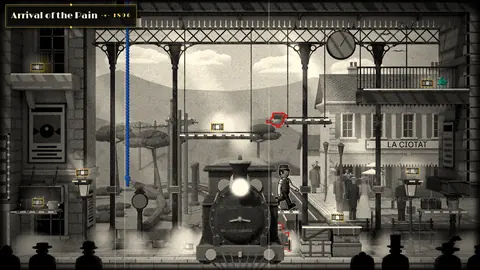 1896
Arrival of a Train at La Ciotat
Our room: Arrival of the Pain
-
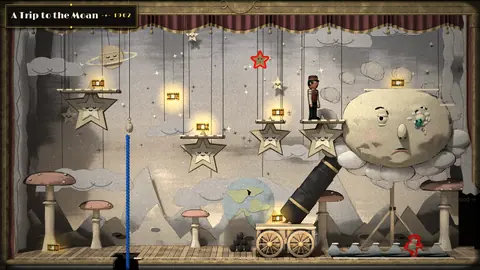 1902
A Trip to the Moon
Our room: A Trip to the Moan
-
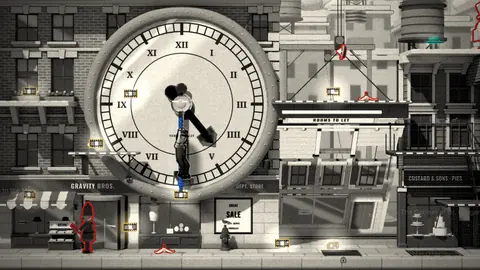 1923
Safety Last!
Our room: Safety Second
Free, in a desktop browser or as a download for Windows, Mac and Linux.
Quick answers
Is Sallie Gardner at a Gallop a film?
Not in the strict sense. It is a set of still photographs, each taken by its own camera, not a strip of film run through one. It is counted among the ancestors of cinema because Muybridge later had the images copied onto discs and projected them in motion.
When was Sallie Gardner at a Gallop made?
The photographs were taken at Leland Stanford's Palo Alto farm on 19 June 1878, and the cards were registered for copyright on 15 July 1878.
Did Leland Stanford really bet $25,000 on a galloping horse?
Probably not. The story that he wagered $25,000 that all four hooves leave the ground is famous, but historians who have looked for evidence have found none, and one calls it apocryphal. Stanford had other reasons to want an answer.
How did Muybridge take the photographs?
With a row of twelve cameras beside the track, each with a fast shutter that was tripped as the horse or her sulky passed. Accounts speak of threads or wires stretched across the track.
Does a galloping horse really have all four feet off the ground?
Yes. Muybridge's photographs showed it, though not at the moment painters had assumed, with the legs stretched out front and back. The horse is airborne with her legs gathered under her body.
What is the zoopraxiscope?
A projector Muybridge devised in 1879. It threw the images from a glass disc on to a screen in quick succession, and the figures on the disc were painted copies of his photographs. It was shown to Stanford and friends in autumn 1879 and to the public in 1880.
Why did Muybridge kill a man?
In October 1874 he shot Harry Larkyns, whom he believed to be his wife's lover. At a trial in February 1875 a jury acquitted him on the ground of justifiable homicide.
Is Sallie Gardner at a Gallop in the public domain?
Yes. The photographs were published in 1878 and Muybridge died in 1904. Wikimedia Commons hosts the Library of Congress's copy under a public-domain mark.
Sources and further reading
- Sallie Gardner at a Gallop, Wikipedia, for the session, the cameras, the cards and the publication
- The Horse in Motion, Wikipedia, for the earlier attempts, the cabinet cards and the doubts about the bet
- Eadweard Muybridge, Wikipedia, for his life, the killing of Harry Larkyns and the zoopraxiscope
- The Man Who Stopped Time, Stanford Magazine, on the session, the press, the wires and the bet
- Muybridge Photographs a Galloping Horse, EBSCO Research Starters
- June 1878: Muybridge Photographs a Galloping Horse, IEEE Spectrum
- The Horse in Motion, animated from the Sallie Gardner series, Wikimedia Commons, from the Library of Congress Prints and Photographs Division