
Palace Picture House · Programme note
Roundhay Garden Scene 1888
Four people circle a Leeds garden for two seconds, seven years before the Lumières sold a ticket and two years before the man behind the camera vanished.
By HertzyPertzy · Updated · 7 minute read
In short
Roundhay Garden Scene is about two seconds of moving pictures taken in 1888 by the French inventor Louis Le Prince, in the garden of his wife's parents at Roundhay, Leeds. Twenty frames survive, as a copy made in the 1930s, and both Guinness World Records and the museum group that keeps them call it the oldest surviving film. Its maker never showed it in public: in September 1890 he boarded a train at Dijon and was not seen again. So the film comes first in the record books and led to nothing, which is why histories of cinema still begin with Edison and the Lumières.
Watch the film
The whole film: two seconds, silent, in the National Science and Media Museum's digital version. It repeats until you stop it.
Played from Wikimedia Commons, which hosts this copy as a public-domain work. Nothing is fetched from there until you press play. If it will not play here, it will on their page.
- Made by
- Louis Aimé Augustin Le Prince, with a single-lens camera built in his workshop at 160 Woodhouse Lane, Leeds
- Filmed
- 1888, at Oakwood Grange, Roundhay, Leeds. The day usually given is 14 October, on the word of his son Adolphe; not later than 24 October
- On screen
- Adolphe Le Prince (his son), Joseph and Sarah Whitley (his wife's parents) and a family friend, Annie Hartley, called Harriet in the museum's record
- Length
- 20 frames: about two seconds as usually shown, nearly three at the seven frames a second that later analysis suggests
- Format
- Silent, black and white, on unperforated paper film a little over two inches wide
- What survives
- A glass copy negative made at the Science Museum, London, in the 1930s; the paper original is reported lost. The camera is shown at the National Science and Media Museum, Bradford
- Record
- Listed by Guinness World Records as the first surviving film
- Copyright
- Public domain: made in 1888 by a man declared dead in 1897. Wikimedia Commons hosts it as a public-domain work
What is on it
Four people walk about a garden. An old man turns, and his coat-tails fly out. An old woman steps backwards as she turns round, as if she were dancing. Then it stops. Twenty frames survive, and as they are usually shown they last about two seconds.
They are a family, or nearly. The old couple are Joseph and Sarah Whitley, and the garden is theirs: Oakwood Grange, at Roundhay, a suburb of Leeds. The young man is their grandson, Adolphe Le Prince. The young woman is a friend of the family, whom the museum's record calls Harriet Hartley and other accounts Annie. Behind the camera is Adolphe's father, Louis Le Prince, the Whitleys' son-in-law. The Science Museum Group, which keeps what is left of the film, explains the odd choreography: they are "walking in a circle to keep within the area framed by le Prince's camera".
The same day, by the museum's account, he filmed Adolphe playing an accordion on the steps of the house. Later that month he filmed the traffic crossing Leeds Bridge.
The man and his camera
Le Prince was a Frenchman from Metz who had studied chemistry and painting. He came to Leeds in 1866 to join the Whitleys' firm of brass founders, married their daughter Lizzie in 1869, and with her ran a school of applied art. In 1881 he went to the United States, where he managed a group of painters of huge circular panoramas and began to experiment with pictures that moved.
His first camera had sixteen lenses. He built it in Paris in 1887 and took several sets of pictures with it. Sixteen lenses see a scene from sixteen slightly different places, so the result would have jumped about on a screen.
Back in Leeds, in a rented workshop at 160 Woodhouse Lane, he and two local craftsmen built something simpler. By the summer of 1888 there were two cameras with a single lens each. He called them "receivers". They took unperforated paper film a little over two inches wide, wound from one spool to another.
How it is dated
The day in the reference books is 14 October 1888. It comes from Adolphe Le Prince, who is in the picture, and the Science Museum Group repeats it. Guinness World Records says only early October. The historian Stephen Herbert has paper negatives exposed in the garden "apparently as early as the summer of 1888".
One date is not in doubt. Sarah Whitley died on 24 October 1888, and she is in the film. Whatever the day, the camera was working before that month was out. Ten years later her death certificate was evidence in an American court.
What survives
Not the strip of paper that went through the camera: that is reported lost. What exists is a glass copy negative made at the Science Museum in London in the 1930s, with twenty frames that its record numbers 110 to 129. Le Prince's daughter Marie had given the museum his apparatus, and accounts differ on whether it copied the paper negative itself or paper prints that she supplied. The camera is on show at the National Science and Media Museum in Bradford.
How fast should it run? Adolphe said twelve frames a second, and Guinness says ten to twelve. Later analysis of the movement, which the 2015 documentary The First Film follows, puts it nearer seven. If that is right, the familiar two-second version is too quick, and the true length is nearly three seconds.
Could he show it? He built projectors, which he called "deliverers", and people close to him said afterwards that they had seen his pictures projected in the workshop. Herbert's summary is that these machines "did not succeed to Le Prince's satisfaction": paper is a poor thing to shine a light through. By 1889 he was probably trying celluloid.
The disappearance
In the summer of 1890 Le Prince packed up his machines for New York, where his wife had rented and done up a mansion to show them in. First he went to France. On 16 September his brother saw him onto the Paris train at Dijon. He did not arrive. Neither he nor his luggage was ever found, and in 1897 he was declared dead.
Every explanation has been tried: suicide over money troubles, murder within the family, a new life somewhere else. His widow suspected foul play by the rival camp in the patent wars, which meant Thomas Edison's. No evidence supports that, or any of the others. In 2003 a photograph of a drowned man of 1890 who looked like Le Prince was found in the Paris police archives; it has been objected that the body was too short.
The family fought on. In 1898 Adolphe gave evidence for the American Mutoscope Company, which Edison was suing as the sole inventor of the moving-picture camera. The court found for Edison, and the ruling was overturned a year later. In 1901 Adolphe was found dead on Fire Island, near New York: by his own hand according to some accounts, in suspicious circumstances according to others. He was not yet thirty.
Why it matters
It is the oldest film that survives, and the wording is careful. Photographs taken in quick succession are older. Eadweard Muybridge photographed a galloping horse with a row of cameras in 1878, and Le Prince's own sixteen-lens machine caught a man walking round a Paris street corner in 1887. The garden at Roundhay is different in kind: one camera, one lens, one strip of film moving through it, which is how films went on being made. The Science Museum Group calls it "the oldest surviving film in existence", and Guinness World Records lists it as the first. The researcher Irfan Shah says only that many people now consider these the first true films, and notes that much of the familiar story rests on articles written in the 1920s from the family's own account.
It led nowhere. Le Prince never showed his invention to a scientific society, a photographic society or the public, and after 1890 there was nobody to carry it on. The cinema that people paid for came from elsewhere: Edison's Kinetoscope, a peepshow, opened to customers in 1894, and the Lumière brothers projected films to a paying audience in Paris in 1895. The museum that keeps his camera states his claim soberly:
Though he lacked the financial backing and research facilities of Thomas Edison and the Lumière Brothers, the acknowledged pioneers of motion pictures, and did not live to exploit his invention commercially, Louis Le Prince came close to achieving a successful process of cinematography.
Science Museum Group, catalogue entry for Le Prince's single-lens camera
Leeds has not forgotten. A bronze tablet went up at the Woodhouse Lane workshop in 1930, and a blue plaque marks the building by Leeds Bridge that he filmed from. Oakwood Grange was pulled down in 1972. Its garden walls are still there.
On the same programme
Some of these films are rooms you can play
These notes come from Reel Trouble, a comedy platformer through film history. Every room in it is a movie set, built from scratch as a parody of a real film, and a fall is never a death: it is a retake.
-
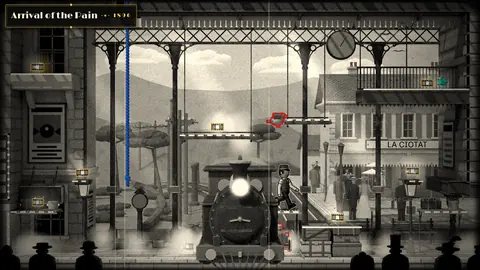 1896
Arrival of a Train at La Ciotat
Our room: Arrival of the Pain
1896
Arrival of a Train at La Ciotat
Our room: Arrival of the Pain
-
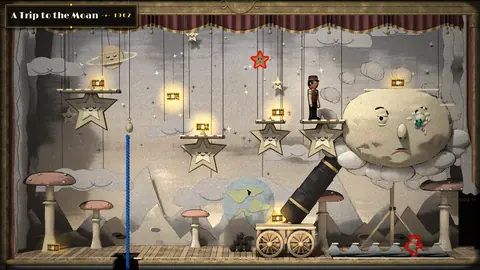 1902
A Trip to the Moon
Our room: A Trip to the Moan
1902
A Trip to the Moon
Our room: A Trip to the Moan
-
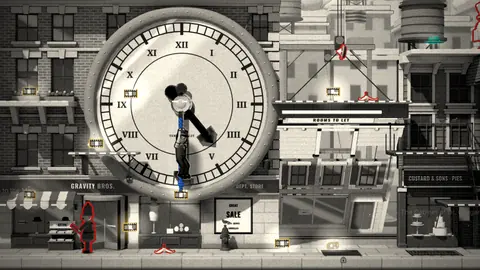 1923
Safety Last!
Our room: Safety Second
1923
Safety Last!
Our room: Safety Second
Free, in a desktop browser or as a download for Windows, Mac and Linux.
Quick answers
What is the oldest film in the world?
The oldest film known to survive is Roundhay Garden Scene, taken by Louis Le Prince in Leeds in 1888. Guinness World Records lists it as the first surviving film. Sequences of photographs are older, such as Eadweard Muybridge's galloping horse of 1878, but they were taken with a row of cameras, not on a strip of film in one camera.
How long is Roundhay Garden Scene?
Twenty frames survive. As usually shown they last about two seconds. At seven frames a second, the speed that later analysis suggests, they last nearly three.
Who are the people in Roundhay Garden Scene?
Adolphe Le Prince, the film-maker's son; Joseph and Sarah Whitley, the parents of the film-maker's wife; and a friend of the family, Annie Hartley, whom the museum's record calls Harriet. Sarah Whitley died on 24 October 1888.
When was Roundhay Garden Scene filmed?
In 1888, and by most accounts on 14 October: that is the day given by Le Prince's son Adolphe and by the Science Museum Group. One biographer has pictures being taken in the garden as early as that summer. It cannot be later than 24 October 1888, when Sarah Whitley, who is in it, died.
Where was Roundhay Garden Scene filmed?
In the garden of Oakwood Grange, the home of Joseph and Sarah Whitley at Roundhay, a suburb of Leeds in Yorkshire, England. The house was demolished in 1972. Its garden walls remain.
What happened to Louis Le Prince?
He was last seen boarding a train from Dijon to Paris on 16 September 1890. Neither he nor his luggage was found, and he was declared dead in 1897. Suicide, murder and a deliberate disappearance have all been proposed, and his widow suspected foul play by rivals, but nothing has been proved.
Did Louis Le Prince invent cinema?
He took moving pictures with a single-lens camera on a strip of paper film in 1888, years before Edison's Kinetoscope and the Lumières' Cinématographe. But he never showed them in public and nobody built on his work. The Science Museum Group's judgement is that he "came close to achieving a successful process of cinematography".
Is Roundhay Garden Scene in the public domain?
It was made in 1888, its maker was declared dead in 1897, and Wikimedia Commons hosts it as a public-domain work.
Sources and further reading
- Single-lens Cine Camera by Louis Le Prince, Science Museum Group Collection, object 1931-4
- Glass copy negative of Roundhay Garden Scene, Science Museum Group Collection, object 2019-259
- Louis Aimé Augustin Le Prince, Stephen Herbert, Who's Who of Victorian Cinema
- First surviving film, Guinness World Records
- The mystery of Louis Le Prince, the father of cinematography, Kieron Casey, National Science and Media Museum blog, 2013
- Louis Le Prince: New Thinking, part 1, Irfan Shah, The Optilogue, 2022
- The tragedy of Louis Le Prince, Maria Lewis, ACMI, 2021
- Roundhay Garden Scene, Wikipedia, for the people in the film, the house and the analysis of its speed
- Louis Le Prince, Wikipedia, for the family, the theories about his disappearance, the Edison lawsuit and the memorials in Leeds
- The Horse in Motion, Wikipedia, on Eadweard Muybridge's photographs of 1878