Palace Picture House · Programme note
Scrooge, or, Marley's Ghost 1901
A magician's trick film squeezes Dickens's Christmas Carol into a few minutes and a dozen scenes, with a ghost's face in the door knocker.
By HertzyPertzy · Updated · 5 minute read
In short
Scrooge, or, Marley's Ghost is a British silent film of 1901, directed by the stage magician Walter R. Booth for the producer R. W. Paul. It boils Dickens's A Christmas Carol down to a handful of scenes, with Marley's face showing in the door knocker and visions of Scrooge's past thrown on a curtain. It is generally called the oldest surviving film of the story, and only part of it is left.
Watch the film
The whole film: five minutes, silent, with no music.
Played from Wikimedia Commons, which hosts this copy as a public-domain work. Nothing is fetched from there until you press play. If it will not play here, it will on their page.
- Original title
- Scrooge, or, Marley's Ghost; the British Film Institute lists it as Scrooge; Or, Marley's Ghost
- Directed by
- Walter R. Booth, a former stage magician and trick-film specialist
- Produced by
- Robert W. Paul, at his Animatograph Works, London, England
- Release
- November 1901, as most listings give it; the BFI's own player lists 1 January 1901
- Cast
- Daniel Smith as Ebenezer Scrooge
- Length
- 620 feet by one silent-film list; the surviving part is given as about 323 feet, or about 3 minutes 26 seconds, and other running times differ
- Format
- Silent, black and white by most listings; one account says some scenes are tinted
- Copyright
- The film is out of copyright; Booth died in 1938 and Paul in 1943. The Public Domain Review calls the story public domain and says the rights in its digital copy are unclear
A magician and a producer
The producer was Robert W. Paul, an electrical instrument maker from London who began making narrative films in 1895 and showed projected films from 1896. In 1898, by one account, he designed and built Britain's first film studio, at Muswell Hill in north London. The credits of this film name his Animatograph Works. The director was Walter R. Booth, born in Worcester in 1869, who began as a porcelain painter, became an amateur magician and joined the conjuring company at the Egyptian Hall in Piccadilly. There, it is presumed, he met Paul, who showed some of his first films at the hall in 1896.
Booth began devising, and then directing, short trick films for Paul in 1899, with The Miser's Doom and Upside Down; or, the Human Flies. In the second, turning the camera upside down made the actors seem to walk on the ceiling. A film about a miser and a ghost needed exactly his habits: the camera as a conjuror's stage, and tricks that the cameraman could do in the lab.
Dickens in a dozen scenes
The film is built in twelve tableaux, or scenes, a form common at the time. The BFI describes it as a heavily condensed tableau of scenes from the book and notes that it was long thought the earliest filmed Dickens adaptation, until a film from about 1900 based on Bleak House, The Death of Poor Joe, was found. The makers could count on the audience knowing the tale, so it drops the story's links and keeps the pictures.
The three Christmas spirits are gone. A ghost of Marley in a white sheet shows Scrooge his visions instead. The BFI says this was probably borrowed from a popular stage version of the day, and other writers name it as J. C. Buckstone's play Scrooge, which the film is said to have drawn on as much as the book. Daniel Smith plays Scrooge. The Public Domain Review quotes the BFI's Michael Brooke on the scale of the job: telling an 80-page story in about five minutes.
The tricks
Two effects are always named. Marley's face appears over the door knocker, a double exposure, in which the film is run through the camera twice so that a second picture lands on the first. And scenes from Marley's youth are shown on a black curtain in Scrooge's bedroom, so that the dead man seems to hold the past up for Scrooge to watch. One account says the film also uses early dissolves between scenes.
Several accounts say the film is thought to have the first intertitles in a film. That claim is shaky: another account gives the credit to Paul's Our New General Servant of 1898. Treat it as a claim, not a fact. Ewan Davidson of the BFI's Screenonline judged it ambitious for its day but flat and stage-bound to modern eyes.
How much survives
Here the figures part company. A silent-film list gives the film as 620 feet long, and its page for the surviving copy says that the British Film Institute's print is incomplete, at about 323 feet. One account puts the survivor at about 3 minutes 26 seconds, running from Bob Cratchit showing someone out of Scrooge's office on Christmas Eve to Scrooge being shown his own grave. The BFI's own player lists the film as 10 minutes and says only that the surviving copy is missing its ending. The Public Domain Review speaks of five minutes. Silent film speeds varied, and so do the listings, and the BFI National Archive holds the copy to settle it.
The release date is also loose. Most listings say November 1901. The BFI's player says 1 January 1901.
A story people already knew
What is clear is that Dickens's tale was already a staple of the lantern show, in which a lecturer read the story aloud over glass slides. The Exeter lantern database lists a set of 24 slides, Marley's ghost: a Christmas carol, first made by York and Son in 1884, with a reading to go with it. It was shown at a lantern entertainment in Yorkshire in 1890 and at a lantern lecture in Bristol on 26 December 1899. A film of 1901 that cut the story into pictures was working in an old habit with a new machine.
Why it matters
It is the oldest surviving film of the story, as careful sources put it. The BFI calls it the debut film version of Dickens's tale. Dickens's tale has been filmed many times since, and this is where the list starts.
It shows what a magician's training did for early film. Booth knew how to make a face appear where there was none, and how to make a scene arrive on a curtain. Those were stage skills, moved onto celluloid.
It is a reminder that early film is mostly fragments. What is left is a few minutes, without an ending, and the sources cannot agree on how many. Booth died in 1938 and Paul in 1943.
On the same programme
Some of these films are rooms you can play
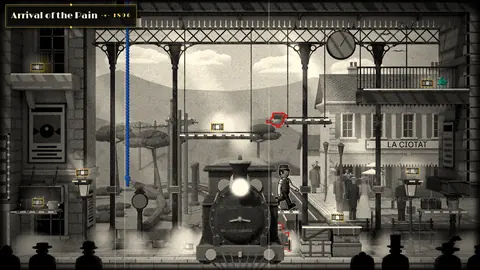
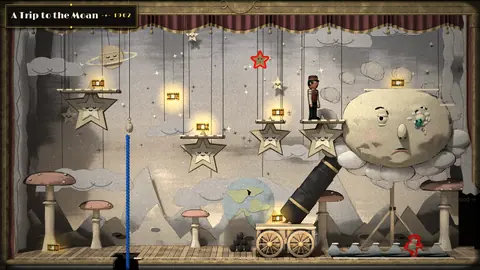
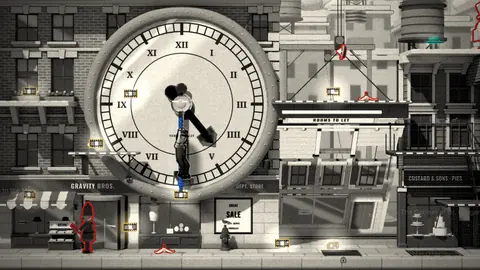
These notes come from Reel Trouble, a comedy platformer through film history. Every room in it is a movie set, built from scratch as a parody of a real film, and a fall is never a death: it is a retake.
-
 1896
Arrival of a Train at La Ciotat
Our room: Arrival of the Pain
-
 1902
A Trip to the Moon
Our room: A Trip to the Moan
-
 1923
Safety Last!
Our room: Safety Second
Free, in a desktop browser or as a download for Windows, Mac and Linux.
Quick answers
Is Scrooge, or, Marley's Ghost the first film of A Christmas Carol?
It is generally described as the earliest known film of the story, and the BFI calls it the debut film version. What can be said safely is that it is the oldest one that survives, in part.
Who directed Scrooge, or, Marley's Ghost?
Walter R. Booth, a former stage magician who made trick films for the producer Robert W. Paul. Paul is credited as producer.
How long is Scrooge, or, Marley's Ghost?
Sources differ. One list gives 620 feet for the film and about 323 feet for the incomplete surviving print, and another account gives the surviving footage as about 3 minutes 26 seconds. The BFI's player says 10 minutes, and the Public Domain Review says about five.
How was the Marley's face effect done?
Marley's face is superimposed over the door knocker. The BFI describes double-exposure effects of this kind, and scenes from Marley's youth are shown on a black curtain in Scrooge's bedroom.
Why are the three Christmas ghosts missing?
In this film a sheeted ghost of Marley replaces them. The BFI says the idea probably came from a popular stage adaptation of the day, J. C. Buckstone's play Scrooge.
Is Scrooge, or, Marley's Ghost complete?
No. The BFI says the only known copy is missing its ending. The surviving part is described as running from Bob Cratchit showing a visitor out of the office to Scrooge being shown his own grave.
Is Scrooge, or, Marley's Ghost in the public domain?
The film is old enough that its makers' rights have long expired: Booth died in 1938 and Paul in 1943. The Public Domain Review lists the underlying story as public domain and says the rights in its digital copy are unclear.
Sources and further reading
- Scrooge; Or, Marley's Ghost, BFI Replay, the British Film Institute
- Scrooge; or, Marley's Ghost (1901), Silent Era, Progressive Silent Film List
- Scrooge, or, Marley's Ghost (1901), The Public Domain Review
- Scrooge, or, Marley's Ghost, Wikipedia, for the credits, the twelve tableaux, the surviving footage and its sources
- Walter R. Booth, Wikipedia, for his dates, his stage career and his work for Paul
- Walter Robert Booth, David Robinson, Who's Who of Victorian Cinema
- Robert W. Paul, Wikipedia, for his dates, the Muswell Hill studio and his film career
- Marley's ghost: a Christmas carol, Lucerna, the Magic Lantern Web Resource, University of Exeter