
Palace Picture House · Programme note
Edison's Frankenstein 1910
Edison's company put Mary Shelley on one reel, promised to leave out anything repulsive, and saw the film disappear; its one known print sat with a Wisconsin collector for decades.
By HertzyPertzy · Updated · 6 minute read
In short
Frankenstein is a one-reel American silent film released by the Edison company on 18 March 1910, directed by J. Searle Dawley, with Charles Ogle as the Monster. The Library of Congress calls it the first film version of Mary Shelley's novel. Edison's publicity promised that the repulsive situations had been eliminated: the Monster rises from a cauldron of burning chemicals, nobody dies, and he fades into a mirror when love cures his maker. Long thought lost, it survived in one print kept by a Wisconsin collector, and the Library restored it in 2018.
Watch the film
The whole film: 12 minutes, silent, from the Library of Congress's copy.
Played from Wikimedia Commons, which hosts this copy as a public-domain work. Nothing is fetched from there until you press play. If it will not play here, it will on their page.
Also with Donald Sosin's 2018 score, at the Library of Congress (stream or download) (opens in a new tab)
- Released
- Friday 18 March 1910 in the United States, in Edison's advertisements and the trade lists of The Moving Picture World; 11 May 1910 in Britain, according to the London Kinetogram
- Made by
- Edison Manufacturing Company. Written and directed by J. Searle Dawley
- Cast
- Uncredited on the surviving print. Charles Ogle (the Monster), Augustus Phillips (Frankenstein), Mary Fuller (his sweetheart, usually listed as Elizabeth)
- Based on
- Mary Shelley's novel of 1818, billed by Edison as "A liberal adaptation of Mrs. Shelley's famous story"
- Filmed
- January 1910 at Edison's studio in the Bronx, New York; over about three days by one account
- Length
- One reel: 975 feet in Edison's American advertisements, 967 feet in the London Kinetogram. About 16 minutes at 16 frames a second, about 11 at 24
- Survival
- One nitrate print, from the collection of Alois F. Dettlaff, now at the Library of Congress, which released its restoration in 2018
- Copyright
- Public domain in the United States, as a work published before 1931. The Library of Congress's restoration and Donald Sosin's 2018 score can have rights of their own
The story
A young student called Frankenstein leaves his father and sweetheart for college. Two years later, a title card announces, he has discovered the mystery of life, and he sets out to make the most perfect human being the world has seen. A cauldron of chemicals blazes in his laboratory, and a card spells out what goes wrong: "Instead of a perfect human being, the evil in Frankenstein's mind creates a monster."
The Monster follows him home, "with the devotion of a dog" in the words of Edison's synopsis, and "insanely jealous" of anyone else. He sees himself in a mirror for the first time and flees in horror. On the wedding night he returns, frightens the bride into a faint, throws off Frankenstein and leaves. Nobody is killed.
In the last scene the Monster stands before a large mirror and fades away, leaving only his reflection. Frankenstein comes in and sees the Monster in the glass where his own face should be. That image fades in turn, he sees himself as a young man, and his bride joins him. The final card explains: "The creation of an evil mind is overcome by love and disappears."
What Edison's company promised
The film was shot at Edison's studio in the Bronx in January 1910, over about three days by one account. J. Searle Dawley wrote and directed. Charles Ogle played the Monster, Augustus Phillips Frankenstein and Mary Fuller the sweetheart, usually listed as Elizabeth. Edison's advertisements in The Moving Picture World of 12 and 19 March 1910 give the release as 18 March, a Friday.
The company's house magazine, the Edison Kinetogram, put a still on the cover of its issue of 15 March 1910, and on its London edition a month later. It chose its words with care:
In making the film the Edison Company has carefully tried to eliminate all the actually repulsive situations and to concentrate its endeavours upon the mystic and psychological problems that are to be found in this weird tale.
The Edison Kinetogram, London edition, 15 April 1910
Wherever the film differed from the book, it went on, that was "purely with the idea of eliminating what would be repulsive to a moving picture audience". The same pages still promise "an awful, ghastly, abhorrent monster". The customer was to be thrilled and reassured at once.
A Monster out of the fire
This Frankenstein robs no graves, and there is no lightning. The Monster comes from "the blazing chemicals of a huge cauldron", and that scene is what Edison sold hardest. A column headed "Edison Notes" in The Moving Picture World of 19 March called it "probably the most remarkable ever committed to a film": a line sometimes quoted as a review, though it reads as the company's own publicity.
The publicity does not explain the trick. By most accounts a dummy was set alight, its head and arms worked out of frame, and the film was run backwards, so that the flames seem to build a body instead of consuming one. Some accounts speak of a puppet, one of a melted model. Ogle's Monster, with wild hair, claw-like hands and ragged wrappings, looks less like a stitched corpse than a ghost.
How far it strays from the novel
Edison billed it as "A liberal adaptation", which was honest. In Mary Shelley's novel of 1818 the creature is assembled in secret and abandoned, teaches himself to speak and read, and kills Frankenstein's young brother, his friend and his bride. Frankenstein dies in the Arctic, still pursuing him. Only the wedding night survives. "I shall be with you on your wedding-night," the creature warns in the book, and he is. In 1910 the bride merely faints.
The deeper change is in what the Monster is. The film makes him a product of Frankenstein's evil thoughts, and the Kinetogram spells out the moral: when the hero's love for his bride has "attained full strength and freedom from impurity", the Monster "cannot exist". Cure the man and the creature goes, which is why the mirror matters. Some writers see a real doubling of maker and monster; others find the twist simply stupid.
Lost, and kept in Wisconsin
By one account most of Edison's prints and negatives went in fires in 1914. For decades the film was thought lost. A copy of the Kinetogram that surfaced in 1963 gave fans their main picture of Ogle's Monster, and in 1980 the American Film Institute put the film on its list of the ten most wanted lost films.
It was in Cudahy, Wisconsin. Alois F. "Al" Dettlaff, a collector who appeared at film conventions as Father Time, had acquired it in the 1950s with a larger collection, for a few dollars by one account. The Library of Congress says he learned what he had only from the AFI's list. He guarded it closely. In 1986 he took it to the Academy of Motion Picture Arts and Sciences, where the director Robert Wise could not persuade him to have it preserved. He sold DVDs at his appearances, the source of the poor versions seen online for years, and died in 2005 with the film still unpreserved.
The Library bought his collection in 2014, and the print, which it calls the sole surviving nitrate copy, arrived in April 2015. The head credits and first title were missing, and were supplied or recreated. The Library released its digital restoration free in 2018, the novel's two hundredth year, on YouTube and in its National Screening Room, with a new score by Donald Sosin.
Why it matters
It starts the line. The Library of Congress calls it the first film version of the novel, and it is generally recognised as the first screen adaptation.
It is the road not taken. The 1931 film took its story from a stage play and gave its Monster a flat head, bolts and a charge of electricity. Edison's Monster comes out of a fire and goes into a mirror, the sickness of one man's mind.
It was softened before anyone asked. The 1931 film was cut by censors after it was made. Edison's company did its own softening and advertised the fact. Even that did not satisfy everyone. In The Moving Picture World of 9 April 1910, W. Stephen Bush called such films "delightful literature to coroners, undertakers, grave-diggers and morgue-keepers".
It hung by one thread. One collector saved the film, then kept it from the people who could preserve it. It reached the Library of Congress 105 years after its release.
On the same programme
Some of these films are rooms you can play
These notes come from Reel Trouble, a comedy platformer through film history. Every room in it is a movie set, built from scratch as a parody of a real film, and a fall is never a death: it is a retake.
-
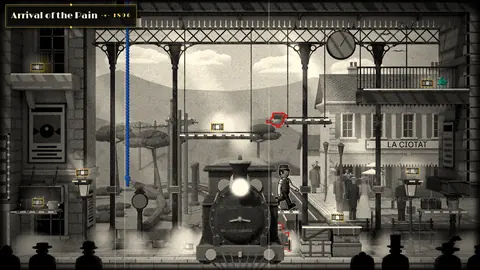 1896
Arrival of a Train at La Ciotat
Our room: Arrival of the Pain
-
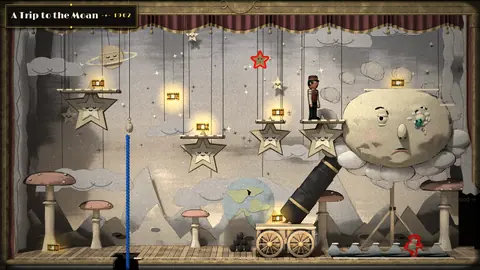 1902
A Trip to the Moon
Our room: A Trip to the Moan
-
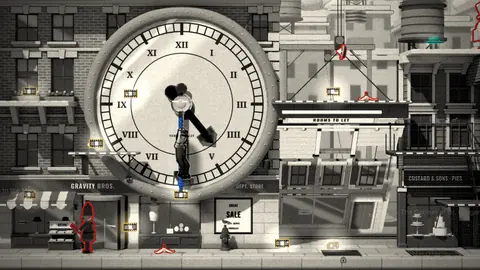 1923
Safety Last!
Our room: Safety Second
Free, in a desktop browser or as a download for Windows, Mac and Linux.
Quick answers
What was the first Frankenstein movie?
Edison's one-reel film of 1910 is generally recognised as the first screen adaptation of Mary Shelley's novel, and the Library of Congress calls it the first film version. It came 21 years before Boris Karloff's.
When was the 1910 Frankenstein released?
On Friday 18 March 1910 in the United States: Edison's advertisements and the release lists in The Moving Picture World both give that date. The London edition of Edison's Kinetogram gives 11 May 1910 for Britain.
Who played the Monster in the 1910 Frankenstein?
Charles Ogle. The surviving print credits no actors; Augustus Phillips is listed as Frankenstein and Mary Fuller as his sweetheart.
How did they make the creation scene in the 1910 Frankenstein?
By most accounts a dummy was set alight and the film run backwards, so that a body seems to form out of the flames; some accounts say a puppet or a model. Edison's publicity praised the scene without explaining it.
How is the 1910 Frankenstein different from the book?
Very. The Monster forms in a cauldron of chemicals, nobody is killed, and he vanishes into a mirror when love cures Frankenstein's mind. Edison's company said it had removed whatever would be repulsive to an audience.
Was the 1910 Frankenstein a lost film?
For decades it was thought to be. One nitrate print had been acquired in the 1950s by the Wisconsin collector Alois Dettlaff, and the Library of Congress bought his collection in 2014.
Where can I watch the 1910 Frankenstein?
On this page, silent, from the copy of the Library of Congress's restoration on Wikimedia Commons. The Library also released it free in 2018, on its YouTube channel and in its National Screening Room, with a modern score by Donald Sosin.
Is the 1910 Frankenstein in the public domain?
Yes, in the United States, as a work published before 1931. The Library of Congress's restoration and Donald Sosin's score can have rights of their own.
Sources and further reading
- The Edison Kinetogram, London edition, 15 April 1910: the cover still and the film's synopsis, pages 3 to 5, Edison Manufacturing Company, on the Internet Archive
- The Moving Picture World, January to June 1910: Edison's advertisements of 12 and 19 March, "Edison Notes" and the release list of 19 March, W. Stephen Bush's column of 9 April, full text, on the Internet Archive
- Now See Hear! post on the Library's Edison film, 29 October 2018, Mike Mashon, head of the Moving Image Section, Library of Congress
- The First Film Version of Frankenstein, Newly Restored!, Mike Mashon, Library of Congress Blog, 15 November 2018
- The Mystery of Thomas Edison's Frankenstein (1910), Frederick C. Wiebel Jr., MovieFanFare, 2009
- Bringing Frankenstein back to life, Andrew Weltch, wordsworth.org.uk, 2019
- Moving Monsters: The First Frankenstein Film, 1910, Kirstin Mills, 2018
- Inside Thomas Edison's Frankenstein Adaptation, Clement Tyler Obropta, Film Inquiry, 2019
- Frankenstein (1910 film): the title cards, Wikisource, a transcription of the film
- Frankenstein (1910 film), Wikipedia, for the shoot, the running times and the points given here as reported