
Palace Picture House · Programme note
A Trip Down Market Street 1906
A camera strapped to the front of a cable car filmed a whole street at work, and a few days later most of that city burned.
By HertzyPertzy · Updated · 5 minute read
In short
A Trip Down Market Street is an American silent film of 1906 by the Miles Brothers of San Francisco: a single take from the front of a cable car, running down Market Street towards the Ferry Building. It was long thought to date from 1905. The historian David Kiehn dated it to about 14 April 1906, four days before the earthquake and fire of 18 April. It is one of the best-known "phantom rides" and a rare moving picture of a city that was about to change, and it entered the National Film Registry in 2010.
Watch the film
The whole film: 8 minutes, silent, with no music, from the Library of Congress's digital copy of its print.
Played from Wikimedia Commons, which hosts this copy as a public-domain work. Nothing is fetched from there until you press play. If it will not play here, it will on their page.
- Released
- 21 April 1906, by one account
- Made by
- The Miles Brothers, San Francisco; cinematography credited to Harry J. Miles
- Filmed
- Market Street, San Francisco, from a moving cable car. Dated by David Kiehn to about 14 April 1906; first thought to be 1905
- Route
- From Eighth Street east to the cable-car turntable at the Embarcadero, in front of the Ferry Building
- Length
- About 13 minutes; the Prelinger Archives copy runs 13:52
- Format
- Silent, 35 mm, black and white, one continuous take
- Survival
- At least four prints are recorded, among them one at the Library of Congress and one in the Prelinger Archives
- Copyright
- Public domain in the United States as a work published in 1906; the Prelinger Archives copy is marked public domain. Colourised and AI-upscaled versions are separate modern works with rights of their own
The ride
The camera sits at the front of a cable car in San Francisco. It faces forward and does not move. The street moves instead. The car starts near Eighth Street and runs east along Market Street, the city's main thoroughfare, to the turntable at the Embarcadero, in front of the Ferry Building and its clock tower. The whole journey is one take of about 13 minutes.
The vehicle that carries the camera never appears in the picture. Such films are called phantom rides.
The film is credited to the Miles Brothers, with Harry J. Miles as cinematographer. By Kiehn's account it was first known as A Trip Through Market Street.
What the street shows
Market Street in 1906 is a wide road with no traffic lights and no marked lanes. Everything shares it: cable cars, horse-drawn carts and carriages, bicycles, and a number of motor cars, still a novelty. Pedestrians walk, and sometimes run, into the path of oncoming traffic and get out of the way at the last moment.
The traffic may be less casual than it looks. One account counts about thirty cable cars, a handful of horsecars and streetcars, and many motor cars. But several of those cars appear to circle the camera again and again, one of them about ten times, so the crowd was probably helped along to make the street look busy and modern.
The date
The film was long thought to date from 1905. The Library of Congress's early description rested on the state of two buildings under construction and on the position of the sun against the Ferry Building clock.
The historian David Kiehn of the Niles Essanay Silent Film Museum looked again. The streets in the film are wet, and he compared that with newspaper weather reports, which showed no rain in the autumn of 1905. He also traced the registration of a car whose licence plate is visible, recorded in early 1906, and read the trade papers that announced the film. His conclusion, in the words usually quoted, is that the film was shot four days before the earthquake of 18 April 1906. That puts it at about 14 April 1906. One account says he first suggested late March or early April, in a rainy spell, before settling on the 14th.
The date is not beyond argument. A later study by an engineer, Richard Greene, worked from the sun's shadows on the Ferry Building and put the filming at 24 to 30 March, which is about three weeks before the earthquake, not four days. A trade advertisement of 28 April 1906 claimed the film was made a week before the disaster. The safe version is: some weeks, perhaps only days, before the earthquake, and by most accounts on 14 April.
The Miles Brothers
There were four of them: Harry, Herbert, Earle and Joe. In 1903 they opened a film exchange in San Francisco, renting and selling films. By Kiehn's account theirs became the first film exchange to operate from coast to coast, and in 1905 they moved their New York office across the road from the Biograph company so that they could make films on their own account.
On 17 April 1906, Harry and Joe left San Francisco by train for New York with their film. The earthquake struck the next morning, and they heard of it on the way. By most accounts the footage went on to New York, where it was processed and shown, while they turned back with their equipment. The studio on Market Street survived the earthquake and was burned by the fire. The firm set up a temporary office in Earle's house at 790 Turk Street and, Kiehn says, vowed to rebuild but never did. Harry withdrew from the business because of ill health.
Survival
At least four prints of the film are known. One came to the Library of Congress by way of the American Film Institute, from a San Francisco projectionist. Another is in the Prelinger Archives, which put it on the Internet Archive, where it is marked public domain. The film was chosen for the National Film Registry in 2010.
It has had an odd second life. In 2016 further Miles Brothers footage of San Francisco after the disaster, including a second ride down the wrecked Market Street, was reported to have resurfaced online.
The viral versions
In recent years the film has been colourised, slowed or sped to a smooth 60 frames a second, sharpened and given a soundtrack of invented street noises, by AI-assisted restorers. A 2022 version credited to a restorer known as NASS spread widely; other outlets credit other names for similar versions. These are separate modern works. The colours are guesses, the extra frames are invented by software, and the sounds are not a recording of 1906. The 1906 negative itself is not what you are watching.
Why it matters
It is a record of a city days or weeks before it changed. By Kiehn's dating, the earthquake and fire arrived four days later and destroyed much of the downtown.
It shows how a film's date can be found. Wet streets, a licence plate and a clock tower turned a mistaken 1905 into 1906, and the argument over a few weeks is still going.
It is free to use. A film published in 1906 is in the public domain in the United States, which is why so many versions of it, old and new, are online.
On the same programme
Some of these films are rooms you can play
These notes come from Reel Trouble, a comedy platformer through film history. Every room in it is a movie set, built from scratch as a parody of a real film, and a fall is never a death: it is a retake.
-
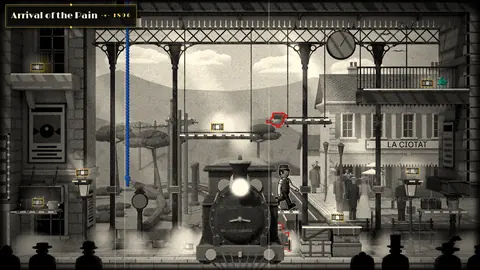 1896
Arrival of a Train at La Ciotat
Our room: Arrival of the Pain
-
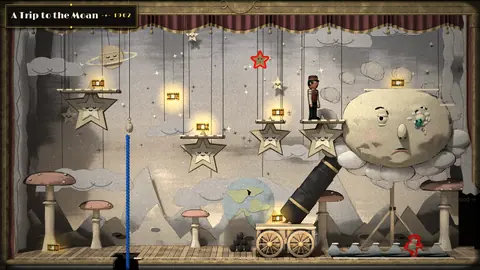 1902
A Trip to the Moon
Our room: A Trip to the Moan
-
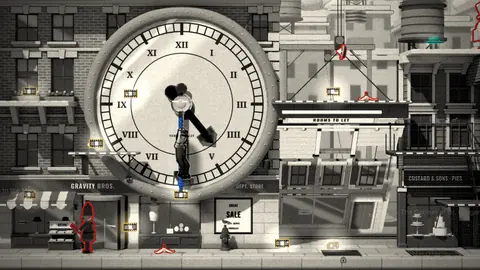 1923
Safety Last!
Our room: Safety Second
Free, in a desktop browser or as a download for Windows, Mac and Linux.
Quick answers
When was A Trip Down Market Street filmed?
By the historian David Kiehn's dating, about 14 April 1906, four days before the San Francisco earthquake. The Library of Congress first dated it to 1905, and at least one later study argued for late March 1906, so the exact day is not beyond argument.
Was A Trip Down Market Street filmed before the earthquake?
Yes. By Kiehn's dating it was shot four days before the earthquake and fire of 18 April 1906. That is why it is often called a last look at the old downtown.
Who made A Trip Down Market Street?
The Miles Brothers, a San Francisco film-exchange and production firm run by four brothers, Harry, Herbert, Earle and Joe. Cinematography is credited to Harry J. Miles.
How was A Trip Down Market Street filmed?
From a camera mounted on the front of a cable car, in one continuous take, travelling from Eighth Street to the Ferry Building. The style is called a phantom ride, because the vehicle carrying the camera is never seen.
How did the film survive the 1906 earthquake?
By most accounts it was already on its way to New York by train when the earthquake struck, and the Miles Brothers' studio was lost to the fire. Prints made from it survived, and a copy came to the Library of Congress and the Prelinger Archives.
Is A Trip Down Market Street in the National Film Registry?
Yes, it was selected for the Library of Congress's National Film Registry in 2010.
Who colourised A Trip Down Market Street?
Several colourised, upscaled versions exist online. One widely shared 2022 version is credited to a restorer known as NASS, who raised the frame rate from 15 to 60 frames a second, coloured the picture and added invented street sounds. Other outlets credit other restorers, and all are modern reinterpretations.
Is A Trip Down Market Street in the public domain?
The 1906 film is in the public domain in the United States, and the Prelinger Archives copy is marked as such. Modern colourised or AI-upscaled versions are new works, and their makers may hold rights in them.
Sources and further reading
- A Trip Down Market Street, Wikipedia: credits, the route, the traffic, the dating and the surviving prints
- The Brothers Who Filmed the Earthquake, David Kiehn, San Francisco Silent Film Festival: the Miles Brothers and the film's date
- [Trip Down Market Street Before the Fire, A], Internet Archive, Prelinger Archives: running time, rights, and the Library of Congress's 1905 dating
- Historian David Kiehn traces old Bay Area films, History News Network
- Risking life and limb on Market Street for over a century, Untapped Cities: the traffic and the pedestrians
- 1905 Film Trip Down Market Street Before the Great Earthquake, Media Collections blog, College of Charleston: the camera and the dating clues
- A Trip Down Market Street, restored in colour and 60 frames a second, Colossal, 2022: the NASS version