Palace Picture House · Programme note
The Great Train Robbery 1903
Four bandits, a train, a posse and a man who empties his revolver at the audience: the twelve-minute Edison film that showed how well a story could sell.
By HertzyPertzy · Updated · 6 minute read
In short
The Great Train Robbery is a 1903 American silent film made by Edwin S. Porter for the Edison Manufacturing Company. In fourteen shots and about twelve minutes, four bandits hold up a train, escape on horseback and are hunted down by a posse, and then an outlaw fires his revolver straight at the audience. Its commercial success was unprecedented, and when the first nickelodeons opened it was often the film they opened with. It is often called the first Western and the first film to tell a story: it was neither, but it showed how well a story could sell.
- Made by
- Edwin S. Porter, director and cameraman, for the Edison Manufacturing Company; second camera J. Blair Smith
- Released
- December 1903 in New York, by Charles Musser's account first at Huber's Museum on 14th Street; copyrighted on 1 December 1903
- Cast
- Justus D. Barnes (the outlaw leader), G. M. Anderson (a robber, a passenger and the tenderfoot), Walter Cameron (the sheriff); Edison staff as extras
- Filmed
- November 1903: Edison's studio at 41 East 21st Street, New York, and in New Jersey, in the South Mountain Reservation and along the Lackawanna railway
- Length
- 740 feet of film in 14 shots, sold to exhibitors for $111: about 12 minutes at 18 frames a second
- Format
- Silent, 35mm, black and white, with no intertitles; some prints were coloured by hand
- Honours
- US National Film Registry, 1990
- Copyright
- Public domain: published in the United States in 1903, and Porter died in 1941. Music added to modern editions may have rights of its own
Watch the real film silent, at the Library of Congress (stream or download) · the Library of Congress copy on Wikimedia Commons
The story
Two masked men walk into a railway telegraph office and force the operator to stop the next train with a false order to take on water. They tie him up. At the water tank the gang, four in all, slips aboard.
Two break into the express car, shoot the messenger and blow open the strongbox with dynamite. The other two climb over the tender to the engine, where one beats the fireman senseless with a lump of coal and throws him off the moving train. The passengers are lined up beside the track and robbed; one who runs is shot down. The gang rides the uncoupled engine up the line, takes to the woods and reaches its horses.
Back at the office, the operator's small daughter cuts him free and revives him with a glass of water. He staggers into a dance hall, where the locals are making a tenderfoot dance by shooting at his feet. A chase on horseback, a shoot-out in the woods, and every bandit is dead.
Then a fourteenth shot, outside the story: an outlaw looks straight at you, raises his revolver and fires six times.
Who made it
Edwin S. Porter was 33 and ran the Edison Manufacturing Company's rooftop studio at 41 East 21st Street in New York. He directed and worked the camera, with J. Blair Smith as second cameraman.
It was shot in November 1903: the interiors in the studio, the woods in the South Mountain Reservation in Essex County, New Jersey, and the train on the Lackawanna railway. Nothing was filmed west of New Jersey.
Justus D. Barnes played the leader of the outlaws and Walter Cameron the sheriff. A young stage actor who had just changed his name from Max Aronson to G. M. Anderson took three parts: a robber, the passenger who is shot, and the tenderfoot. He later claimed a share of the direction, and the historian Charles Musser allows that he may have helped. Anderson went on to become "Broncho Billy", the screen's first cowboy hero.
Where it came from
The title and the idea came from the stage: Scott Marble's melodrama The Great Train Robbery opened in Chicago in 1896 and was revived in New York in 1902. The way of telling it came from Britain. In June 1903 Edison had copied and sold the Sheffield Photo Company's A Daring Daylight Burglary, a crime film with a chase, and Musser calls it "particularly influential" on Porter's.
The detail came from the newspapers. Musser reprints a report of September 1903 in which masked men hold up an express in Oregon, crawl over the tender to the engine and dynamite a car door. Edison's leaflet promised a "faithful duplication of the genuine 'Hold Ups' made famous by various outlaw bands in the far West". Butch Cassidy's Union Pacific raid of 1900 has also been suggested. That is a guess.
How it was made
Most of the film was shot out of doors, a long way from the painted stages of Méliès. Twice Porter brings the outdoors into the studio: a train pulls up outside the telegraph office window, and the landscape rushes past the open door of the express car. Both are matte shots, two exposures on one strip of film.
The camera moves, too. It rides on the train for the fight on the tender, and three times it swings to keep the action in view, once down and sideways together, shakily. For Musser, Porter filmed the robbery like a news event he could not control.
Reference books credit the film with cross-cutting, or parallel editing. Musser describes something looser. Twice the film steps back in time to show what was happening meanwhile: the fight on the tender during the robbery of the express car, and the operator's rescue during the getaway. It never cuts back and forth between two actions, and no titles explain. The timing, he writes, is "imprecise and open to interpretation".
Some prints were coloured by hand: in the Museum of Modern Art's copy, gunfire and dynamite flare orange and yellow, and the women at the dance wear bright dresses.
The man with the gun
The close-up of Barnes is the only one in the film. Edison's leaflet for exhibitors describes it:
A life size picture of Barnes, leader of the outlaw band, taking aim and firing point blank at each individual in the audience. (This effect is gained by foreshortening in making the picture.) The resulting excitement is great. This section of the scene can be used either to begin the subject or to end it, as the operator may choose.
Edison Manufacturing Company, leaflet no. 201, 1903
So the most famous ending in early cinema was also an optional beginning. The operator is the projectionist. The version that has come down to us puts the shot last.
Did audiences scream, duck or faint? It is the best-known story about the film, and the evidence is thin. Edison's "resulting excitement" is advertising. So is the catalogue for Siegmund Lubin's remake of 1904, which says that "women scream, and even though no sound is heard, they put their fingers in their ears to shut out the noise of the firing". None of the sources used for this note quotes anyone who saw a panic.
Why it matters
It was the hit that made story films pay. Musser calls its commercial success "unprecedented". By his account it opened at Huber's Museum in New York in December 1903 and was in eleven theatres around the city a week later. When nickelodeons spread from Pittsburgh in 1905, it was often the first film a new one showed.
It was not the first Western, and not the first story film. Films on Western subjects go back to the 1890s, and a one-minute British drama, Kidnapping by Indians, dates from 1899. Méliès' A Trip to the Moon and Porter's own Life of an American Fireman told stories first. In 1903 it was sold as a sensational crime picture. Historians disagree about what the Western owes it: Scott Simmon has argued that it led nowhere for the genre, which did not take off until about 1908. The safe claim is that it is one of the earliest Westerns, and that no film before it had been such a success.
The last shot is still being fired. In the closing moments of Goodfellas (1990), Joe Pesci shoots straight into the lens, and Martin Scorsese has called it a reference to Porter's film. The Library of Congress added The Great Train Robbery to the National Film Registry in 1990.
On the same programme
Some of these films are rooms you can play
These notes come from Reel Trouble, a comedy platformer through film history. Every room in it is a movie set, built from scratch as a parody of a real film, and a fall is never a death: it is a retake.
-
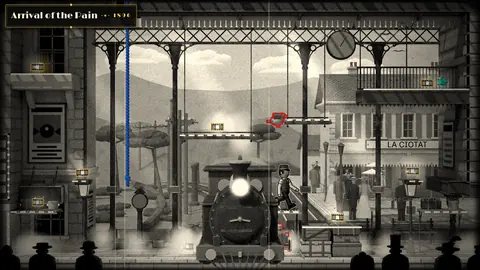 1896
Arrival of a Train at La Ciotat
Our room: Arrival of the Pain
1896
Arrival of a Train at La Ciotat
Our room: Arrival of the Pain
-
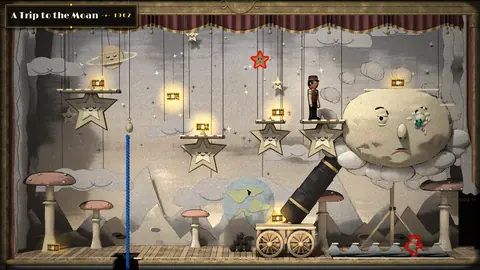 1902
A Trip to the Moon
Our room: A Trip to the Moan
1902
A Trip to the Moon
Our room: A Trip to the Moan
-
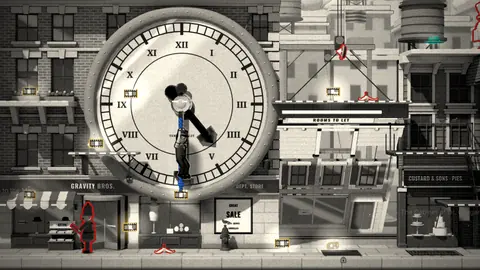 1923
Safety Last!
Our room: Safety Second
1923
Safety Last!
Our room: Safety Second
Free, in a desktop browser or as a download for Windows, Mac and Linux.
Quick answers
Is The Great Train Robbery the first Western?
No, though it is often called that. Films on Western subjects had been made since the 1890s, and a British one, Kidnapping by Indians, dates from 1899. It is one of the earliest Westerns, and far the most successful of them.
Was The Great Train Robbery the first film to tell a story?
No. Georges Méliès' A Trip to the Moon (1902) and Porter's own Jack and the Beanstalk (1902) and Life of an American Fireman (1903) all came first. It was the most successful story film of its day.
How long is The Great Train Robbery?
It was sold as 740 feet of film, in 14 shots. That is about 12 minutes at 18 frames a second. Depending on the speed, copies run from about 10 minutes to more than 13.
Where was The Great Train Robbery filmed?
In November 1903, at Edison's studio in New York and in New Jersey: in the South Mountain Reservation in Essex County and along the Lackawanna railway, probably between Denville and Dover according to the Library of Congress. None of it was shot in the West.
Who is the man who shoots at the camera?
Justus D. Barnes, who plays the leader of the outlaws. Some older books, and the AFI Catalog, call him George Barnes. Charles Musser's history of the Edison films and the Library of Congress both identify him as Justus D. Barnes.
Was the gunshot at the beginning or the end of the film?
Either. Edison's sales leaflet says the shot "can be used either to begin the subject or to end it, as the operator may choose". The operator is the projectionist. The version that has come down to us puts it at the end.
Did audiences really panic when the outlaw fired at them?
It is a famous story, and the evidence for it is thin. The claims made in 1903 and 1904 come from sales catalogues, which promised excitement and screaming women. The sources used for this note quote no witness to a panic.
Is The Great Train Robbery in the public domain?
Yes. It was published in the United States in 1903, and Edwin S. Porter died in 1941. The Library of Congress offers its copy to watch and to download. Music added to modern editions may have rights of its own.
Sources and further reading
- Before the Nickelodeon: Edwin S. Porter and the Edison Manufacturing Company, chapter 8, Charles Musser, University of California Press, 1991
- The Great Train Robbery: catalogue record and film, Library of Congress
- No. 201, Edison Film, The Great Train Robbery: the sales leaflet of 1903, Edison Manufacturing Company, digitised by Rutgers University Libraries
- Edwin S. Porter, The Great Train Robbery, 1903, The Museum of Modern Art, on its hand-coloured print
- The Great Train Robbery (1903), AFI Catalog
- The Great Train Robbery (1904), AFI Catalog, on Lubin's remake and its catalogue text
- The Great Train Robbery's parting shot, Pamela Hutchinson, first published in Sight and Sound, February 2016
- The Great Train Robbery, Don Vaughan, Encyclopaedia Britannica
- World's first Western movie 'filmed in Blackburn', BBC News, 31 October 2019
- The Great Train Robbery (1903 film), Wikipedia, for its references and for the points given here as "has argued" and "has called"