
Palace Picture House · Programme note
Fantasmagorie 1908
A French caricaturist drew about 700 pictures of a stick man who keeps changing shape, and historians call the result the first animated cartoon.
By HertzyPertzy · Updated · 5 minute read
In short
Fantasmagorie is a French animated film of 1908, drawn by the caricaturist Émile Cohl for the Gaumont company and released on 17 August 1908. It runs under two minutes and uses about 700 drawings. A stick man, a clown and a gentleman change shape from one moment to the next, while the artist's hands wander in and out of the picture. Historians commonly call it the first animated cartoon, though earlier work by J. Stuart Blackton and Émile Reynaud is part of the careful answer.
Watch the film
The whole film: 105 seconds, silent, with no music, in a modern edition that opens with a title card.
Played from Wikimedia Commons, which hosts this copy as a public-domain work. Nothing is fetched from there until you press play. If it will not play here, it will on their page.
- Original title
- Fantasmagorie (French for "phantasmagoria")
- Made by
- Émile Cohl, who drew and directed it, for Gaumont (Société des Établissements L. Gaumont), France
- Released
- 17 August 1908, Paris; by one account at the Théâtre du Gymnase, turned into a cinema for its annual closing
- Drawings
- About 700, each filmed on two frames, so roughly 1,400 frames
- Length
- About 36 metres of film: 1 minute 45 seconds with titles, about 1 minute 20 seconds of animation, by one account
- Format
- Silent, black and white, 35 mm, 1.33:1; drawn in ink on white paper and printed to show white lines on black
- Survival
- A 16 mm print at the Academy Film Archive, described as the only surviving full-frame copy; Gaumont holds a 35 mm copy made from it. The master negative is presumed lost
- Copyright
- Public domain: Wikimedia Commons marks the film so, noting that Cohl died in 1938, and a restoration or a score added to it can carry rights of its own
What is on screen
A hand draws a clown on a white page, and the clown comes to life. He is a stick man, drawn in a few quick lines, and nothing about him stays put. He meets a gentleman. A wine bottle turns into a flower, and the flower into an elephant. There is a woman in a cinema in an enormous feathered hat, and a strongman. The artist's hands keep coming back into the picture to draw the next thing, so that the film shows its own making.
The story, such as it is, is a chain of changes with no reason given for any of them: each shape becomes the next one. The film is under two minutes long, and it has the lively, dreamlike logic of a doodle.
The man with the pen
Émile Cohl was born in Paris on 4 January 1857, which made him 51 when the film came out. He was a caricaturist first. As a young man he assisted the cartoonist André Gill, and in 1879 he was jailed over a caricature of the president of the Republic, which made his name. In the 1880s he drew for the Incoherents, a Paris group that liked absurdity and a deliberately crude, childlike line. The group faded by about 1888.
Cohl joined the film company Gaumont around 1907, as a scriptwriter and a maker of animated effects for its live-action films. The story of how he was hired is doubtful; he may simply have been recruited by colleagues.
How it was made
He worked on it from about February to May or June 1908. By the usual figure, he made some 700 drawings in ink on white paper and filmed each one on two frames, so the film holds roughly 1,400 frames. At the hand-cranked speeds of the day that is a minute and three-quarters or so of screen time. Each drawing differs from the last by a small change, which is what makes the figure move.
The look comes from the film stock. Printed from a negative, the black ink lines show up white on a dark ground, like chalk on a blackboard. A French account notes that he drew on white paper and not on black. The blackboard idea was probably borrowed, as one account has it, from Blackton's Humorous Phases of Funny Faces (1906), though the French account stresses that Blackton drew on black and Cohl on white.
Release, and the title
The film was released in France on 17 August 1908, under the Gaumont name. One account places the first screening at the Théâtre du Gymnase in Paris, which was turned into a cinema for the annual closing of the theatre; another says only that it was shown in a Paris cinema.
The title is the French word for phantasmagoria, the nineteenth-century magic lantern shows that threw ghostly, changing images onto a wall. It is also described as a tribute to the Incoherents, the movement Cohl had belonged to in his youth.
A print, and no negative
Only one full-frame copy is known to survive: a 16 mm print kept at the Academy Film Archive. It was used for a Gaumont 35 mm copy, restored and scanned at 2K. The master negative is presumed lost.
Why it matters
It is called the first animated cartoon, and the wording matters. Film historians commonly give it that title, and one source says it was the first film made entirely by traditional animation. But it was not the first drawn picture to move on a screen: Émile Reynaud had shown painted strips in his Théâtre optique in the 1890s, though not on film, and Blackton had used drawing on film two years before. Cohl's film is the first in which the whole picture is drawn.
It is a film about change. Nothing in it is fixed. A line that is a flower one second is an elephant the next, which is something a camera on a real world cannot do.
Fame did not pay its maker. In 1912 he moved to the United States to work for Éclair at Fort Lee, New Jersey, where he made the Newlyweds series, based on a comic strip by George McManus. He came back to Paris in March 1914. In the end, by most accounts, he lived in poverty and almost forgotten. A benefit screening of his work was held on 19 January 1938, and he died the next day, aged 81. Wikimedia Commons treats the film as public domain because of that date.
On the same programme
Some of these films are rooms you can play
These notes come from Reel Trouble, a comedy platformer through film history. Every room in it is a movie set, built from scratch as a parody of a real film, and a fall is never a death: it is a retake.
-
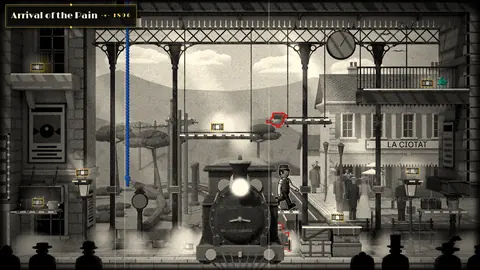 1896
Arrival of a Train at La Ciotat
Our room: Arrival of the Pain
-
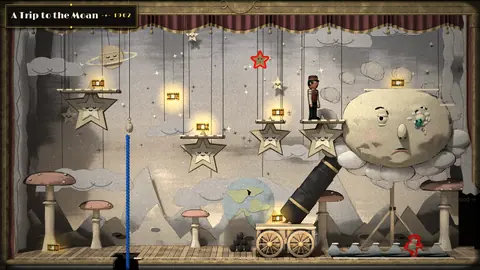 1902
A Trip to the Moon
Our room: A Trip to the Moan
-
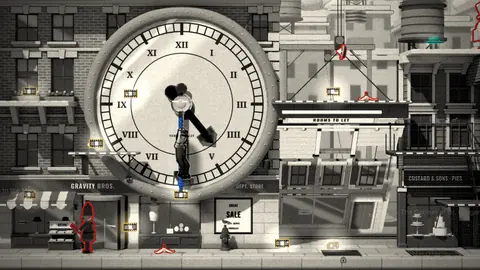 1923
Safety Last!
Our room: Safety Second
Free, in a desktop browser or as a download for Windows, Mac and Linux.
Quick answers
Is Fantasmagorie the first animated film?
Historians commonly call it the first animated cartoon, and one source says it was the first film made entirely with traditional animation techniques. It was not the first projected animation: Émile Reynaud showed drawn pictures in his Théâtre optique from the 1890s, and J. Stuart Blackton's Humorous Phases of Funny Faces (1906) used drawing on film before it.
When was Fantasmagorie released?
On 17 August 1908, in France. One account says the first screening was at the Théâtre du Gymnase in Paris, a theatre turned into a cinema for its annual closing.
How long is Fantasmagorie?
A little under two minutes: about 1 minute 45 seconds including titles, with some 36 metres of film. Silent films were not projected at one fixed speed, so timings differ from copy to copy.
How was Fantasmagorie made?
Émile Cohl drew about 700 pictures in ink on white paper and filmed each on two frames. A negative was then used, so the lines show white on black like chalk on a blackboard.
What does the word Fantasmagorie mean?
It is French for phantasmagoria, a nineteenth-century magic lantern show that threw ghostly images on a wall. The film is also described as a tribute to the Incoherents, the absurdist group Cohl had belonged to.
Who was Émile Cohl?
A French caricaturist and film-maker, born in Paris on 4 January 1857 and dead on 20 January 1938. He was 51 when he made Fantasmagorie, and he spent his last years poor and little remembered.
Is Fantasmagorie in the public domain?
Wikimedia Commons marks the film as public domain, noting that Cohl died in 1938. A modern restoration or a recorded score added to it can have rights of its own.
Does the original negative of Fantasmagorie survive?
Apparently not: the master negative is presumed lost. The surviving full-frame copy is a 16 mm print kept at the Academy Film Archive, and Gaumont has a 35 mm copy made from it.
Sources and further reading
- Fantasmagorie (1908 film), Wikipedia, for the production, the plot, the title and the surviving prints
- Fantasmagorie (film, 1908), French Wikipedia, for the first screening, the length, the process and the claim to be first
- Émile Cohl, Wikipedia, for his life, the Incoherents, Gaumont, the United States and his death
- Cohl, Émile, Lambiek Comiclopedia, on his career and his last years
- Culture Re-View: the first ever fully animated cartoon film, Euronews, 17 August 2023
- Fantasmagorie (1908), Silent Era, Progressive Silent Film List
- Animated GIFs: Émile Cohl's Fantasmagorie (1908), The Public Domain Review
- File: Fantasmagorie (1908).webm, Wikimedia Commons, for the film's public-domain status