
Palace Picture House · Programme note
Drácula 1931
When Lugosi's crew went home for the night, a Spanish-speaking cast filmed Dracula again on the same sets, under a director said to speak no Spanish. Some historians prefer the result.
By HertzyPertzy · Updated · 6 minute read
In short
Drácula is a Spanish-language version of Universal's Dracula, made in Hollywood in 1930 and released in 1931. It was shot at night on the sets of Tod Browning's English film, directed by George Melford with Carlos Villarías as the Count and Lupita Tovar as Eva. It runs about half an hour longer than the English film. Long neglected, it was found again in incomplete and complete prints, and the Library of Congress added it to the National Film Registry in 2015. Some historians prefer it to the English version; others do not.
Watch the film
It is not played on this page: see where to watch it.
Find where to stream, rent or buy it, on JustWatch.
- Original title
- Drácula; the English-language film of the same year is Dracula, without the accent
- Made by
- Universal Pictures. Directed by George Melford, with the interpreter Enrique Tovar Ávalos described by some sources as a co-director; Paul Kohner, head of Universal's foreign department, supervised it, and Carl Laemmle Jr. is credited as producer by some accounts
- Written by
- Garrett Fort's English screenplay, in a Spanish adaptation by Baltasar Fernández Cué; after Bram Stoker's novel of 1897 and the stage play by Hamilton Deane and John L. Balderston
- Cast
- Carlos Villarías (the Count, credited as Carlos Villar), Lupita Tovar (Eva), Barry Norton (Juan Harker), Pablo Álvarez Rubio (Renfield), Eduardo Arozamena (Van Helsing)
- Filmed
- At night in October and November 1930, on the English film's sets; sources put the start at 10 October (most) or 23 October (one), for 22 shooting days
- Length
- 104 minutes in the figure most often given, about half an hour longer than the English film; a complete print in Cuba is reported at 102 minutes
- Released
- Disputed. Havana, 1 or 11 March 1931; Mexico, 4 April; New York, 24 April; Los Angeles, 8 May. The English film opened at the Roxy, New York, on 12 February 1931
- Copyright
- In copyright in the United States until the end of 2026 (works of 1931 enter the public domain on 1 January 2027). Sources give the United States as its country of origin. Universal's trade marks in its monster characters are a separate matter
Why shoot it twice
Silent films crossed borders easily: a translator wrote new intertitles and that was that. Talkies did not. A film in English was of little use in Madrid or Mexico City, and dubbing and subtitling were still crude. So, from 1929, Hollywood studios tried the obvious thing and shot the same film again, in French, German, Spanish and other languages, often on the same sets with the same costumes and a different cast. The practice faded within a few years, as better dubbing and subtitling made it less necessary and the cost looked less worth it. Drácula is the best remembered of Universal's Spanish versions.
At night, on the same sets
Universal's English Dracula, directed by Tod Browning with Bela Lugosi, began filming on 29 September 1930. The Spanish film was announced on 1 October. By most accounts its shooting began on 10 October and took 22 nights, with sessions starting in the evening and a dinner break at midnight. One account instead dates the start to the night of 23 October, so the exact dates are not settled. The cast and crew worked after Browning's company had gone home, on the same castle, drawing room and sanatorium sets.
The director was George Melford, an American veteran best known for the silent The Sheik. By several accounts he spoke no Spanish. He is said to have worked through interpreters, and he studied the English footage shot by day and planned his own shots from it. One of the interpreters was Enrique Tovar Ávalos, whom the Library of Congress calls Melford's co-director and other sources describe as uncredited, so the credit is not agreed. Universal's young foreign-department chief Paul Kohner supervised the production, and he is credited as its producer in some sources. The cinematographer was George Robinson, and the Spanish adaptation was by Baltasar Fernández Cué.
The cast was Carlos Villarías as the Count, billed as Carlos Villar, Lupita Tovar as Eva, the Spanish film's Mina, Barry Norton as Juan Harker, Pablo Álvarez Rubio as Renfield and Eduardo Arozamena as Van Helsing. Tovar, born in Mexico, married Kohner in 1932.
What is different
The Spanish film is about half an hour longer, 104 minutes by the figure most often given. It keeps scenes and dialogue that the English version trimmed, and it adds some comedy. The camera moves more, with a greater variety of shots, and the American Society of Cinematographers judges the Melford and Robinson sequences the better looking of the two. Some of the effects shots and long shots are borrowed from the English first unit.
The women are bolder. Tovar's Eva wears lower-cut, more transparent nightdresses than Helen Chandler's Mina, and critics link this to the censorship that bore on the English film. Villarías was the one cast member who watched Browning's footage, and his task was to imitate Lugosi. Many reviewers find him the weak point: one calls him less menacing than Lugosi, and another says his pauses are almost comic. Álvarez Rubio's Renfield is more manic than Dwight Frye's.
Opening night, or nights
The English film opened at the Roxy in New York on 12 February 1931 and went into general release two days later. The Spanish film's first showing is where sources part. Some put its première in Havana, on 1 March or on 11 March. Another dates a United States opening to 20 March and the Mexican one to 4 April, and does not mention Havana at all. New York saw it on 24 April, and Los Angeles on 8 May, where it took little money. Of all these dates, Havana's is the least certain. The film was made for Spanish-speaking audiences, and a studio screening had been held in January.
Lost, and found
The film was forgotten for decades, mentioned by a few horror historians in the 1960s and 1970s. A copy turned up in a New Jersey warehouse in the 1970s. It was incomplete, and was shown at the Museum of Modern Art in New York in August 1977. A complete print was later found at the Cinemateca de Cuba in Havana, the Cuban film archive. When is disputed: one source says Cuba answered Universal's call for copies around the 1977 retrospective, another says a good copy appeared in the early 1990s. Universal released a restoration on video in October 1992 and a further restoration on Blu-ray in 2012. The Library of Congress selected the film for the National Film Registry in 2015. The English film had entered in 2000.
Which is better
Critics have compared the two for decades, and the reputation of the Spanish film has risen. William K. Everson wrote in 1986 that it made better use of the sets than Browning's film, and David J. Skal concluded in 1990 that it was the better picture. Some historians prefer it, and the AllMovie critic Mark Deming praised its atmosphere. Others are cooler. Variety, reviewing the video, called it far less ambitious and found ponderous pauses, and Tom Weaver is reported to have cautioned against naming a winner. The English film has Lugosi, and nothing in the Spanish one replaces him.
Why it matters
It shows a short-lived way of making films. For a few years studios paid for whole second productions instead of subtitles, and this is one of the few that people still watch.
It reminds us the classic was not one film. What the camera did on Browning's sets by day was not what it did at night, and the comparison is still argued.
It is a lesson in what a director decides. The same script, the same sets and the same story, filmed by two crews a few hours apart, came out half an hour apart in length and different in mood: few films let you watch that experiment so directly.
On the same programme
Some of these films are rooms you can play
These notes come from Reel Trouble, a comedy platformer through film history. Every room in it is a movie set, built from scratch as a parody of a real film, and a fall is never a death: it is a retake.
-
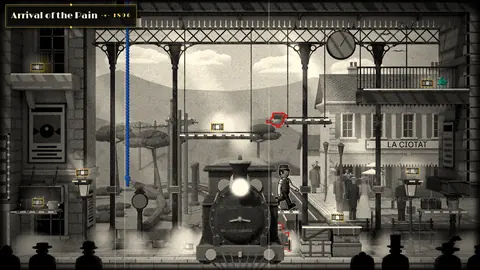 1896
Arrival of a Train at La Ciotat
Our room: Arrival of the Pain
-
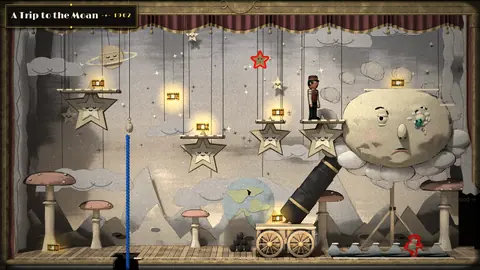 1902
A Trip to the Moon
Our room: A Trip to the Moan
-
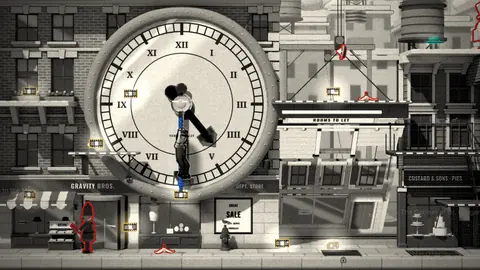 1923
Safety Last!
Our room: Safety Second
Free, in a desktop browser or as a download for Windows, Mac and Linux.
Quick answers
What is the Spanish version of Dracula (1931)?
A separate film, Drácula, shot in Spanish by Universal on the same sets as Tod Browning's English Dracula. George Melford directed it, with Carlos Villarías as the Count and Lupita Tovar as Eva.
Why did Hollywood make Dracula again in Spanish?
Early sound films could not simply be sold abroad as silents had been. For a few years studios reshot their pictures in other languages, often on the same sets, and Spanish was one of the most common.
Was the Spanish Dracula filmed at night?
Yes. Melford's crew worked after Browning's day crew had finished, on the same sets. Sources give the start as 10 October 1930, or in one account 23 October, and 22 shooting days.
Did the director speak Spanish?
By several accounts he did not. George Melford is said to have worked through interpreters, among them Enrique Tovar Ávalos, whom some sources call his co-director.
Is the Spanish Dracula better than the English one?
Critics disagree. William K. Everson and David J. Skal are cited as preferring it, while others find Villarías weaker than Bela Lugosi. Tom Weaver is reported to have warned against declaring a winner.
How long is the Spanish Dracula?
About 104 minutes by the figure most often given, roughly half an hour longer than the English film's 75 or so. A complete print in Cuba is reported at 102 minutes.
Was the Spanish Dracula lost?
It was long neglected. An incomplete print from a New Jersey warehouse was shown at the Museum of Modern Art in 1977, and a complete print was later found at the Cinemateca de Cuba in Havana. Sources differ on when.
Is the Spanish Dracula in the public domain?
Not yet in the United States. Works of 1931 enter on 1 January 2027, by the 95-year term as press reports describe it. Universal's trade marks, later restorations and publicity rights are separate questions.
Sources and further reading
- Drácula (1931 Spanish-language film), Wikipedia: credits, dates, running time, premieres, rediscovery, critics
- The Two Faces of Dracula, American Society of Cinematographers: the two crews, the camera work and the English film's opening
- From the National Film Registry: Drácula (1931), Library of Congress blog, Now See Hear, October 2022
- Dracula 90: a 90 años de la versión hispana de Drácula, Macabro, on the shooting, the release and the rediscovery
- The Making of Dracula (1931), Cinema Scholars, on the Spanish production
- Dracula (Spanish version, 1931), Foster on Film, a review
- Multiple-language version, Wikipedia, on foreign-language versions of early sound films
- Dracula (1931 English-language film), Wikipedia, on the Roxy opening and the Spanish version's later history
- Universal Horror Classics Frankenstein and Dracula Are Set to Enter Public Domain Soon, Luke Bouma, Cord Cutters News, 26 August 2026