Palace Picture House · Programme note
Frankenstein 1931
Universal followed Dracula with a second monster, and a little-known actor in hours of make-up each day gave the screen the face it still uses.
By HertzyPertzy · Updated · 6 minute read
In short
Frankenstein is an American horror film of 1931, made by Universal and directed by James Whale, with Colin Clive as the scientist and Boris Karloff as the creature he builds. It is based on Peggy Webling's stage play of 1927, itself drawn from Mary Shelley's novel of 1818. It followed the success of Dracula earlier the same year, was cut and banned in several places, and gave the cinema the flat-headed, bolted Monster that people picture today.
Watch the film
It is not played on this page: see where to watch it.
Find where to stream, rent or buy it, on JustWatch.
- Released
- 21 November 1931 in the United States, according to the AFI Catalog; the film is reported to have opened at the Mayfair Theatre in New York on 4 December 1931
- Made by
- Universal Pictures. Directed by James Whale; produced by Carl Laemmle Jr.
- Written by
- Screenplay by Garrett Fort and Francis Edward Faragoh, adapted by John L. Balderston from Peggy Webling's play; Robert Florey and John Russell contributed without screenplay credit
- Cast
- Colin Clive (Henry Frankenstein), Boris Karloff (the Monster, credited "?" at the start), Mae Clarke, John Boles, Edward Van Sloan, Dwight Frye
- Craft
- Camera Arthur Edeson; art direction Charles D. Hall; make-up Jack P. Pierce; special electrical properties Kenneth Strickfaden
- Filmed
- 24 August to 3 October 1931, according to the AFI Catalog; the budget is reported as about $250,000 to $262,000
- Length
- 70 minutes; 72 minutes with the footage found in 1986
- Copyright
- Still under US copyright in 2026. On the 95-year term for a film of 1931 published with notice, it is due to enter the US public domain on 1 January 2027. Universal's rights in its version of the creature's look are a separate matter
The story
Henry Frankenstein (Colin Clive) is a young scientist who has left town and shut himself in an old watchtower with his hunchbacked assistant, Fritz. There they assemble a body from the dead. Fritz is sent to fetch a brain and, in a gag the film is fond of, drops the good one and brings back a criminal's. Henry's fiancée Elizabeth and his friend Victor come looking for him, and so does his old teacher, Dr Waldman. On a stormy night the body is raised to the lightning on a table, and Henry shouts that it is alive.
The Monster, played by an actor the opening credits show only as a question mark, is not evil at first. He is tormented by Fritz, locked up, and drugged. He kills Fritz and, in a scene that was long cut, a small girl, Maria, who plays with him by a lake. The villagers hunt him with torches and he ends in a burning windmill. The ending was changed so that Henry lives, which left the way open for a sequel.
From a novel to a play to a film
Mary Shelley published Frankenstein; or, The Modern Prometheus in 1818. The film is not taken straight from it. Its immediate source is a stage play of 1927 by Peggy Webling, adapted for the screen by John L. Balderston. The credits still name "Mrs. Percy B. Shelley", and the screenplay is by Garrett Fort and Francis Edward Faragoh, with Robert Florey and John Russell contributing without credit. Russell is credited by the AFI Catalog with the device of the criminal brain set beside a normal one.
The studio's reason for making it was Dracula. That film opened in February 1931, and by one account sold 50,000 tickets in 48 hours and made a profit reported at $700,000. The head of production, Carl Laemmle Jr., announced more horror at once. Florey, who wrote an early outline, was set to direct, and Bela Lugosi was in line for a part. The AFI Catalog says James Whale then took the project over, replacing Lugosi and the cameraman Karl Freund, who moved with Florey to Murders in the Rue Morgue. Why Lugosi left is disputed: the usual story is that he refused to play a "scarecrow", while recent evidence is said to suggest he was removed along with Florey.
Making the Monster
Whale cast Boris Karloff, an English actor who had already made dozens of films without being noticed. Karloff was not Universal's first choice, and the studio billed him in the opening titles with a "?". His name appears at the end.
The face was the work of Jack Pierce, Universal's make-up chief. One reference work says he spent three months studying anatomy first. The head was built up with cotton, collodion and gum, and green greasepaint, chosen to read as pale on black-and-white film, went on the face and hands. The neck "bolts" were electrodes. How long it took depends on the account: five hours to put on and two to take off in one, four hours a day in another. Whale's own part in the design is described as controversial.
The laboratory belongs to Kenneth Strickfaden, who is credited with "special electrical properties". The sparks and arcs of the creation scene came from equipment he built, some of it reported to include Tesla coils.
Cuts and warnings
Universal knew it had a shocker. The film opens with a speaker stepping from behind a curtain to warn nervous viewers; the cast list credits Edward Van Sloan as Waldman and as the announcer.
Censors cut it in several places. Kansas removed a hypodermic close-up and the moment Maria is carried in her father's arms. Quebec rejected the film whole. It was banned in Northern Ireland, Sweden and Italy in 1932, and in Czechoslovakia in 1935. Henry's line "Now I know what it feels like to be God!" was reported to have offended several American states. For the 1937 reissue Universal agreed to remove dialogue using God's name, and the scene in which the Monster throws Maria into the water.
That footage was lost for decades. By the AFI Catalog, three lost segments were found in 1986 and the film ran to 72 minutes; another reference work says 1987. Universal put them on video as the restored version.
Opening and reception
The AFI Catalog gives the release date as 21 November 1931. The film is reported to have opened at the Mayfair Theatre in New York on 4 December, taking $53,000 in its first week. The New York Times put it among the ten best films of 1931. It was a hit: a budget of about $250,000 against earnings given as about twelve million dollars, a total over many reissues and not a first-run gross.
The sequels began with Bride of Frankenstein in 1935. In 1991 the Library of Congress added the film to the National Film Registry.
Copyright, and what Universal still holds
Two questions are easily mixed up. The first is the film itself. A work of 1931 published with notice is protected in the United States for 95 years, which on Cornell Library's duration chart means it enters the public domain on 1 January 2027. Until then it is under copyright, so this page links to no copy.
The second is the Monster. Shelley's novel is free to everyone. But it gave the creature little look, and the flat head, bolts and green skin were invented for Universal, which copyrighted Pierce's design quickly, by one account, and is said to have enforced that claim against close copies. A film leaving copyright does not by itself end rights of that kind, so anyone who wants Karloff's look should take advice.
Why it matters
It gave the Monster his face. The flat-topped head, neck bolts and heavy boots are Pierce's and Karloff's, not Shelley's, and they are still what people draw when asked for Frankenstein's monster.
It made the mad scientist a type. The lightning, the lever and the cry from the laboratory became a standard scene, and Strickfaden's sparks were reused for decades.
It made horror a studio line. After Dracula and this film, Universal had a cycle of monsters to build on.
It outlived its copyright date. On 1 January 2027 the film itself is due to be free to reuse in the United States, while its most famous face may not be.
On the same programme
Some of these films are rooms you can play
These notes come from Reel Trouble, a comedy platformer through film history. Every room in it is a movie set, built from scratch as a parody of a real film, and a fall is never a death: it is a retake.
-
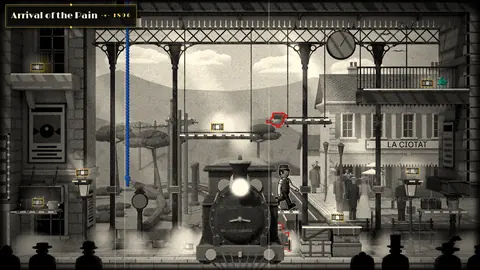 1896
Arrival of a Train at La Ciotat
Our room: Arrival of the Pain
-
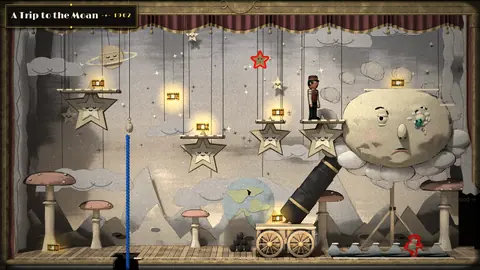 1902
A Trip to the Moon
Our room: A Trip to the Moan
-
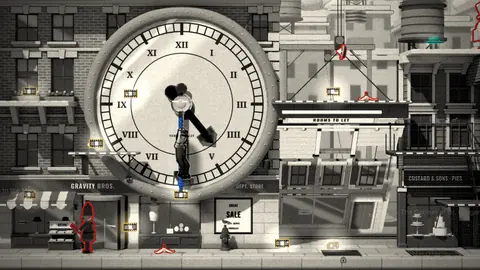 1923
Safety Last!
Our room: Safety Second
Free, in a desktop browser or as a download for Windows, Mac and Linux.
Quick answers
Is Frankenstein (1931) based on the book?
Loosely. The film is based on Peggy Webling's 1927 play, adapted by John L. Balderston, which drew on Mary Shelley's novel of 1818. The screen credit names "Mrs. Percy B. Shelley".
Who directed Frankenstein (1931)?
James Whale, a British director. Robert Florey was set to direct at first, and the AFI Catalog says Whale took the project over from him.
How long did Boris Karloff's make-up take?
Accounts differ. One reference work says five hours to apply and two to remove; another says four hours a day under Jack Pierce's hands. Either way, it was long.
What scene was cut from Frankenstein?
The scene in which the Monster and a little girl, Maria, are by the water, and he throws her in. Censors cut it, Universal removed it for the 1937 reissue, and it was found again in the 1980s.
Did Bela Lugosi turn down Frankenstein?
By the common account he refused the part of the Monster. A more recent view is that he was moved off the project along with Florey. Sources differ.
Is Frankenstein (1931) in the public domain?
Not yet in the United States. A 1931 film published with notice is protected for 95 years, which points to 1 January 2027. Universal's rights in its own version of the Monster's look are a separate question.
Who owns the Frankenstein Monster's look?
Mary Shelley's novel is free for anyone to use. The flat head, neck bolts and green skin of Universal's version were invented for the film, and Universal has treated that design as its own.
Is Frankenstein in the National Film Registry?
Yes. The Library of Congress selected it in 1991 as culturally, historically or aesthetically significant.
Sources and further reading
- Frankenstein (1931): the AFI Catalog entry, American Film Institute
- Frankenstein (1931 film), Wikipedia, for the points given here as reported
- Frankenstein (film), Rebecca Kraft Rector, EBSCO Research Starters, 2019
- Jack Pierce (makeup artist), Wikipedia, on the make-up of the Monster
- Boris Karloff, Wikipedia, on his casting and the costume
- Kenneth Strickfaden, Wikipedia, on the electrical effects
- How Universal Re-Copyrighted Frankenstein's Monster, Plagiarism Today, 2011, on the studio's claim over its Monster
- Copyright and the public domain: duration chart, Cornell University Library
- Universal Monsters, Wikipedia, on the studio's horror cycle