
Palace Picture House · Programme note
Nosferatu 1922
A small Berlin company filmed Dracula without asking and went bankrupt, a court ordered every copy destroyed, and the vampire has outlived them all.
By HertzyPertzy · Updated · 6 minute read
In short
Nosferatu, eine Symphonie des Grauens (Nosferatu, a Symphony of Horror) is a German silent film of 1922, directed by F. W. Murnau, with Max Schreck as the vampire Count Orlok. It is an unauthorised adaptation of Bram Stoker's Dracula with the names changed: Stoker's widow went to law, and in 1925 a Berlin court ordered the negative and every print destroyed. Prints that had already left Germany survived. The film gave the screen vampire his fatal weakness for sunlight, took horror out of the studio into real streets and mountains, and has been remade and quoted ever since.
- Original title
- Nosferatu, eine Symphonie des Grauens ("Nosferatu, a Symphony of Horror")
- Released
- Berlin gala premiere on 4 March 1922 in the Marmorsaal of the Zoological Garden; cinema run from 15 March 1922 at the Primus-Palast
- Made by
- Prana-Film, Berlin (Enrico Dieckmann and Albin Grau). Director F. W. Murnau; script Henrik Galeen; camera Fritz Arno Wagner; sets and costumes Albin Grau; music Hans Erdmann
- Cast
- Max Schreck (Count Orlok), Gustav von Wangenheim (Hutter), Greta Schröder (Ellen), Alexander Granach (Knock)
- Filmed
- Summer and autumn 1921 in Wismar, Lübeck and other north German towns, at Orava Castle and in the Tatra mountains (now Slovakia), and in a Berlin studio
- Length
- Five acts, 1,967 metres when the censor passed it in December 1921. About 94 minutes in the current restoration; 63 to 94 depending on the version and its speed
- Format
- Silent, 35 mm, 1.33:1; black and white, tinted in the original prints; German intertitles
- Copyright
- Public domain in the United States, and in Germany and the EU since 1 January 2020. Modern restorations and recorded scores have rights of their own
The story
Wisborg, a German port, in 1838. Hutter, a young estate agent, is sent by his employer Knock to Transylvania to sell Count Orlok the house opposite his own. He leaves his wife Ellen with friends. At an inn the locals take fright at the Count's name, and he finds a book about vampires, which makes him laugh.
Orlok is tall, bald and rat-toothed. When Hutter cuts his thumb at supper, the Count goes for the blood. Next morning Hutter blames the marks on his neck on mosquitoes. Orlok signs for the house and notices a portrait of Ellen: she has, he remarks, a lovely neck. Hutter finds him by day asleep in a coffin, then watches him load a cart with coffins and leave.
The coffins go by sea. The crew dies, and the ship reaches Wisborg with no living soul on board and a cargo of rats. Plague follows. Ellen reads in Hutter's book that a vampire can be destroyed if a woman pure in heart gives him her blood freely and so makes him forget the dawn. She sends Hutter for the doctor and opens her window. Orlok stays too long. At sunrise he vanishes in a puff of smoke, and Ellen dies in her husband's arms.
Who made it
The film was the first and last production of Prana-Film, a Berlin company founded in 1921 by Enrico Dieckmann and Albin Grau. Grau, an artist and occultist, produced the film and designed its sets, costumes and publicity. The letter Orlok sends to Knock is a page of occult signs. Grau said the idea came from the war: in the winter of 1916 a Serbian farmer told him that his own father had been a vampire. The story is his alone, and may have been invented for the publicity.
The script was by Henrik Galeen, who had worked on The Golem. The director was F. W. Murnau, then 32, and the cameraman Fritz Arno Wagner. Gustav von Wangenheim and Greta Schröder play the Hutters, Alexander Granach plays Knock. Much of the film was shot outdoors, in the summer and autumn of 1921. Wisborg is chiefly Wismar and Lübeck, and Orlok's new house is Lübeck's old salt warehouses. Transylvania is Orava Castle and the Tatra mountains, in what is now Slovakia.
The Berlin premiere, on 4 March 1922, was a costume party in the Marmorsaal, the marble hall of the Zoological Garden: "The Festival of Nosferatu". Guests were asked to come in Biedermeier dress, the composer Hans Erdmann conducted his own score, and a ball followed. The reviews were mostly good and the business was not. By the summer Prana was bankrupt.
The lawsuit, and how the film survived
Nobody had asked Bram Stoker's estate. The new names are usually explained as a way round the copyright. If so it was a thin disguise: the original German titles name the novel Dracula as the source. Stoker's widow Florence learned of the film in April 1922, when someone posted her the programme. She joined the Society of Authors, which hired a Berlin lawyer.
A Berlin court found for her in 1924, the bankrupt company's receivers lost their appeal, and in July 1925 they were ordered to destroy the negative and every print. But prints had gone abroad: the film had played in Paris in November 1922. A copy surfaced in London within months of the ruling, and the film opened in New York in 1929. The British Film Institute sums up the destruction order in five words: "Luckily this was never achieved."
The restoration made in 2005 and 2006 by Luciano Berriatúa for the Friedrich-Wilhelm-Murnau-Stiftung starts from a tinted French print of 1922 kept at the Cinémathèque française, and fills the gaps from other copies. Most of Erdmann's score was lost. What survived was a published suite of about forty minutes, the basis of Berndt Heller's reconstruction.
Sunlight and shadows
The film does more than rename Stoker's characters. It drops or plays down several, Van Helsing among them, adds the plague and gives the ending to a woman. It also changes how a vampire dies. In the novel, daylight does not kill the Count. Film historians generally credit Nosferatu with introducing the vampire destroyed by the sun's rays, on screen at least. In Murnau's copy of the script the pages for the last scene are his own rewriting, and the idea has been credited to him.
The camera does the haunting. The Count's coach comes for Hutter in jerky fast motion, shot a frame at a time, and the forest turns white: a strip of negative. Orlok passes through a closed door by double exposure. At the end he is only a shadow climbing the stairs, and the shadow of a hand closing on Ellen's heart. The prints were tinted, blue for night and pink for dawn, which the black-and-white copies that circulated for decades had lost.
The man called Fright
Schreck is German for fright, and it was the actor's real name. That, the make-up and his obscurity gave rise to tales that no such actor existed, that Murnau had played the part himself, or that the Count had. The film Shadow of the Vampire (2000) runs with the joke: John Malkovich's Murnau has hired a real vampire, played by Willem Dafoe.
The real Max Schreck was born in Berlin in 1879, acted in Max Reinhardt's company and at the Munich Kammerspiele, and appeared there in Bertolt Brecht's Drums in the Night. He died in Munich in 1936, the morning after a performance. The tales, as one critic puts it, are "unfortunately untrue".
Why it matters
It is where the screen vampire starts. The foundation that bears Murnau's name calls it the first feature-length vampire film, and the British Film Institute "the first serious Dracula adaptation". Death at sunrise, now a rule of the genre, starts here.
It took horror outdoors. Filming on location was rare in Germany at the time. Murnau's dread lives in real streets, a real castle and real mountains.
It made the vampire repulsive. Schreck's Orlok is, in the BFI's words, "the polar opposite of the suave Count later typified by Bela Lugosi and Christopher Lee".
It would not stay dead. Werner Herzog remade it in 1979 with Klaus Kinski, and Robert Eggers in 2024 with Bill Skarsgård as Orlok and Willem Dafoe back, this time as the professor. Since 1 January 2020 the film is out of copyright in Germany too, the country whose court once ordered it destroyed.
On the same programme
Some of these films are rooms you can play
These notes come from Reel Trouble, a comedy platformer through film history. Every room in it is a movie set, built from scratch as a parody of a real film, and a fall is never a death: it is a retake.
-
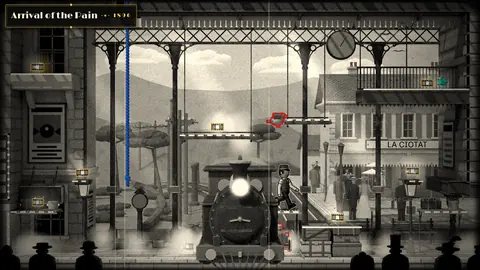 1896
Arrival of a Train at La Ciotat
Our room: Arrival of the Pain
1896
Arrival of a Train at La Ciotat
Our room: Arrival of the Pain
-
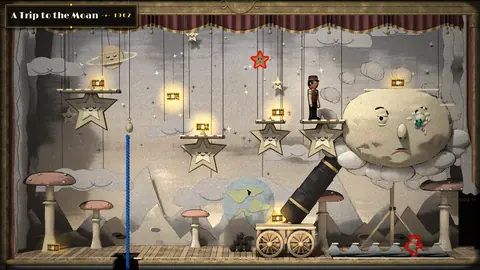 1902
A Trip to the Moon
Our room: A Trip to the Moan
1902
A Trip to the Moon
Our room: A Trip to the Moan
-
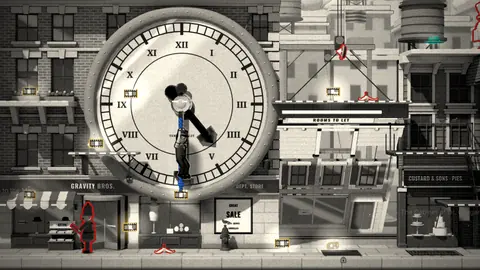 1923
Safety Last!
Our room: Safety Second
1923
Safety Last!
Our room: Safety Second
Free, in a desktop browser or as a download for Windows, Mac and Linux.
Quick answers
Is Nosferatu based on Dracula?
Yes. It is an unauthorised adaptation of Bram Stoker's 1897 novel with the names changed: Count Dracula becomes Count Orlok, Harker becomes Hutter and Mina becomes Ellen. The original German titles name the novel as the source.
Why was Nosferatu ordered to be destroyed?
Because nobody had bought the film rights to Dracula. Bram Stoker's widow Florence took action through the Society of Authors, and in July 1925 a Berlin court ordered the negative and all prints destroyed.
How did Nosferatu survive?
Prints had already gone abroad, out of the German court's reach: the film played in Paris in November 1922. A tinted French print of 1922, kept at the Cinémathèque française, is the basis of the current restoration.
Was Max Schreck a real vampire?
No. Max Schreck (1879 to 1936) was a German stage and film actor who worked for Max Reinhardt and at the Munich Kammerspiele. The idea comes from old rumours about him and from the film Shadow of the Vampire (2000), which is fiction.
Did Nosferatu invent vampires dying in sunlight?
On screen, by most accounts, yes: it is described as the first film in which sunlight destroys a vampire. In Stoker's novel daylight does not kill Dracula.
Where was Nosferatu filmed?
In the north German towns of Wismar and Lübeck, which play Wisborg, and at Orava Castle and in the Tatra mountains in what is now Slovakia, which play Transylvania. The interiors were shot in a Berlin studio.
How long is Nosferatu?
The film was 1,967 metres long when the German censor passed it in December 1921. The current restoration runs about 94 minutes; older copies, run faster, can last barely more than an hour.
Is Nosferatu in the public domain?
The 1922 film is in the public domain in the United States, and in Germany and the rest of the EU since 1 January 2020, seventy years after the death of its writer Henrik Galeen in 1949. Modern restorations and recorded scores can have rights of their own.
Sources and further reading
- Nosferatu: credits, length, censorship date and locations, filmportal.de
- Nosferatu: Aufführungsdaten, Jeanpaul Goergen, Filmblatt, 2002, on the screenings from 1922 to 1931
- 100. Geburtstag Nosferatu, Friedrich-Wilhelm-Murnau-Stiftung, 2022
- Nosferatu – Eine Symphonie des Grauens, Martin Ganguly, Bundeszentrale für politische Bildung, 2016
- Nosferatu Is Found to Have Violated Dracula Copyright, Grove Koger, EBSCO Research Starters, 2022, on the lawsuit
- Film 2: Nosferatu (1922), British Film Institute, teaching notes
- Nosferatu: A Symphony of Horror, Michael Koller, Senses of Cinema, 2000
- Nosferatu, Beatrice Loayza, San Francisco Silent Film Festival
- Nosferatu: History and Home Video Guide, Part 3, Brent Reid, Brenton Film, on the surviving prints and the copyright
- Nosferatu, Wikipedia, with its German counterpart and the article on Max Schreck: the plot, the tinting and the points given here as reported