
Palace Picture House · Programme note
City Lights 1931
Four years into the talkies, Chaplin made a film that mocks the human voice, spent months on one street corner, and ended on a close-up.
By HertzyPertzy · Updated · 6 minute read
In short
City Lights is a 1931 American comedy written, directed, produced, edited and scored by Charlie Chaplin, who plays the Tramp. He falls for a blind flower girl and befriends a millionaire who knows him only when drunk. It came four years after talking pictures began, and it has music and sound effects but no spoken dialogue: when officials speak, a kazoo-like noise speaks for them. It took more than two years to make, and it is often named among the finest comedies ever filmed, mainly for its last scene.
Watch the film
It is not played on this page: see where to watch it.
Find where to stream, rent or buy it, on JustWatch.
- Premiere
- 30 January 1931, Los Angeles Theater, Los Angeles. The AFI Catalog dates the New York opening to 6 February 1931, and Chaplin rented the George M. Cohan Theater there for the run. General release: 7 March 1931
- Made by
- Written, produced, directed, edited and scored by Charlie Chaplin. Released by United Artists. Music arranged by Arthur Johnston and directed by Alfred Newman
- Cast
- Charlie Chaplin (the Tramp), Virginia Cherrill (the blind girl), Harry Myers (the eccentric millionaire), Florence Lee (her grandmother), Allan Garcia (the butler), Hank Mann (the prizefighter)
- Filmed
- Production began on 27 December 1928, by the AFI Catalog. Per Chaplin's biographer David Robinson, the last scene was shot in September 1930 and editing ran to December 1930
- Length and format
- About 87 minutes, black and white, with a recorded score and a few sound effects and no spoken dialogue. Printed titles carry the words
- Cost and takings
- The budget is usually given as $1.5 million. Variety reported worldwide rentals of $4.25 million. The AFI Catalog says the New York run made a net profit of over $400,000
- Honours
- Best film of 1931 for the National Board of Review. Added to the US National Film Registry in 1991. 76th on the American Film Institute's 1998 list of 100 movies, 11th on its 2007 list. 50th in the 2012 Sight and Sound critics' poll
- Copyright
- On the 95-year term that applies in the United States, a 1931 film enters the public domain there on 1 January 2027. In the EU and the UK, Chaplin's death in 1977 puts the term at the end of 2047. Chaplin's company, Roy Export, holds and enforces the rights. This page links to no free copy
The story
A new monument, "Peace and Prosperity", is unveiled before a crowd, and when the cloth comes off the Tramp is asleep in the lap of the central statue. Chased away, he meets a blind flower girl (Virginia Cherrill) on a street corner. A car door slams nearby, and she takes him for the rich man who owns the car. He buys a flower and does not correct her.
That night, by the river, he stops a drunk millionaire (Harry Myers) from drowning himself. The two end up in the water twice. Sober, the millionaire does not know him; drunk, he treats him as a best friend, with champagne, a car and a house. The Tramp learns that the girl and her grandmother face eviction, and that an operation might cure her blindness. He sweeps streets and fights a boxing match for money. In the end the millionaire, drunk again, gives him the sum, and the Tramp is arrested as a thief when the millionaire sobers up. The girl has her sight back by the time he is free.
A silent film made after sound
Talking pictures had arrived in 1927 with The Jazz Singer. When Chaplin began City Lights in December 1928, most of Hollywood was converting its studios. He did not. By Robinson's account he was dismissive of the talkies, said they would last about three years, and doubted that the Tramp could speak without losing his appeal. His biographer Jeffrey Vance has called the film an act of defiance.
It is not wholly silent. The AFI Catalog lists a recorded soundtrack on the Western Electric system, with a score and a handful of effects: the officials' voices at the start, a whistle swallowed at a party, pistol shots and the bell in the boxing ring. The speeches at the unveiling are the joke. The mayor "talks" in a kazoo-like quack and a woman civic leader in a squawk, so that the talkies are mocked in the first minutes by the sound of talking. Later the Tramp swallows a whistle, and every hiccup sets it off.
Chaplin wrote the score himself, the first he composed for one of his own films. By his own account, as quoted by Robinson, he hummed the tunes and Arthur Johnston wrote them down. Alfred Newman directed the recording, and the flower girl's theme is "La Violetera" by José Padilla. Padilla is said to have won a claim over the lack of credit.
Two years on one street
The AFI Catalog dates the start of production to 27 December 1928. Robinson dates the end of the millionaire scenes to 29 September 1929, the final scene to September 1930 and the editing to October to December 1930. The budget is usually given as $1.5 million. The official Chaplin archive calls the film the hardest and longest undertaking of his career.
The famous delay was the flower girl's first scene. Chaplin could not find a way, without a word, to make her believe the Tramp was rich. The answer he settled on was the parked limousine: he passes through it, the door slams, and she hears the sound. The scene runs about three minutes. Guinness World Records counts 342 takes, by one account shot over five days.
The cast changed on the way. Henry Clive was first cast as the millionaire and was dismissed, by the AFI Catalog, after refusing to fall into the water; Harry Myers took over. Chaplin was angry with Cherrill in late 1929, tested other actresses, among them Marian Marsh, and considered giving the part to Georgia Hale, his co-star in The Gold Rush. Cherrill came back, by most accounts on a higher wage.
Premiere, Einstein and the Cohan
The film had its gala at the Los Angeles Theater on 30 January 1931, the first such premiere held downtown rather than in Hollywood, by the AFI Catalog. Chaplin came with Georgia Hale and with his guests, Albert Einstein and his wife Elsa, and it is said the audience stood to applaud.
In New York the AFI Catalog gives 6 February 1931, though sources differ. United Artists had given it little publicity, so Chaplin rented the George M. Cohan Theater himself and, by one account, spent $60,000 of his own money on advertising. It ran there for twelve weeks and made a net profit of over $400,000. Variety later reported rentals of $4.25 million worldwide.
Who owns it
On the 95-year term that applies in the United States, a film published in 1931 enters the public domain there on 1 January 2027, as the Duke Center for the Study of the Public Domain counts the term. Until that day the film is protected there.
The picture is different in Europe. In the EU and the UK, copyright generally runs for seventy years after the author's death, and Chaplin died in 1977, so a film he wrote, directed and scored is protected to the end of 2047. Roy Export, the company that holds his films, says that all photographs from his films made from 1918 on are its property.
Copyright and trade marks are separate things. Roy Export and Bubbles Inc. also hold trade marks in the Little Tramp, in Chaplin's name and in certain film titles, and these do not expire when a film's copyright does. This page links only to where the film can be streamed, rented or bought.
Why it matters
It is the ending that critics keep returning to. The girl, her sight restored, takes the Tramp's hand and knows him by touch. He has no words, and the film needs none. Its last close-up is often counted among the finest in cinema, and it is the reason this film is so often ranked above his others.
It held out against sound and did well. A film without dialogue, released four years into the talkies, ran for twelve weeks in New York and won the National Board of Review's prize for the best film of 1931.
It shows what a perfectionist costs. A scene of three minutes took 342 takes, and the whole film took the better part of two years.
It is the recognised classic. The Library of Congress added it to the National Film Registry in 1991. The American Film Institute placed it 76th in 1998 and 11th in 2007, and ranked it first among romantic comedies in 2008.
On the same programme
Some of these films are rooms you can play
These notes come from Reel Trouble, a comedy platformer through film history. Every room in it is a movie set, built from scratch as a parody of a real film, and a fall is never a death: it is a retake.
-
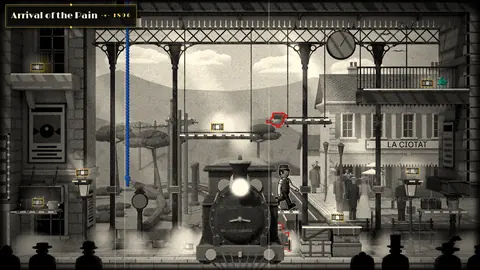 1896
Arrival of a Train at La Ciotat
Our room: Arrival of the Pain
-
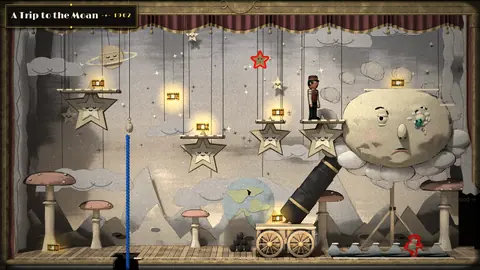 1902
A Trip to the Moon
Our room: A Trip to the Moan
-
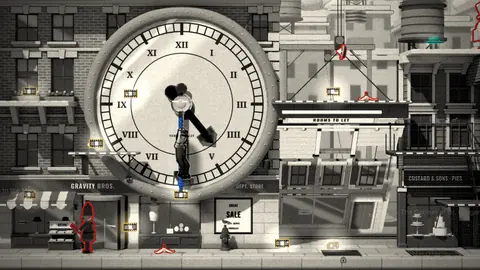 1923
Safety Last!
Our room: Safety Second
Free, in a desktop browser or as a download for Windows, Mac and Linux.
Quick answers
What is City Lights (1931) about?
The Tramp falls for a blind flower girl who takes him for a rich man. He befriends a millionaire who is kind to him only when drunk, and raises money for an operation that might restore her sight.
Is City Lights a silent film?
Mostly. It has a recorded score and a few sound effects, but no spoken dialogue, and printed titles carry the words. It was made four years after The Jazz Singer, and is best described as a silent comedy with a soundtrack.
Who wrote the music for City Lights?
Chaplin composed it, his first score for one of his own films. He is said to have hummed the tunes while Arthur Johnston wrote them down, and Alfred Newman directed the recording. The flower girl's theme is "La Violetera", by José Padilla.
How many takes did the flower girl scene need?
342, according to Guinness World Records and by most accounts, which makes it the record for the most retakes of one scene. Chaplin could not find a way to make her think the Tramp was rich without dialogue.
Did Albert Einstein go to the City Lights premiere?
Yes. Einstein and his wife Elsa came to the Los Angeles premiere on 30 January 1931 as Chaplin's guests, by the AFI Catalog and the TCM account.
Why did Chaplin refuse to use dialogue in City Lights?
He distrusted the talkies, and by Robinson's account he gave them three years. He also worried about how the Tramp could speak without losing what made him universal. His biographer Jeffrey Vance called the film an act of defiance.
What is the famous ending of City Lights?
The girl, her sight restored and now running a flower shop, meets the ragged Tramp again and recognises him by touch. The film ends on a close-up of his face. Critics often call it the best last scene in cinema.
Is City Lights in the public domain?
Not yet. On the 95-year US term it enters the public domain there on 1 January 2027. In the EU and the UK it is protected to the end of 2047, and Chaplin's company, Roy Export, holds its rights.
Sources and further reading
- City Lights: catalogue entry, AFI Catalog, American Film Institute, on the dates, the credits, the sound effects, the premieres and the honours
- City Lights, Wikipedia, for the production dates after David Robinson, the budget, rentals, the casting changes, the score and the rankings
- Trivia: City Lights, Turner Classic Movies, on the 342 takes, Einstein, Cherrill and Myers
- 95 Years Later, Charlie Chaplin's City Lights Still Holds the Record for Most Retakes of a Single Scene, No Film School, on the flower girl scene and the limousine
- City Lights, Filmsite, on the statue scene, the kazoo-like voices and the opening of the story
- City Lights, Charlie Chaplin official archive (Roy Export), on the film as the hardest and longest undertaking of his career, and the rights and trade mark notice
- Public Domain Day 2026, Duke Center for the Study of the Public Domain, on the 95-year term and works of 1931 entering in 2027