
Palace Picture House · Programme note
The Jazz Singer 1927
A mostly silent film with six songs and two minutes of chat opened in New York in 1927, and within two years Hollywood had stopped making silents.
By HertzyPertzy · Updated · 6 minute read
In short
The Jazz Singer is a 1927 American film directed by Alan Crosland for Warner Bros., starring the stage star Al Jolson as a cantor's son who becomes a Broadway singer. It is a silent film with a recorded score, plus song sequences and two short passages of speech played from discs by the Vitaphone system. It was not the first sound film, nor the first all-talking feature, but its success convinced the industry to convert to sound. Its star performs his big stage numbers in blackface, which makes it a hard film to watch today.
Watch the film
The whole film: 89 minutes, with its original Vitaphone sound.
Played from Wikimedia Commons, which hosts this copy as a public-domain work. Nothing is fetched from there until you press play. If it will not play here, it will on their page.
- Premiere
- 6 October 1927, Warners' Theatre, New York. General release 4 February 1928
- Made by
- Directed by Alan Crosland. Screenplay by Alfred A. Cohn, from Samson Raphaelson's play. Photographed by Hal Mohr. Score arranged by Louis Silvers. Darryl F. Zanuck is credited by some sources as producer
- Cast
- Al Jolson (Jakie Rabinowitz, called Jack Robin), May McAvoy, Warner Oland, Eugenie Besserer
- Studio and cost
- Warner Bros. Pictures and the Vitaphone Corporation. Cost about $422,000; by 1931 it had earned about $2 million, according to the Vitaphone Project's founder Ron Hutchinson
- Length
- About 90 minutes, nine reels, 8,117 feet (AFI Catalog)
- Format
- 35 mm, black and white. Silent, with intertitles, a recorded orchestral score, and sound on 16-inch discs for the songs and two short passages of speech
- Honours
- Special Academy Award to Warner Bros. at the first ceremony, 1929. Added to the National Film Registry in 1996. Remade in 1952, for television in 1959, and in 1980
- Copyright
- Public domain in the United States since 1 January 2023, when Duke's Center for the Study of the Public Domain listed it among the 1927 films. This page does not give the position in other countries
The story
Jakie Rabinowitz (Al Jolson) is the son of a cantor, a singer of the liturgy, on New York's Lower East Side. His father expects him to follow in the post. Jakie is caught singing popular songs in a beer garden, is punished, and runs away.
Years later he is Jack Robin, a rising jazz singer who performs in blackface. He is about to open on Broadway when his father falls gravely ill on the eve of Yom Kippur. Jack must choose between the opening and singing Kol Nidre in his father's place. He sings it. The film ends with him back on stage, singing to his mother in the audience.
Where it came from
The source is Samson Raphaelson, who grew up on the Lower East Side. He wrote a short story, "The Day of Atonement", published in 1922, after seeing Jolson perform in 1917. In 1925 it became a stage play, The Jazz Singer, with George Jessel in the lead. Warner Bros. bought the film rights in 1926.
Warner Bros. at first announced Jessel for the film. Why he lost it is told differently. One account has a row over his pay and the script. The Library of Congress essay notes that Jolson had electrified an audience in a Vitaphone short in 1926, and Jessel's short had not. The studio, the essay says, decided that the film needed Jolson, "not only for the film but for Vitaphone itself".
What it actually is
It wasn't the first talking picture. Or even the thousandth.
Ron Hutchinson, "The Jazz Singer", Library of Congress National Film Registry essay
Most of the film is a silent film. The story is told in intertitles, with a recorded orchestral score. The Vitaphone sequences are the songs, and two short passages of talk. Hutchinson puts the real dialogue at about two minutes.
Vitaphone was a sound-on-disc system developed by Western Electric and Bell Laboratories. One motor drove both the projector and a turntable carrying a 16-inch disc, and the sound was played through newly developed loudspeakers. Sam Warner, the Warner brother most taken with it, had seen a Bell Labs demonstration in 1925. The studio launched it in August 1926 with Don Juan, a silent film with a recorded score, and a programme of sound shorts. It was audience response to those shorts, Hutchinson says, that turned Warner Bros. towards speech and song.
Jolson sang his songs during nine days of filming from 17 August 1927. His first words come in the club scene: "Wait a minute, wait a minute, you ain't heard nothin' yet." It was stage patter he had used for years. Later, at the piano, he talks to his mother, played by Eugenie Besserer. Hutchinson says the banter was ad-libbed, and that the lines about moving to the Bronx were not in the script. The studio knew the scene did not advance the plot and could be cut. It stayed.
The premiere, and "first"
The film opened on 6 October 1927 at Warners' Theatre in New York. Sam Warner had died the day before, of pneumonia after weeks of illness. None of his brothers was at the premiere. Reviews were mixed.
Careful sources choose their words. The Library of Congress calls it "the first successful synchronized feature with talking". Duke's list of 1927 films calls it "the first feature-length film with synchronized dialogue". Neither says it was the first sound film, or the first to be all talking. That was Lights of New York, in 1928, which cost Warner Bros. about $23,000 and grossed over a million dollars, according to Hutchinson.
The money, and the next two years
The film cost about $422,000. By March 1928 it was showing in 235 theatres, and by 1931 it had earned about $2 million. Jolson's next film, The Singing Fool (1928), had much more dialogue and grossed $4 million.
The success drove Warner Bros. to expand, buying theatres and the First National studio, and its share price rose from $21 to $132, Hutchinson reports. The studio announced that all its future features would carry Vitaphone sound. By the end of 1929, he writes, the silent picture was dead. The first Academy Awards, held in 1929, gave Warner Bros. a special award for "the pioneer outstanding talking picture, which has revolutionized the industry". The film joined the National Film Registry in 1996.
The blackface
Blackface was a stage tradition in which performers, usually white, used burnt cork or make-up to portray Black people as caricatures. It grew from the minstrel shows of the 1830s and 1840s, whose stock figures were lazy, cowardly and foolish, and spoke a mangled English. These stereotypes were invented by white performers for white audiences, and they fed the racism of the time. Blackface is now widely condemned as racist.
In the film Jack Robin blacks up with burnt cork for his stage act, and Jolson performs songs, including "Mammy", in it. The film treats this as glamorous and as the route to Jack's success.
Historians read it in more than one way. Michael Rogin's Blackface, White Noise (1996) argues that for Jewish immigrants and their children blackface was a means of becoming American, by separating themselves from the Black Americans whose music they borrowed. Other scholars read Jack's mask as a picture of a divided identity: a man caught between his father's synagogue and Broadway. Neither reading makes the caricature less of one.
Why it matters
It made sound pay. Sound films had been tried, and had failed at the box office, for decades. This one showed that audiences would pay for them.
It is easy to misdescribe. It was a silent film with some songs and two minutes of talk, not the first sound film, and not the first all-talkie. The accurate claim is the one the Library of Congress makes: the first successful synchronized feature with talking.
It is a document of American entertainment, painful parts included. It records how ordinary blackface still was on the American stage and screen in 1927, which is one reason it is studied. It was remade in 1952 and 1980.
On the same programme
Some of these films are rooms you can play
These notes come from Reel Trouble, a comedy platformer through film history. Every room in it is a movie set, built from scratch as a parody of a real film, and a fall is never a death: it is a retake.
-
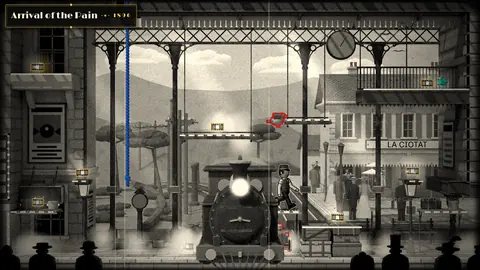 1896
Arrival of a Train at La Ciotat
Our room: Arrival of the Pain
1896
Arrival of a Train at La Ciotat
Our room: Arrival of the Pain
-
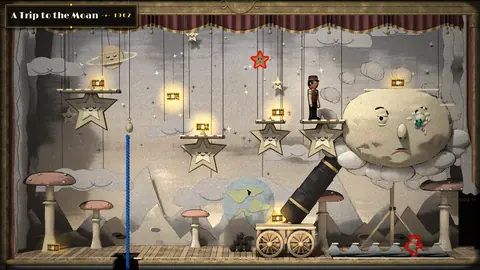 1902
A Trip to the Moon
Our room: A Trip to the Moan
1902
A Trip to the Moon
Our room: A Trip to the Moan
-
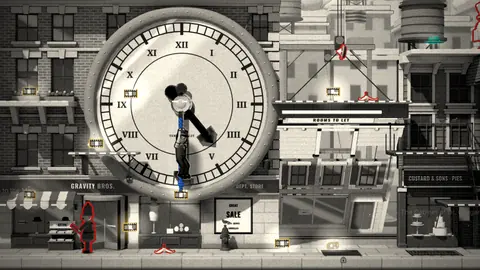 1923
Safety Last!
Our room: Safety Second
1923
Safety Last!
Our room: Safety Second
Free, in a desktop browser or as a download for Windows, Mac and Linux.
Quick answers
What is The Jazz Singer (1927) about?
Jakie Rabinowitz, the son of a synagogue cantor on New York's Lower East Side, runs away to sing popular music and becomes the Broadway star Jack Robin. On the eve of his big opening his father falls ill, and he must choose between the show and singing Kol Nidre in the synagogue on Yom Kippur.
Was The Jazz Singer the first talking picture?
No. Warner Bros. had been showing Vitaphone shorts with speech and song since 1926, and many sound systems were tried before that. The Library of Congress essay says it was "the first successful synchronized feature with talking", and the first all-talking feature was Lights of New York (1928).
What did Al Jolson say in The Jazz Singer?
"Wait a minute, wait a minute, you ain't heard nothin' yet." It was stage patter he had used before. Later he chats with his screen mother at the piano, and the Library of Congress essay says he probably made up his lines about moving to the Bronx himself.
How much of The Jazz Singer has sound?
Little of it talks. Jolson sings six songs, and there is cantorial singing as well. Hutchinson's essay puts the actual dialogue at about two minutes. The rest is intertitles and a recorded score, as in a silent film.
What was Vitaphone?
A sound-on-disc system made by Western Electric and Bell Laboratories and taken up by Warner Bros. One motor drove the projector and the turntable holding a 16-inch disc, so the two stayed in step. Warner Bros. launched it with Don Juan in 1926.
Why is The Jazz Singer controversial?
Jolson performs his big stage numbers in blackface, the make-up of minstrel shows that caricatured Black people. The film presents it as a stage act and as a route to success for an immigrant's son, and historians still argue about what it meant.
Is The Jazz Singer in the public domain?
In the United States, yes, since 1 January 2023, according to Duke's Center for the Study of the Public Domain. Copyright elsewhere differs, and restorations, scores and new titles can have rights of their own.
Who played the jazz singer on stage?
George Jessel played Jakie in Samson Raphaelson's play on Broadway in 1925. Warner Bros. announced him for the film, but Jolson took the part. Sources differ on why.
Sources and further reading
- The Jazz Singer, Ron Hutchinson, founder of The Vitaphone Project, National Film Registry essay, Library of Congress
- The Jazz Singer (1927), AFI Catalog of Feature Films, American Film Institute
- Public Domain Day 2023, Jennifer Jenkins, Duke Center for the Study of the Public Domain
- My songs mean as much to my audience as yours do to your congregation, J. Hoberman, London Review of Books, 18 July 1996, a review of Michael Rogin's Blackface, White Noise
- The Jazz Singer, Wikipedia, for the plot, the Jessel and Raphaelson history, the premiere, box office, the registry and the remakes
- Vitaphone, Wikipedia, for the discs and Western Electric
- Sam Warner, Wikipedia, for his death and the Vitaphone venture
- Blackface, Wikipedia, for minstrelsy, its stereotypes and the scholarship of Eric Lott
- 1st Academy Awards, Wikipedia, for the wording of the special award