Palace Picture House · Programme note
Modern Times 1936
Nine years into the talkies, Chaplin sent the Tramp through the factory and the department store, sang in gibberish, and said goodbye to him.
By HertzyPertzy · Updated · 6 minute read
In short
Modern Times is a 1936 American comedy written, produced, directed and scored by Charlie Chaplin, who also stars as a factory worker. Nine years after talking pictures arrived, it uses music, sound effects and printed titles, and lets only machines speak. It is the last film in which Chaplin plays the Tramp, and the one in which his voice is first heard, in a song of gibberish. It turns the Depression and the assembly line into slapstick, and it was banned in Germany and Italy as communist.
Watch the film find where to stream, rent or buy it, on JustWatch (opens in a new tab)
- Premiere
- 5 February 1936, Rivoli Theatre, New York. Los Angeles followed on 12 February. The New York opening had first been planned for 16 January
- Made by
- Written, produced, directed and scored by Charlie Chaplin. Photographed by Rollie Totheroh and Ira Morgan. Music arranged by Edward Powell and David Raksin and conducted by Alfred Newman
- Cast
- Charlie Chaplin (a factory worker, the Tramp), Paulette Goddard (the gamine), Henry Bergman (the cafe proprietor)
- Studio and cost
- Charles Chaplin Productions, released by United Artists. The budget is usually given as $1.5 million. Filmed from October 1934 to August 1935; the AFI Catalog gives the whole production as October 1934 to November 1935
- Length and format
- About 87 minutes, black and white, with a recorded score and sound effects and no spoken dialogue between people. Mostly shot at 18 frames a second and shown at 24, which speeds up the slapstick
- Music
- Chaplin's own score, played as "A Modern Symphony". Its love theme became the song "Smile" when lyrics were added in 1954
- Honours
- One of the first 25 films in the US National Film Registry, in 1989. 78th on the American Film Institute's 2007 list of 100 movies. 63rd in the 2012 Sight and Sound critics' poll, 20th in the directors' poll
- Copyright
- Still in copyright. Chaplin's family company, Roy Export, holds the rights in his films from 1918 on. On the 95-year term that applies in the United States, a 1936 film enters the public domain there on 1 January 2032. This page links to no free copy
The story, in episodes
Chaplin's Tramp is a factory hand who tightens bolts on an assembly line. The boss watches from a screen, even in the washroom. A feeding machine, meant to do away with the lunch break, is tried out on him and goes berserk. Then the line speeds up, he is dragged through the giant gears of the machine, and he has a breakdown: he cannot stop his wrists twisting, and is taken away.
Cured, he is turned out into the street. A red warning flag falls off a lorry, he runs after it to hand it back, and a column of strikers turns the corner behind him. The police take him for their leader, and he goes to jail.
Out again, he meets the gamine (Paulette Goddard), an orphan who steals bread and runs from the police. They look for a home. He becomes night watchman in a department store, and they roller-skate through it. Later he is a singing waiter in a cafe, and loses the words of his song, which is how the nonsense song comes about. When the police come for the girl again, the two walk off down the road at dawn.
A film nine years into the talkies
Talking pictures had come in with The Jazz Singer in 1927, and Chaplin refused to join them. Modern Times compromises: it has a recorded score, sound effects and printed titles, but no dialogue between people. Voices come only from machines. The boss speaks from his screen, a salesman lets a phonograph record make his pitch, and a radio reads the news.
Chaplin's own voice is heard once, in the cafe, where he sings in gibberish, half mock French and half mock Italian, to the tune of Léo Daniderff's Je cherche après Titine. It was the first time audiences heard him on film.
It is also the last time he played the Tramp. His next film, The Great Dictator (1940), was a full talkie without him. So the careful way to put it is "the Tramp's last appearance", or "Chaplin's last film without spoken dialogue", and not simply "the last silent film", which it is not.
Where it came from
Chaplin toured Europe and beyond in 1931 and 1932, after City Lights, and saw the Depression at close quarters. On 22 September 1931 he met Gandhi in a small house in London's East End. He asked about machinery, and Gandhi's reply, as reported, was that machines had made India dependent on England. Chaplin did not share the dislike of technology, though by most accounts he granted that machinery run only for profit had thrown people out of work.
The assembly line itself is said to have come from Detroit: a reporter told him that healthy farm boys were taken on by the car factories and worn out within a few years. A popular story that the boss is meant to be Henry Ford rests on weaker ground.
Making it
Filming ran from October 1934 to the end of August 1935. The budget is usually given as $1.5 million. Chaplin is said to have written dialogue for the film before dropping the idea, fearing that the Tramp would lose his universal appeal the moment he spoke.
A studio story has Chaplin tipping a bucket of water over Goddard's carefully done hair when she arrived: the gamine was to look as if she lived on the street.
The roller-skating scene, in which the Tramp skates blindfold along the edge of a drop, is a trick. The drop was a painting placed in front of the camera, and Chaplin skated on a flat floor. The giant gears that swallow him are said to have been made of wood and rubber.
The music and the lawsuit
Chaplin composed by ear: he hummed or picked out his tunes and had them taken down. He hired the 23-year-old David Raksin, who criticised the themes and was fired, then taken back, and the two worked closely. Alfred Newman conducted, until a quarrel with Chaplin in the recording sessions. He never worked with him again. The love theme became "Smile" in 1954, with words by John Turner and Geoffrey Parsons, and Nat King Cole's recording reached number 10 on the Billboard chart.
After the release, Tobis, which held the rights to René Clair's À nous la liberté (1931), sued over the similar factory scenes. The AFI Catalog dates the suit to April 1937 and says damages of $1.2 million were claimed. Clair would not support it: he said he was honoured, and was embarrassed by the whole affair. Chaplin said he had never seen the film. The case dragged on for about a decade and, by most accounts, ended in an out-of-court settlement after the war.
Premiere, bans and applause
The film opened at the Rivoli in New York on 5 February 1936, after the planned January date was put back. It earned about $1.8 million in North American rentals and did well abroad: it is reported to have been the most popular film in British cinemas that season.
Politics followed. Germany and Italy banned it as communist propaganda, the AFI Catalog records, and Chaplin replied that he had no political aims. Graham Greene, writing in The Spectator, feared that it would be called a communist film, and thought that it offered no political solution at all. In 1945 Sartre, de Beauvoir and Merleau-Ponty named their journal Les Temps modernes after it.
Why it matters
It is the Tramp's farewell. Chaplin had played him since 1914. Here he gives him a voice for one song, a companion, and a road to walk away on.
It is the great comedy of work. The man fed by a machine, the man swallowed by the gears and the boss on the screen have become pictures of what the factory does to people. The screen has often been compared with the telescreen of Nineteen Eighty-Four, which came thirteen years later.
It stood out against the talkies and won. Nine years after sound arrived, a film without a word of spoken dialogue played around the world. In 1989 it was among the first 25 films chosen for the National Film Registry.
On the same programme
Some of these films are rooms you can play
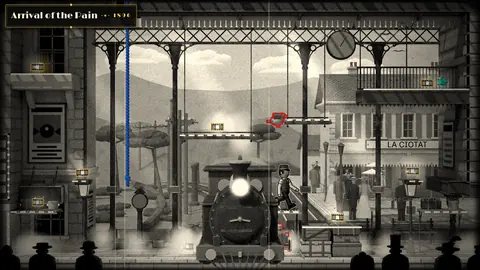
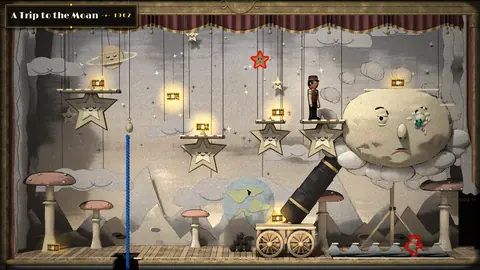
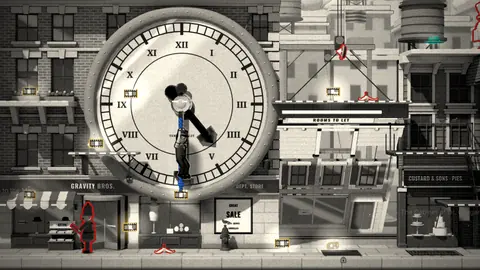
These notes come from Reel Trouble, a comedy platformer through film history. Every room in it is a movie set, built from scratch as a parody of a real film, and a fall is never a death: it is a retake.
-
 1896
Arrival of a Train at La Ciotat
Our room: Arrival of the Pain
1896
Arrival of a Train at La Ciotat
Our room: Arrival of the Pain
-
 1902
A Trip to the Moon
Our room: A Trip to the Moan
1902
A Trip to the Moon
Our room: A Trip to the Moan
-
 1923
Safety Last!
Our room: Safety Second
1923
Safety Last!
Our room: Safety Second
Free, in a desktop browser or as a download for Windows, Mac and Linux.
Quick answers
What is Modern Times (1936) about?
A factory worker, Chaplin's Tramp, is driven mad by the assembly line, loses job after job, is jailed by mistake and meets a homeless young woman, the gamine. They try to make a home during the Great Depression, and end on the road together.
Is Modern Times a silent film?
Not quite. It has no spoken dialogue between people, but it has printed titles, a recorded score and sound effects, and voices that come from machines. It is best described as a sound film with no spoken dialogue.
Is Modern Times Charlie Chaplin's last silent film?
It is his last appearance as the Tramp, and his last film without spoken dialogue between people. His next film, The Great Dictator (1940), was a full talkie without the Tramp.
What is the song Chaplin sings in Modern Times?
A nonsense song, in gibberish with scraps of French and Italian, set to the tune of Léo Daniderff's "Je cherche après Titine". It is the first time Chaplin's voice was heard on film.
Did Modern Times copy René Clair's À nous la liberté?
Tobis, which held the rights to Clair's 1931 film, sued over the similar factory scenes. Clair would not back the claim and said he was honoured. Chaplin said he had never seen it. Accounts of how the case ended differ: one has a first suit failing and a second, after the war, settled out of court.
Why was Modern Times banned in Germany and Italy?
Both countries banned it as communist propaganda, the AFI Catalog records. Chaplin answered that he had no political aims. Critics at the time, among them Graham Greene, noted that it shows the problem without offering a political answer.
Who wrote the song Smile?
Charlie Chaplin wrote the tune for Modern Times in 1936. John Turner and Geoffrey Parsons added the words in 1954, and Nat King Cole's recording reached number 10 on the Billboard chart that year.
Is Modern Times in the public domain?
No. On the 95-year term that applies in the United States, a 1936 film becomes free there on 1 January 2032. Until then the rights are held by Chaplin's family company, Roy Export.
Sources and further reading
- Modern Times: catalogue entry, American Film Institute Catalog
- Modern Times (film), Wikipedia, for dates, budget, rentals, the roller-skating scene, the Tobis cases and the rankings
- Behind the Camera: Modern Times, Turner Classic Movies
- Pop Culture 101: Modern Times, Turner Classic Movies, on the score, "Smile" and the lawsuit
- À nous la liberté, Wikipedia, on the Tobis dispute and René Clair's view
- When Charlie Chaplin met Mahatma Gandhi, Gandhi Sarvodaya (mkgandhi.org)
- 10 Industrial Facts About Modern Times, Mental Floss, on Detroit, Henry Ford and the machine sets
- Public Domain Day 2026, Duke Center for the Study of the Public Domain
- Charlie Chaplin: the official site, Roy Export S.A.S., for its copyright notice on Chaplin's films