Palace Picture House · Programme note
The Gold Rush 1925
Chaplin sent a tramp to the Klondike, boiled his boot for dinner, and spent seventeen months making the comedy he said he wanted to be remembered by.
By HertzyPertzy · Updated · 6 minute read
In short
The Gold Rush is a 1925 American silent comedy written, produced and directed by Charlie Chaplin, who plays a nameless Lone Prospector in the Klondike. It holds the boiled boot eaten like a banquet, the dance of the bread rolls and the cabin that teeters over a cliff. It is usually called the most expensive comedy of the silent era, and it was a hit. Chaplin said it was the picture he wanted to be remembered by. He reissued it in 1942 with his own music and narration, and the silent original was pieced back together in 1993.
Watch the film the silent version of 1925 on Wikimedia Commons, which hosts it as public domain in the United States (opens in a new tab)
- Premiere
- 26 June 1925, Grauman's Egyptian Theatre, Hollywood. The AFI Catalog gives 16 August 1925 as the release date
- Made by
- Charles Chaplin Productions, released by United Artists. Written, produced and directed by Charlie Chaplin; working title The Lucky Strike
- Cast
- Charlie Chaplin (the Lone Prospector), Mack Swain (Big Jim McKay), Tom Murray (Black Larsen), Georgia Hale (Georgia), Malcolm Waite (Jack Cameron)
- Filmed
- Location work near Truckee, in the Sierra Nevada of California, in early 1924; the rest in Chaplin's Hollywood studio. The AFI Catalog dates the shoot 7 February 1924 to 16 April 1925
- Length
- Ten reels in 1925, called record-breaking for a comedy by the AFI Catalog. The 1942 reissue runs 72 minutes
- Cost
- About $923,886 (by the figures quoted by the San Francisco Silent Film Festival). Worldwide takings are given as $4 million to $6 million
- Format
- Black and white, silent, 35 mm, with intertitles. The 1942 version has a score, effects and spoken narration by Chaplin
- Copyright
- The 1925 version's US copyright was not renewed, according to Duke's Center for the Study of the Public Domain. The 1942 version has rights of its own, the EU term runs from Chaplin's death in 1977, and his family's company, Roy Export, asserts rights in all his films
The story
The Klondike, in the gold rush of the late 1890s. Charlie Chaplin is the Lone Prospector, a tramp in a bowler hat and a tight jacket who has wandered into the snow with a cane. A blizzard drives him into a cabin owned by Black Larsen (Tom Murray), a fugitive. The giant prospector Big Jim McKay (Mack Swain) arrives, and the three quarrel over the one gun.
Charlie and Big Jim are left to starve. On Thanksgiving Day, with a gourmet's airs, Charlie boils his boot and serves it, the laces as spaghetti. Big Jim, delirious with hunger, sees Charlie as a huge chicken and goes after him with a knife. A bear wanders in, and supper is solved.
In town, Charlie falls for Georgia (Georgia Hale), a dance-hall girl who hardly notices him. He cooks her a New Year's Eve dinner, and she does not come. In his dream he does the dance of the rolls: two bread rolls on forks become a pair of dancing feet. Big Jim needs Charlie to find his lost claim, and in a storm the cabin ends up on the edge of a cliff and begins to tip. Both men come out of it rich.
Where the idea came from
The official Chaplin archive tells it plainly. Chaplin looked at stereoscope pictures of the Klondike gold rush, and one of them stayed with him: a long line of prospectors toiling up the Chilkoot Pass. He had also read about the Donner Party of 1846, a party of emigrants snowbound in the Sierra Nevada who were reduced to eating their moccasins and then the bodies of their dead companions. The film takes the starving and the leather, and leaves out the rest.
Seventeen months, one mountain
The unit went to Truckee, in the Sierra Nevada, in early 1924. By the archive's account the location work lasted about two weeks. Six hundred extras, many of them drawn from the vagrants and the down-and-out of Sacramento, came up by train to climb a 2,300-foot slope cut in the snow and make the Chilkoot Pass. By one account Chaplin caught influenza there, and little of the location footage beyond the pass ended up in the film.
The rest was made in Chaplin's studio in Hollywood. The archive says the mountain range was built from timber (a quarter of a million feet, it was reported), chicken wire, burlap, plaster, salt and flour. The cabin on the cliff was studio work too: by most accounts a full-size set that could be rocked, cut together with a model for the long shots.
The San Francisco Silent Film Festival gives 17 months of work, 235 days of actual shooting, over 230,000 feet of film exposed, and a cost of $923,886, the most expensive comedy of the silent era. The AFI Catalog dates the shoot from 7 February 1924 to 16 April 1925.
Lita Grey, who had been the flirtatious angel in The Kid, was first cast as the girl. She was fifteen. She became pregnant, married Chaplin, and was replaced. Georgia Hale, then 24 and little known, took the part.
The boot, the rolls and the chicken
The boot was made of liquorice. The scene is said to have taken three days and 63 takes, and to have left Chaplin and Swain the worse for it. The chicken is Big Jim's hunger: he looks at Charlie and sees one. By the archive's account another actor was tried in the costume first. In the end Chaplin played the bird himself, and the change from man to chicken and back was done in the camera.
The dance of the rolls needs no special effects: only Chaplin's hands, two forks and his face.
The premiere, and the 1942 version
The film opened at Grauman's Egyptian Theatre in Hollywood on 26 June 1925. It was a hit. Takings are reported at $4 million worldwide in one source and $6 million in two others. In the film's publicity Chaplin was quoted as saying: "This is the picture that I want to be remembered by."
In 1942 he reissued it. He added his own musical score and sound effects, replaced the intertitles with narration in his own voice, re-edited some sequences and dropped others. The AFI Catalog lists the revised version with two Academy Award nominations, for music and for sound. It runs 72 minutes, against about an hour and a half for the silent original.
In 1993 the film historians Kevin Brownlow and David Gill reconstructed the 1925 version, which Chaplin himself had not kept. For the centenary a 4K restoration was made by the Cineteca di Bologna at L'Immagine Ritrovata, from elements held by several archives, and released worldwide on 26 June 2025.
Who owns it
This is the untidy part. The 1925 film's American copyright was not renewed when its first 28-year term ran out, according to Duke's Center for the Study of the Public Domain. The 1942 version, with its music and narration, is a separate work with rights of its own.
In the European Union copyright generally runs for seventy years after the author's death, and Chaplin died in 1977. His family's company, Roy Export, asserts rights in all his films from 1918 on. That is why this page plays no copy itself: the answer depends on the version and on the country.
Why it matters
It made comedy and hunger share a plate. The boot supper is funny and also about a starving man, and the film never lets the hunger go.
It gave the screen two of its best-known gags. The dance of the rolls and the cabin on the cliff have been copied for a century.
It is the film Chaplin chose. Of everything he made, this is the one he said he wanted to be remembered by, and the one he went back to seventeen years later to give a voice.
On the same programme
Some of these films are rooms you can play
These notes come from Reel Trouble, a comedy platformer through film history. Every room in it is a movie set, built from scratch as a parody of a real film, and a fall is never a death: it is a retake.
-
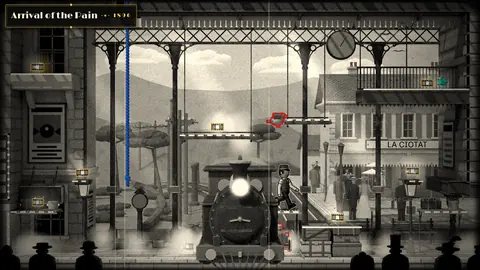 1896
Arrival of a Train at La Ciotat
Our room: Arrival of the Pain
1896
Arrival of a Train at La Ciotat
Our room: Arrival of the Pain
-
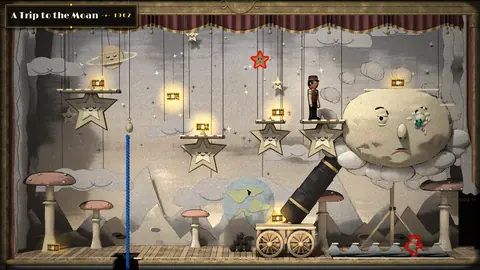 1902
A Trip to the Moon
Our room: A Trip to the Moan
1902
A Trip to the Moon
Our room: A Trip to the Moan
-
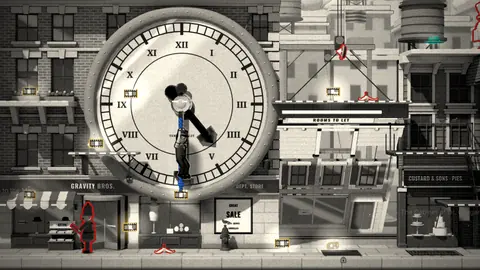 1923
Safety Last!
Our room: Safety Second
1923
Safety Last!
Our room: Safety Second
Free, in a desktop browser or as a download for Windows, Mac and Linux.
Quick answers
What is The Gold Rush (1925) about?
A lone prospector goes to the Klondike, shelters from a blizzard in a cabin with the fugitive Black Larsen and the giant prospector Big Jim McKay, and nearly starves. He falls for a dance-hall girl, Georgia, and by luck ends up rich.
What was the boot in The Gold Rush made of?
Liquorice. The scene is said to have taken three days and 63 takes, and to have left both actors the worse for it.
Where was The Gold Rush filmed?
The snowbound exteriors, including the line of men on the Chilkoot Pass, were shot near Truckee in the Sierra Nevada, California. The cabins and the mountain scenery were built in Chaplin's Hollywood studio.
Did Chaplin say The Gold Rush was the film he wanted to be remembered for?
Yes. In the film's publicity he was quoted as saying: "This is the picture that I want to be remembered by."
Why is there a 1942 version of The Gold Rush?
In 1942 Chaplin re-edited the film, added his own score and sound effects, and replaced the intertitles with spoken narration. He also dropped some material. That version was nominated for two Academy Awards, for music and sound.
Who replaced Lita Grey in The Gold Rush?
Georgia Hale, then 24 and little known. Lita Grey had been cast as the girl at fifteen, but became pregnant and married Chaplin, and was replaced after the Truckee shoot.
Is The Gold Rush in the public domain?
In the United States the 1925 version's copyright was not renewed, according to Duke's Center for the Study of the Public Domain. The 1942 version has separate rights, and the EU position is different again. Check each version before you copy it.
Was The Gold Rush based on a true story?
Not as a whole. Chaplin said the idea came from stereoscope pictures of the Klondike gold rush, and the starving scenes owe something to the Donner Party of 1846, snowbound in the Sierra Nevada.
Sources and further reading
- Filming The Gold Rush, Charlie Chaplin official archive (Roy Export), on the stereoscope pictures, the Donner Party, Truckee, the extras, the sets and the premiere
- The Gold Rush (1925), AFI Catalog, American Film Institute, on the dates, the credits and the 1942 reissue
- The Gold Rush, San Francisco Silent Film Festival, on the cost, the 235 days, Chaplin's statement and Brownlow and Gill's 1993 reconstruction
- The Gold Rush, San Francisco Silent Film Festival, second note, on Georgia Hale, the effects and the restorations
- Charlie Chaplin and "The Gold Rush", Journal of Sierra Nevada History and Biography, Sierra College, on the Truckee shoot
- 12 Fascinating Facts About Charlie Chaplin's The Gold Rush, Mental Floss, on the liquorice boots, the extras and the reception
- The Gold Rush (silent film), EBSCO Research Starters, on the cast and Chaplin's own verdict
- Public Domain Day 2021, Jennifer Jenkins, Duke Center for the Study of the Public Domain
- The Gold Rush Centennial: new trailer and worldwide release, Charlie Chaplin official archive, on the 2025 restoration and the rights notice
- The Gold Rush, Wikipedia, for the points given here as "by most accounts": the honours, the polls, the 1942 length and the copyright history