
Palace Picture House · Programme note
King Kong 1933
A film-maker takes a giant ape from a jungle island to New York, and a small crew of animators gives it a face that audiences still pity.
By HertzyPertzy · Updated · 7 minute read
In short
King Kong is an American adventure film of 1933, made at RKO by Merian C. Cooper and Ernest B. Schoedsack. A film-maker takes an actress to a remote island, where a giant ape carries her off, and then brings the ape back to New York. Kong is a model about 18 inches high, animated one frame at a time by Willis O'Brien and his team, with a thunderous orchestral score by Max Steiner. It was a hit that helped RKO through the Depression, it was cut for later reissues, and it has been remade and argued over ever since.
Watch the film find where to stream, rent or buy it, on JustWatch (opens in a new tab)
- Opening
- New York, at Radio City Music Hall and the RKO Roxy, in the first days of March 1933 (2 March is the date usually given; the AFI Catalog gives 7 March). General release 7 April 1933
- Made by
- RKO Radio Pictures. Directed and produced by Merian C. Cooper and Ernest B. Schoedsack. Story credited to Edgar Wallace and Cooper, screenplay to James Creelman and Ruth Rose. Special effects by Willis O'Brien, models by Marcel Delgado, music by Max Steiner
- Cast
- Fay Wray (Ann Darrow), Robert Armstrong (Carl Denham), Bruce Cabot (Jack Driscoll)
- Cost
- The final negative cost is given as $672,254.75, a figure that includes $177,633 spent on the abandoned film Creation and studio overhead. Cooper put the cost of Kong itself at $430,000
- Filmed
- Production ran from January 1932 into early February 1933, with 55 weeks of work on the animation. Jungle scenes were shot on sets left over from The Most Dangerous Game
- Length
- About 100 minutes. The 2005 restoration runs 104 minutes with an overture added
- Format
- 35 mm, black and white, sound
- Copyright
- Still in copyright in the United States. On the 95-year term that applies to a work of 1933 published with notice, it is expected to enter the public domain on 1 January 2029. This page therefore links to no free copy
The story
Carl Denham (Robert Armstrong) is a film-maker known for shooting wild animals in far places. He finds Ann Darrow (Fay Wray), an out-of-work actress, on a New York street. His ship sails for an uncharted island, where the people live behind a great wall and keep a god called Kong. They seize Ann as his bride.
Kong carries her into the jungle, where he fights dinosaurs for her. Denham and the mate Jack Driscoll (Bruce Cabot) follow, and Driscoll gets her out. Denham gasses Kong and takes him to New York as a stage attraction. Kong breaks his chains, recaptures Ann and climbs the Empire State Building, where naval aircraft shoot him down. A policeman says the aeroplanes got him. Denham answers:
Oh, no. It wasn't the airplanes. It was Beauty killed the Beast.
Denham's last line, as given in the Library of Congress essay by Michael Price
Who made it
The idea was Merian C. Cooper's. He had been a newspaper reporter, a wartime pilot and an explorer, and with the cameraman Ernest B. Schoedsack he had made the real-life adventure films Grass (1925), Chang (1927) and The Four Feathers (1929). Cooper pictured a giant gorilla on a skyscraper fighting aircraft, and joined RKO at the call of its head of production, David O. Selznick.
The credits name Edgar Wallace. By the usual account he wrote a rough draft in the winter of 1931 to 1932 and died in February 1932; Cooper had promised him the credit. James Creelman completed a script, and Ruth Rose, Schoedsack's wife, rewrote it in fragments through the shoot. How much of Wallace's work survived is disputed.
How Kong was made
Kong was a puppet. Willis O'Brien, who had animated the dinosaurs of The Lost World (1925), moved each model a little between exposures. At 24 frames a second, the Library of Congress essay notes, only 15 to 20 feet of film could be animated in a ten-hour day. The sculptor Marcel Delgado built the models: by most accounts 14 to 18 inches high, with a metal skeleton under padding, latex and rabbit fur.
The fur has a story. The producers were appalled to see it ripple in the rushes, wherever the animators' fingers had pressed it, until one executive, the story goes, said: "Kong is mad! Look at him bristle!"
Close-ups used life-size parts: a mechanical head, two arms and hands. Sources differ on how many men worked the head, three or six. Actors met the models through rear projection, O'Brien's miniature projection (live action thrown onto small screens inside the model sets), Linwood Dunn's optical printing and travelling mattes. The jungles were painted on glass by Mario Larrinaga and Byron Crabbe, in the manner, a festival note says, of Gustave Doré's engravings. The jungle sets came from The Most Dangerous Game, directed by Schoedsack and starring Wray.
The music was meant to be borrowed. Executives told the composer Max Steiner to reuse old scores, and Cooper let him write a new one for 46 players. By Steiner's own account Cooper paid $50,000 of his own money for the orchestra. Critics call it a landmark of film music, and it sits at number 13 on the American Film Institute's list of film scores, though the music historian Michael Slowik argues it did not change how Hollywood scored films. The sound man Murray Spivack made Kong's roar, by the usual account, from lions and tigers recorded and played slowly backwards.
Opening, takings and RKO
The film opened in New York at Radio City Music Hall and the RKO Roxy at the start of March 1933. Dates differ: 2 March is common, the AFI Catalog says 7 March. The AFI says over 50,000 people came on the first day. The opening weekend is estimated at $90,000. Days later President Roosevelt closed the banks, and second-week receipts fell by up to half.
The claim that Kong saved RKO needs a careful phrase. RKO was in receivership when it opened, and the AFI says its success "greatly boosted" the studio. The film historian Richard B. Jewell says Kong and Little Women together let RKO survive until Fred Astaire and Ginger Rogers arrived. It helped. It did not do it alone.
Cuts, and the spider pit
Stricter rules came after the film opened. RKO reissued it in 1938, 1942 and 1952, with cuts to three scenes: Kong undressing Ann, Kong biting a villager and stepping on others, and Kong dropping a woman from a hotel window when he finds she is not Ann. A 16 mm print with the cut scenes turned up in Philadelphia in 1969, and Janus Films reissued the full version around 1970 (sources give 1969, 1970 or 1971). The 2005 restoration by Warner Bros. and The Film Foundation used a dupe negative from an RKO studio print.
The spider pit is another matter. Kong shakes sailors off a log into a ravine, where giant spiders and other creatures devour them. It is in the script and the novelisation. Cooper recalled that a preview audience at San Bernardino fled the theatre in horror, so he cut it. A studio memo is said to say instead that the scene "stopped the story". Some say it was never filmed. Two stills and production drawings survive; no footage is known. Claims that people saw it in cinemas in 1933 are hearsay.
How it has been read
On screen, the islanders are a stock "savage tribe" of the period, and a giant black ape carries off a white woman and is later put on show in chains. Scholars have read the film as a story about race and fear of mixed-race relationships, a reading that sees Kong as a stand-in for Black men in a white supremacist society. Others see Denham as a colonialist, and Kong's capture and display in chains as echoing the slave trade. Another reading puts the film in the Depression: a monster that stands for the fears of the time, and that is, in the end, beaten. The film supports more than one of these at once, which is part of why it is still argued over.
Why it matters
It made a model into a star. Audiences pitied an eighteen-inch puppet. One of the film's own producers said the ape could show more expressions than many of the actors.
It is where the effects film learned its trade. Stop-motion, miniature projection, glass painting and optical printing all work together here in one picture. Ray Harryhausen, who saw it at thirteen, said it set him on his career.
It gave the monster film its shape. Son of Kong followed within the year, then the remakes of 1976 and 2005, and the giant creature loose in a city has been a staple ever since. The Library of Congress added the film to the National Film Registry in 1991.
On the same programme
Some of these films are rooms you can play
These notes come from Reel Trouble, a comedy platformer through film history. Every room in it is a movie set, built from scratch as a parody of a real film, and a fall is never a death: it is a retake.
-
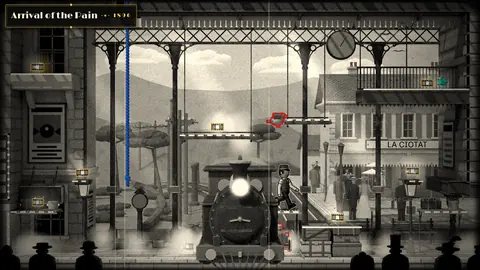 1896
Arrival of a Train at La Ciotat
Our room: Arrival of the Pain
1896
Arrival of a Train at La Ciotat
Our room: Arrival of the Pain
-
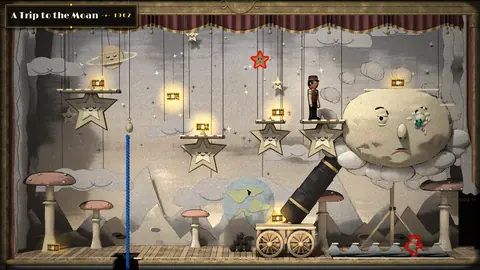 1902
A Trip to the Moon
Our room: A Trip to the Moan
1902
A Trip to the Moon
Our room: A Trip to the Moan
-
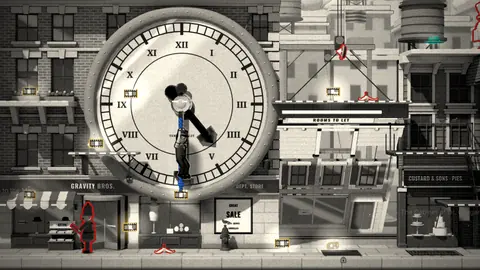 1923
Safety Last!
Our room: Safety Second
1923
Safety Last!
Our room: Safety Second
Free, in a desktop browser or as a download for Windows, Mac and Linux.
Quick answers
What is King Kong (1933) about?
The film-maker Carl Denham takes the actress Ann Darrow on a ship to Skull Island. Its people offer her to a giant ape, Kong, who carries her off. Denham captures Kong and ships him to New York, where he escapes and climbs the Empire State Building.
What is the last line of King Kong?
A policeman says the aeroplanes got Kong, and Denham answers: "Oh, no. It wasn't the airplanes. It was Beauty killed the Beast." The line is number 84 on the American Film Institute's list of film quotes.
How was King Kong made in 1933?
Kong was a model, about 14 to 18 inches high, with a metal skeleton under rubber and rabbit fur. Willis O'Brien moved it a fraction at a time and photographed each frame. Rear projection, glass paintings and optical printing placed it among the live actors.
Was King Kong a man in a suit?
No. The Library of Congress essay on the film says rumours of a man in an ape suit persist, and that the producers and craftsmen denied them repeatedly. Close-ups used a full-size head, and two full-size hands and arms, as well as the models.
What was the spider pit scene in King Kong?
A scene in which men shaken from a log by Kong fall into a ravine and are eaten by giant spiders and other creatures. It is in the script and the novelisation. Whether it was ever filmed is disputed, and no footage is known to survive.
Did King Kong save RKO?
It helped. RKO was in receivership when the film opened, and the American Film Institute says the film's success greatly boosted the studio. The film historian Richard B. Jewell says Kong and Little Women together let RKO survive until its Astaire and Rogers musicals arrived.
Is King Kong (1933) in the public domain?
Not yet in the United States. A work of 1933 published with notice is protected for 95 years, which points to 1 January 2029. Other countries have their own terms.
How many King Kong remakes are there?
Two full remakes of the story: Dino De Laurentiis's of 1976 and Peter Jackson's of 2005. There was also a sequel in 1933, Son of Kong, and later films that use the character.
Sources and further reading
- King Kong, National Film Registry essay, Michael Price, Library of Congress (PDF)
- Reading the Film Registry: King Kong (1933), Library of Congress, Now See Hear! blog, 2018
- King Kong (1933): the AFI Catalog entry, American Film Institute
- Out of the Vaults: King Kong, 1933, The Film Foundation, on the 2005 restoration and the cut scenes
- King Kong (1933), Il Cinema Ritrovato, Bologna, 2004 festival note drawing on the Library of Congress
- King Kong: The Famous Spider Pit Sequence, Martin Grams Jr., blog, 2015
- Hollywood History: How King Kong saved a movie studio, Yahoo Finance, quoting the film historian Richard B. Jewell
- Copyright and the public domain: duration chart, Cornell University Library
- King Kong (1933 film), Wikipedia, with its articles on the lost spider pit sequence, Max Steiner, Marcel Delgado and Willis H. O'Brien, for the points given here as "by most accounts"