
Palace Picture House · Programme note
The Golem 1920
A rabbi shapes a giant from clay to save Prague's Jews, in a ghetto built in a Berlin studio, and the film is argued over to this day.
By HertzyPertzy · Updated · 6 minute read
In short
Der Golem, wie er in die Welt kam (The Golem: How He Came into the World) is a German silent film, directed by Paul Wegener and Carl Boese and first shown in Berlin on 29 October 1920. It tells the legend of Rabbi Loew of Prague, who makes a clay giant to save his community from expulsion and then loses control of it. It was Wegener's third golem film, and the only one that survives. Its crooked ghetto, designed by the architect Hans Poelzig, and its lumbering clay figure influenced the horror films that followed, and its picture of Prague's Jews has been debated ever since.
Watch the film
It is not played on this page: see where to watch it.
Find where to stream, rent or buy it, on JustWatch.
- Original title
- Der Golem, wie er in die Welt kam ("The Golem, How He Came into the World")
- Released
- 29 October 1920, Ufa-Palast am Zoo, Berlin. New York: 1921
- Made by
- Directed by Paul Wegener and Carl Boese; script Wegener and Henrik Galeen; produced by Paul Davidson for Projektions-AG Union (PAGU), distributed by Ufa; camera Karl Freund; music Hans Landsberger
- Design
- Sets by the architect Hans Poelzig, with Marlene Moeschke; art direction Kurt Richter; costumes Rochus Gliese
- Cast
- Paul Wegener (the Golem), Albert Steinrück (Rabbi Loew), Lyda Salmonova (Miriam), Ernst Deutsch (Pamulus), Otto Gebühr (the Emperor)
- Filmed
- May and June 1920 at the Ufa studios in Berlin-Tempelhof
- Length
- 1,922 metres, black and white, silent, 35 mm, 1.33:1. About 91 minutes is the figure given in one review
- Copyright
- Public domain in the United States. The Friedrich-Wilhelm-Murnau-Stiftung is listed as holding the rights in Germany, and the film may still be protected in some countries. Restorations and scores have rights of their own
The story
Prague, in the age of the emperors. Rabbi Loew, who is an astrologer as well as a spiritual leader, reads in the stars that disaster is coming to the Jewish ghetto. It arrives as a decree: the Emperor orders the Jews to leave the city.
The rabbi's answer is a giant of clay. By the film's account he summons a demon who teaches him the word that gives life, and he puts the word in an amulet on the figure's chest. The golem is sent to the palace, where it saves the court when a ceiling gives way. The grateful Emperor withdraws the decree.
Then it goes wrong. The rabbi's daughter Miriam is involved with a young squire, and the golem, no longer under its master's hand, kills him and sets the ghetto on fire. It is stopped by a small girl who takes the amulet from its chest. The golem falls, lifeless clay again.
The legend, and the film's own version
Golem stories are old. The earliest written method for making one dates from the late twelfth or early thirteenth century, and the first golem-maker described as a historical person is Elijah of Chełm, who died in 1583. The link to Prague is much newer. Historians generally treat the Prague golem as a German literary invention of the early 1800s. Judah Loew ben Bezalel was a real and famous rabbi of Prague in the sixteenth century, but his own writings never mention a golem, and nor do the early accounts of his life.
A Polish book of 1909 helped to fix the tale to him. It presented itself as an eyewitness account, and scholars such as Gershom Scholem took it for fiction. In the best-known versions the rabbi forgets to deactivate the creature before the Sabbath, and it runs amok. Wegener's film keeps the rabbi and the amulet but gives the story its own plot of a threatened expulsion, a court and a love affair. The film is credited as based on Gustav Meyrink's novel.
Wegener's three golems
Paul Wegener, an actor, first heard the legend while making The Student of Prague in 1913, and went on to make three golem films. The first, a modern story, is dated 1914 or 1915 depending on the source. A parody followed in 1917. Both are lost. Wegener is said to have been dissatisfied with the first and wanted a version closer to the legend, which is why the 1920 film carries the subtitle How He Came into the World: it is the story of the golem's origin, set in the past.
He directed with Carl Boese, wrote with Henrik Galeen and played the golem himself. It was shot in May and June 1920 at the Ufa studios in Tempelhof, and shown at the Ufa-Palast am Zoo in Berlin on 29 October 1920. It is the golem film that survives whole, which is why it is the one people mean.
A ghetto built in Berlin
The star of the film's look is the set. The architect Hans Poelzig, assisted by Marlene Moeschke, designed a ghetto of 54 buildings, built for real by Kurt Richter at Tempelhof, with narrow alleys and steeply slanted roofs. The Cabinet of Dr. Caligari, shown earlier the same year, had painted its town on canvas. This one could be walked through.
One reviewer finds the shapes confining, people and things squeezed into squares, triangles and circles, and thinks the sets give the film grandeur more than psychology. The camera was Karl Freund's, who went on to shoot Dracula (1931) and to direct The Mummy (1932) in Hollywood. The golem itself is a grey clay figure in enormous boots. Wegener plays it stiff and expressionless, and the same reviewer says it can look like a giant grey robot, or like Frankenstein's monster. The score was by Hans Landsberger, a Jewish composer, and an orchestral score was an unusual step for a film then. He was deported in 1940 and died in the Gurs internment camp in 1941. His music was long thought lost, and was reconstructed by Richard Siedhoff in 2018 from the surviving piano part and fragments.
The ghetto and its people
The film shows a Jewish community, its rabbi and its ghetto, in a story made in Germany in 1920. Writers differ on what it does with them, and the disagreement is worth stating without softening either side.
The scholar Maya Barzilai, in a book on the film, argues that it restores the story's Jewish identity, which Wegener's first film had nearly removed, and that it answers the antisemitic politics of its day through its Emperor. Even so, she finds that it indulges in ugly Jewish stereotypes. A scholar interviewed by the University of Wuppertal is harsher: for him the Prague Jews of the film are exotic clichés, and a story of a monster made in the ghetto suited those who wanted to stir up fear of another religion.
These are readings by later critics, and they do not agree. What can be said is that the film shows the rabbi as a sorcerer, that its Prague Jews are drawn with the stereotypes of its time, and that its own composer was a Jewish man who did not survive the next war.
Why it matters
It was a success. The film was a major hit in Germany, and by one account it ran for 16 weeks in New York after it opened there in 1921. The New York Times is said to have praised its acting and sets.
It is the golem film that is left. The two earlier films are lost. This one survives in several archives, with restorations made in 1977, 2000 and 2017, and its original score has been heard again since 2020.
It helped to shape the horror film. Its sets, its sorcerer and its lumbering creature are often cited as an early influence on Frankenstein (1931). The link is a critic's, not a documented chain, but few dispute that the clay giant belongs to the same family.
It keeps the argument alive. A film that took a Jewish legend seriously and still drew on the stereotypes of its day is a good reason to look at who tells a story and how. The golem has since passed through many other hands.
On the same programme
Some of these films are rooms you can play
These notes come from Reel Trouble, a comedy platformer through film history. Every room in it is a movie set, built from scratch as a parody of a real film, and a fall is never a death: it is a retake.
-
 1896
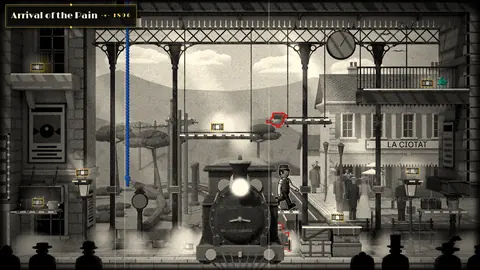
Arrival of a Train at La Ciotat
Our room: Arrival of the Pain
-
 1902
A Trip to the Moon
Our room: A Trip to the Moan
-
 1923
Safety Last!
Our room: Safety Second
Free, in a desktop browser or as a download for Windows, Mac and Linux.
Quick answers
What is the 1920 Golem film about?
Rabbi Loew of Prague learns that the Emperor means to expel the city's Jews. He makes a giant from clay and brings it to life with a magic word in an amulet, and the golem saves the Emperor's court, but it later runs out of control and sets the ghetto on fire.
Is the legend of the golem of Prague real?
The rabbi was real: Judah Loew ben Bezalel lived in Prague in the sixteenth century. But historians generally see the Prague golem as a German literary invention of the early nineteenth century, and his own writings never mention one.
How many golem films did Paul Wegener make?
Three: one dated 1914 or 1915, a parody in 1917, and this film in 1920. The first two are lost. The 1920 film is the one that survives.
Who designed the sets of The Golem?
The architect Hans Poelzig, with Marlene Moeschke. The ghetto was built as a real set of 54 buildings at the Ufa studios in Tempelhof, not painted on canvas.
Did The Golem influence Frankenstein?
It is often cited as an early influence on Frankenstein (1931), and its grey clay giant is sometimes compared with that monster. It is a link critics draw, not a proven chain of cause.
Is The Golem (1920) antisemitic?
Critics disagree. Some scholars say it restores the story's Jewish identity and answers antisemitic politics, yet admit it indulges ugly stereotypes. Others call its Prague Jews exotic clichés.
Is The Golem (1920) in the public domain?
In the United States, yes. A film archive listing says the Murnau Foundation holds the rights in Germany, so it may still be protected in some countries.
Who wrote the music for The Golem?
Hans Landsberger, a Jewish composer, wrote an orchestral score for the premiere. It was long thought lost, and in 2018 Richard Siedhoff reconstructed it. Landsberger died in 1941 in the Gurs internment camp.
Sources and further reading
- The Golem: How He Came into the World, Wikipedia: credits, plot, production, release, preservation and reception
- Der Golem, wie er in die Welt kam (1920), Silent Era: credits, length, premiere, rights and archive prints
- Golem, Wikipedia: the legend, Rabbi Loew and the early nineteenth-century German tales
- Celebrating 100 Years of The Golem, AIPT Comics, 2020, on Maya Barzilai's book on the film
- The Golem: a myth takes over the cinema screen, University of Wuppertal, 2020
- The Golem (1920), Classic-Horror.com: the film's look and the golem's design
- The Golem: How He Came into the World, reconstructed music, Bauhaus-Universität Weimar, media release, 2020
- Paul Wegener, Wikipedia: his golem films and his dates
- Hans Poelzig, Wikipedia: the architect and his work for the film
- Karl Freund, Wikipedia: his career, from this film to Hollywood