
Palace Picture House · Programme note
In Nacht und Eis 1912
Within weeks of the Titanic going down, a Berlin company shot its own version with a model ship, a glasshouse studio and a fire brigade's hoses.
By HertzyPertzy · Updated · 4 minute read
In short
In Nacht und Eis (In Night and Ice) is a German silent film of 1912 about the sinking of the Titanic, directed by the Romanian Mime Misu for Continental-Kunstfilm of Berlin. It was shot in May and June 1912, less than two months after the disaster, and shown in August. It is the earliest surviving film about the sinking: the American Saved from the Titanic, made first, is lost. The German film was itself thought lost until a print was found in 1998.
Watch the film
There is no clean free copy to play or link to here.
In Nacht und Eis
1912
- Original title
- In Nacht und Eis ("In Night and Ice"); also called Der Untergang der Titanic, and Shipwrecked in Icebergs in the United States
- Released
- Passed the censor on 6 July 1912; premiered in Berlin on 17 August 1912
- Made by
- Continental-Kunstfilm, Berlin. Director and writer Mime Misu; producer Max Rittberger; cameramen Willy Hameister, Emil Schünemann and Viktor Zimmermann
- Cast
- Otto Rippert (the Captain), Ernst Rückert (the First Officer), Waldemar Hecker (the wireless operator), Mime Misu
- Filmed
- May and June 1912: a glasshouse studio in Chausseestrasse, Berlin; the ports of Hamburg and Cuxhaven; the liner Kaiserin Auguste Victoria; a lake near Königs Wusterhausen
- Length
- Three acts, 946 metres. Running time given as 35 to 42 minutes, depending on the source and the speed
- Format
- Silent, 35 mm, 1.33:1; black and white with tinted scenes; German intertitles
- Copyright
- Published in 1912, so in the public domain in the United States. Sources opened here do not state its standing in Germany or the EU; modern restorations and scores may have rights of their own
A Titanic film from Berlin
The Titanic sank on 15 April 1912, and more than fifteen hundred people died. Film companies moved at once. One of them was Continental-Kunstfilm of Berlin, which put a young Romanian, Mime Misu, in charge of a picture about the sinking. Shooting began in May and ran into June, less than two months after the disaster. The censor passed it on 6 July, and it opened in Berlin on 17 August 1912.
The title, In Nacht und Eis, means "in night and ice". It also circulated as Der Untergang der Titanic, and in the United States as Shipwrecked in Icebergs. It runs to three acts and 946 metres, roughly 35 to 42 minutes depending on the source and the projection speed. That was long for 1912, when most films were far shorter.
What is on screen
The story follows the ship from Southampton to the iceberg. The wireless operators send the distress call. There are too few lifeboats, and women and children are loaded first while the men are held back. The band plays, and by one account the hymn "Nearer, My God, to Thee" is among the tunes. The Captain, played by Otto Rippert, saves a drowning man, refuses a place in a boat himself and goes down with his ship. Ernst Rückert plays the First Officer and Waldemar Hecker a wireless operator.
The film is a drama built on real events, with invented touches. A title card tells of a baby boy sent off in a lifeboat with his nanny while the rest of his family stay behind. Some scenes are tinted: night in dark blue, a stoker's furnace in red. The loss of life is the subject, and the Captain's death is shown.
How it was made
Most of it was shot in a glasshouse studio in a courtyard at Chausseestrasse 123 in Berlin. Exteriors were taken at the ports of Hamburg and Cuxhaven, and the liner Kaiserin Auguste Victoria lent its interiors: the Café Parisien scenes were reportedly filmed in its Winter Garden. The Berlin fire brigade supplied water for the sinking.
The ship that meets the iceberg is a model, about eight metres long according to the German article on the film. The Deutsche Kinemathek says the sinking itself was staged with a model on a lake near Königs Wusterhausen. Misu wrote and directed, and is named in the cast too, possibly as a wireless operator; the German article does not give his role.
Misu was about 24. Born Mișu Rosescu in Botoșani in 1888, he had been a child dancer and mime, performed at the Paris World Fair of 1900, and worked in Paris for Lux and Pathé Frères before joining Continental-Kunstfilm in 1912. The year of his death is given as 1953, with the later part of his life uncertain.
Lost, then found
The film got little attention when it opened and was long taken for lost. In February 1998, after James Cameron's Titanic had stirred up the subject, a newspaper wrote about the missing film, and the archivist Horst Lange told it he had a print. Another account says collectors and an archive came forward with copies. The Deutsche Kinemathek restored it, and the restoration was shown in Bonn on 28 August 1998.
It is usually called the earliest surviving film about the disaster. The American Saved from the Titanic, shown on 16 May 1912, was made first, in about a week, with the survivor Dorothy Gibson playing a version of herself. Its last known prints burned in a studio fire in 1914, and only stills remain. The German film is the longer and more ambitious of the two, and the only one anyone can still watch.
Why it matters
It is the earliest Titanic film we have. Everything since, including the lavish versions, comes after a picture made while the news was still raw.
It shows how fast the cinema of 1912 reacted. A model, a studio, borrowed water and a few actors were enough to put a disaster on the screen within weeks.
It reminds us the story is real. Many people died, and the film's first audiences knew it.
On the same programme
Some of these films are rooms you can play
These notes come from Reel Trouble, a comedy platformer through film history. Every room in it is a movie set, built from scratch as a parody of a real film, and a fall is never a death: it is a retake.
-
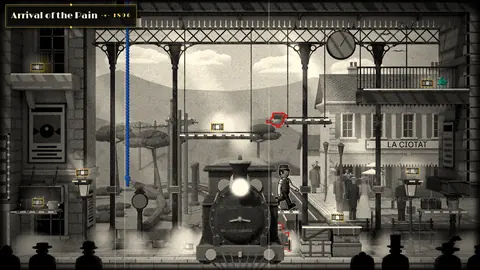 1896
Arrival of a Train at La Ciotat
Our room: Arrival of the Pain
-
 1902
A Trip to the Moon
Our room: A Trip to the Moan
-
 1923
Safety Last!
Our room: Safety Second
Free, in a desktop browser or as a download for Windows, Mac and Linux.
Quick answers
What is In Nacht und Eis?
A German silent film of 1912 about the sinking of the Titanic, directed by Mime Misu. It premiered in Berlin on 17 August 1912, about four months after the disaster.
Is In Nacht und Eis the first Titanic film?
No. The American Saved from the Titanic was shown in May 1912, but it is lost. In Nacht und Eis is the earliest Titanic film that survives.
How was the sinking filmed?
With a model. The German article on the film describes the ship that strikes the iceberg as a model about eight metres long, and one source places the sinking on a lake near Königs Wusterhausen. Interiors were shot in a Berlin studio.
Was In Nacht und Eis lost?
For some 86 years it was believed lost. In February 1998 the archivist Horst Lange told a newspaper he had a print, and a restoration was shown in Bonn in August 1998.
How long is In Nacht und Eis?
The surviving version has three acts and 946 metres of film. Sources give the running time as 35, 41 or 42 minutes.
Who directed In Nacht und Eis?
Mime Misu, a Romanian dancer, mime and film-maker, born in 1888. He is also named in the cast, and may have played a wireless operator.
Is In Nacht und Eis in the public domain?
In the United States, yes: it was published in 1912. The sources opened here do not state its position in Germany and the EU, and a modern restoration or score can carry rights of its own.
Sources and further reading
- In Nacht und Eis, Wikipedia (English): cast, release, filming, rediscovery
- In Nacht und Eis, Wikipedia (German): production, locations, length, censorship, the model ship
- In Night and Ice. The Sinking of the Titanic, Deutsche Kinemathek
- In Nacht und Eis (1912), Silent Era, film listing
- The first film version of the Titanic, Classics of the Silent Screen
- Mime Misu, Wikipedia (English)
- Saved from the Titanic, Wikipedia (English): the American film of May 1912