
Palace Picture House · Programme note
Little Nemo 1911
A famous newspaper cartoonist bet his friends that he could make four thousand drawings move, and the film he made of it is still watched.
By HertzyPertzy · Updated · 5 minute read
In short
Little Nemo is an American short of 1911 by the cartoonist Winsor McCay, made at the Vitagraph studio with J. Stuart Blackton and released as Winsor McCay, the Famous Cartoonist of the N.Y. Herald and His Moving Comics. A live-action story about a bet frames a short stretch of animation in which characters from McCay's newspaper strip come to life. It was not the first animated film, and McCay's own claim to be the first is doubted, but it is admired for the way its figures move. It is in the National Film Registry and is in the public domain in the United States.
Watch the film
The whole film: 12 minutes, silent, with no music, in its hand-tinted colour. From the 2004 DVD Winsor McCay: The Master Edition.
Played from Wikimedia Commons, which hosts this copy as a public-domain work. Nothing is fetched from there until you press play. If it will not play here, it will on their page.
- Original title
- Released as Winsor McCay, the Famous Cartoonist of the N.Y. Herald and His Moving Comics; known today as Little Nemo
- Made by
- Winsor McCay, who drew the animation; photographed at Vitagraph's studio under J. Stuart Blackton's supervision. Sources differ on who is credited as director
- Cinema release
- 8 April 1911, distributed by Vitagraph
- Vaudeville
- McCay added it to his stage act from 12 April 1911, by one account
- Length
- About 11 minutes 33 seconds in the version one reference gives; the animated part is a small share of it, put at two to four minutes depending on the source
- Technique
- About 4,000 drawings on rice paper, photographed frame by frame; no cels, which had not yet been invented
- Format
- Silent, 35 mm, 1.33:1; shot in black and white, with colour added to the film, by most accounts by hand
- Copyright
- Public domain in the United States, because it was published before 1931; McCay died in 1934. Modern restorations and recorded scores can carry rights of their own
What is on screen
Most of the film is not animation at all. It opens in live action with Winsor McCay and his friends, who include the cartoonist George McManus, the Vitagraph comedian John Bunny, the publisher Eugene V. Brewster and the actor Maurice Costello. McCay bets them that he can make four thousand drawings move within a month. They laugh, and suggest he is drunk or mad. We see him in a studio directing helpers who move bundles of paper and barrels of ink. A month later he shows the friends the result on a projector.
The wager belongs to the film's story. It is a way of announcing the stunt, not a record of how the drawings were made. Reviewers also differ on how long the drawn part runs: some say under two minutes, one reference about four, in a film of about eleven and a half.
Then a drawing of Flip, a cigar-smoking character, is slotted in front of the camera. The words "Watch me move" appear above him, and he does. Blocks fall from the sky and make up Impie. The two distort, vanish and return, until Little Nemo appears and stops them fighting, stretching and squashing their shapes with the raising and lowering of his arms. Nemo then draws a Princess to life and hands her a rose. A gigantic dragon arrives, with a throne in its mouth, and carries the Princess and Nemo off as they wave. Flip and Impie give chase in a jalopy, which explodes. The picture freezes and the camera pulls back to show a thumb holding the last drawing, numbered "No. 4000".
Impie is drawn as a racist caricature, as was common on the comic pages of the time, and one reviewer calls Flip an Irish stereotype. The film keeps both as they were drawn.
The strip
The characters belong to McCay's full-page Sunday strip Little Nemo in Slumberland, which began in the New York Herald in October 1905. Its hero is a small boy who dreams his way to Slumberland each night and wakes at the end of the page. McCay left the Herald for William Randolph Hearst's New York American in 1911, the year of the film, and won a lawsuit that let him go on using the characters under a new title.
Before the film he had a vaudeville act in which he sketched his characters at speed. Daniel Eagan, in the Library of Congress's National Film Registry essay, writes that McCay built a narrative frame that could be slotted into vaudeville programmes, and notes that J. Stuart Blackton had performed quick sketches on stage under the name "Lightning Sketches" before him.
The making
The drawings were done on rice paper and photographed at the Vitagraph studio under Blackton's supervision. The count of four thousand comes from the film's own title cards, and writers repeat it. It is a good round number for a film that is about a stunt. The time is less settled too: the film says one month, while one popular account says four.
The animation has a craftsman's shortcuts. By one account McCay reused seven drawings six times to move Flip's cigar up and down, an early loop. Cel animation, in which figures are drawn on clear sheets over a fixed background, did not yet exist, so every frame was redrawn in full.
The film was shot in black and white. Several sources say that after the audience's warm response McCay hand-coloured the frames. One reviewer disputes that he coloured all four thousand, arguing that colour in the period was applied by teams to the release prints, with the colours chosen by a head colourist, and that McCay may have chosen them himself. The point is not settled.
Release
Vitagraph released the film in cinemas on 8 April 1911, under the title Winsor McCay, the Famous Cartoonist of the N.Y. Herald and His Moving Comics. By one account McCay put it into his vaudeville act on 12 April. The Moving Picture World praised it, and The Morning Telegraph is said to have put the new act on its list of top-rated turns. Sources differ on who is credited as the director, McCay or Blackton or both.
Why it matters
It was McCay's first animated film. It was followed by How a Mosquito Operates in 1912 and, in 1914, by his dinosaur. He made ten animated films between 1911 and 1921, and some survive only in fragments.
It was not the first. McCay said he was the first man in the world to make animated films. Blackton and Émile Cohl had made animated films before, and McCay probably knew of them. Cohl's Fantasmagorie of 1908 is often called the first fully animated film.
It is praised for its movement. One writer says its drawn animation was used in a way not seen in earlier films. The Library of Congress selected it for the National Film Registry in 2009.
It is free to see. The film is in the public domain in the United States because it was published before 1931, and McCay died on 26 July 1934. A restoration or a score added to it is another matter.
On the same programme
Some of these films are rooms you can play
These notes come from Reel Trouble, a comedy platformer through film history. Every room in it is a movie set, built from scratch as a parody of a real film, and a fall is never a death: it is a retake.
-
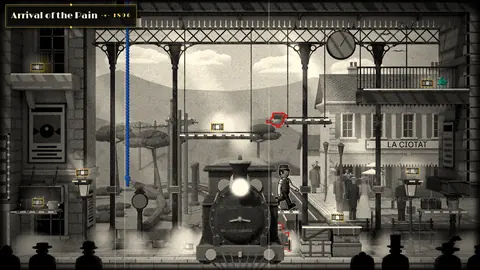 1896
Arrival of a Train at La Ciotat
Our room: Arrival of the Pain
-
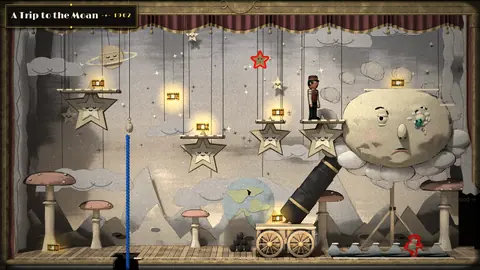 1902
A Trip to the Moon
Our room: A Trip to the Moan
-
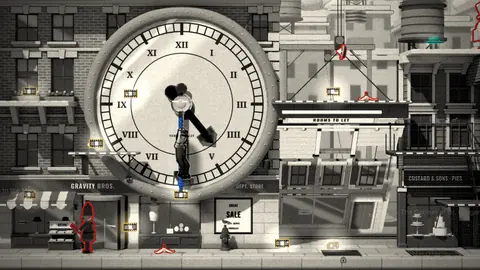 1923
Safety Last!
Our room: Safety Second
Free, in a desktop browser or as a download for Windows, Mac and Linux.
Quick answers
Was Little Nemo the first animated film?
No. J. Stuart Blackton and Émile Cohl had made animated films before it, and McCay is thought to have known their work. McCay claimed to be the first man in the world to make animated films, but critics praise him for the quality of his characters' movement, not for being first.
How many drawings are in Little Nemo?
The film itself says 4,000, and the figure is repeated by most writers. The last frame shows the number "No. 4000" on a drawing held up by a thumb. Whether it is exact is unknown.
Who are Flip, Impie and Little Nemo?
They are characters from McCay's newspaper strip Little Nemo in Slumberland, which began in the New York Herald in October 1905. Nemo is a boy who dreams his way to Slumberland each night, and Flip and Impie are two of his companions there.
Was Little Nemo made in colour?
It was shot in black and white. Several accounts say McCay then hand-coloured the frames after the film proved a success. One reviewer argues that colour was added to the release prints, not to the drawings, as was usual in that era.
Where was Little Nemo first shown?
In cinemas from 8 April 1911, through Vitagraph. By one account McCay began showing it in his vaudeville act on 12 April.
Who was John Bunny?
A comedy star of the Vitagraph company, who appears in the live-action story as one of the friends who take McCay's bet.
Is Little Nemo in the public domain?
Yes, in the United States, because it was published before 1931. McCay died in 1934, so it may be free in other countries too. A modern restoration or a recorded score can have rights of its own.
Is Little Nemo in the National Film Registry?
Yes. The Library of Congress selected it in 2009.
Sources and further reading
- Little Nemo (1911 film), Wikipedia, for the release dates, the framing story, the animated plot, the colour and the Registry year
- Winsor McCay, Wikipedia, for the strip, McCay's early films and his death
- Little Nemo (1911): A Silent Film Review, Movies Silently, 2018, on the framing story, the colour and the characters
- The Cartoons of Winsor McCay, Turner Classic Movies
- “Little Nemo”: National Film Registry #21, Library of Congress, Now See Hear! blog, 2018, quoting Daniel Eagan's Registry essay
- Animation Pioneers, The Marginalian, 2011, on Cohl, Blackton and McCay
- Little Nemo (film), Wikisource, on the public domain status
- Winsor McCay, the Famous Cartoonist of the N.Y. Herald and His Moving Comics, Silent Era, on the release title, date and prints