
Palace Picture House · Programme note
Suspense 1913
A woman alone, a tramp at the door, a husband stealing a car: ten minutes from 1913, the screen split in three, by a director history then mislaid.
By HertzyPertzy · Updated · 6 minute read
In short
Suspense is a one-reel American thriller released on 6 July 1913, directed by Lois Weber and Phillips Smalley under the Rex brand and distributed by Universal. A woman alone with her baby telephones her husband as a tramp breaks in, and he steals a car to race home with the police behind him. It is best known for a frame split in three. Weber, who wrote it and played the wife, became Universal's top director and was then all but forgotten until historians went looking in the 1970s; the film joined the US National Film Registry in 2020.
Watch the film
There is no clean free copy to play or link to here.
Suspense
1913
- Released
- 6 July 1913, United States
- Made by
- Rex brand; distributed by the Universal Film Manufacturing Company. Directed by Lois Weber and Phillips Smalley; scenario by Lois Weber
- Cast
- Lois Weber (the wife), Valentine Paul (the husband), Douglas Gerrard (the pursuer), Sam Kaufman (the tramp)
- Length
- One reel, about 10 minutes; 10 or 11 on current discs
- Format
- Silent, 35 mm, 1.33:1, black and white, English intertitles
- Surviving prints
- British Film Institute National Archive: 35 mm positive, including a British release print. A 35 mm duplicate negative was made from the BFI's prints
- Honours
- Added to the US National Film Registry in 2020
- Copyright
- Public domain in the United States, according to the Silent Era database. Modern transfers and recorded scores have rights of their own, so this page links to no free copy
The story
The maid leaves, and a young mother is alone with her baby. Her husband is working late. A tramp slips in. The wife telephones her husband, and the tramp cuts the line.
The husband steals a car and drives for home with the police behind him, hitting a man smoking in the road on the way. The wife has locked herself and the baby in a room, and the tramp is breaking through its door as he arrives. He overpowers the intruder, and the police who were chasing him take the tramp away instead.
Who made it
Suspense was released on 6 July 1913, a single reel under the Rex brand, distributed by Universal. Lois Weber and Phillips Smalley share the direction, and Weber wrote the scenario and played the wife.
Weber and Smalley married in 1904 and came to film from the theatre. In 1912 they were put in charge of Rex at Universal, and she was writing, directing and acting in about a film a week. The historian Shelley Stamp, author of Lois Weber in Early Hollywood, believes she was the creative lead from the beginning.
How she learned the trade is less clear. Some accounts have her at American Gaumont from 1908, singing for its Chronophone sound shorts; Stamp dates her start to 1910. Alice Guy-Blaché, the French pioneer who ran the Solax studio in New Jersey, and her husband Herbert Blaché later claimed to have given Weber her start. That rests on their word, and it is a claim about a job: the idea that Guy-Blaché taught Weber her trade goes further.
The story was not new. It follows earlier film versions of André de Lorde's play Au téléphone (1901), and D. W. Griffith's The Lonely Villa (1909) tells the same basic tale.
Three places at once
Griffith's answer to a story like this was to cut between victim and rescuer. Suspense does that too, and then does something stranger. While the wife is on the telephone, the frame divides in three: the wife, the husband and the tramp on his way in, all at the same moment.
It was not the first. The film is among the early examples of the split screen, and the historian Kevin Brownlow says the triptych had been developed earlier in Denmark. But the idea suits the story exactly: she can reach him by wire, he cannot reach her, and the man at the door is closer than either.
The rest of the camera work is just as alert, with high-angle shots, point-of-view shots and shots in mirrors, and the car chase is an early one. The historian Russell Merritt called Suspense the best film of the nickelodeon era. Scholars note that the threat to the wife is explicitly sexual.
How it survived
Stamp counts 44 features and at least 150 shorts by Weber, about half the features and many of the shorts surviving. Another count has 153 films, sixteen of them surviving. The early shorts carried no credits, and some of her films were catalogued under her husband's name.
Suspense came through in Britain. The British Film Institute's National Archive holds 35 mm positive prints, and a duplicate negative was made from them. Kino Classics scanned the BFI's British release print for its box Pioneers: First Women Filmmakers (2018), and even that copy shows its age.
The rediscovery that counted was of its director. Historians such as Anthony Slide brought Weber back into view in the 1970s, and in 2020 the Library of Congress added Suspense to the National Film Registry.
One legend did not survive. Lon Chaney is sometimes listed in an uncredited part, but the Chaney researcher Jon Mirsalis, who once named him as the tramp, withdrew that after a frame-by-frame study. The Silent Era database says he is not in it.
Top of the lot, then forgotten
Weber moved on to features early, leaving Universal because its boss, Carl Laemmle, saw little future in them. Stamp counts her four-reel The Merchant of Venice (1914) as the first feature directed by a woman in the United States. By 1916 she was back at Universal as, in Stamp's phrase, its top director, and Where Are My Children?, on abortion and birth control, was the studio's top money-maker. It carries a eugenic argument: it condemns wealthy white women for abortion and urges birth control on working-class and immigrant families.
The Academy Museum says she was reportedly the highest-paid director in the industry in 1916; Stamp says so for a time, on the word of the fan magazine Photoplay. She was the first woman in the Motion Picture Directors Association, and in 1917 she formed Lois Weber Productions.
She was, in her time, considered one of the three great minds of early Hollywood, alongside D.W. Griffith and Cecil B. DeMille.
Shelley Stamp, Infinite Women podcast
She was not alone. In Stamp's account the early industry was loose, demand was close to insatiable, with cinemas changing programmes two or three times a week, and nobody had settled what a director was. Women were also welcomed as moral guardians who lent a rough trade respectability. Universal, by one count, had eleven women directors between 1912 and 1919.
Then the money grew. The cost of a typical film is said to have quadrupled after 1915, and power gathered in a few large studios. Stamp calls 1921 a watershed: independents collapsed, Guy-Blaché's and Nell Shipman's among them. Weber's went the same year, after Paramount refused What Do Men Want? Her marriage ended soon after, and some have blamed that for her decline; Stamp calls it a misreading, since Smalley did not direct at her company. By 1927, Weber wrote, nobody on a set remembered who she was or believed a woman could direct. She died in Hollywood in 1939, aged 60, and in poverty according to the Academy Museum. Her memoir is lost, as is her only sound film, White Heat (1934). The first histories of Hollywood, written as her career ended, left such women out, apart from the stars.
Why it matters
It is a whole thriller in ten minutes. The telephone, the locked door and the race home were old ideas by 1913. Packed into one reel, they still work.
It shows a woman at the controls in 1913. Weber wrote it, shared the direction and played the lead, and, as Stamp stresses, she was one of a generation.
It is the way in to a lost career. Apart from Guy-Blaché, says Stamp, no American woman directed so many films over so long a time.
On the same programme
Some of these films are rooms you can play
These notes come from Reel Trouble, a comedy platformer through film history. Every room in it is a movie set, built from scratch as a parody of a real film, and a fall is never a death: it is a retake.
-
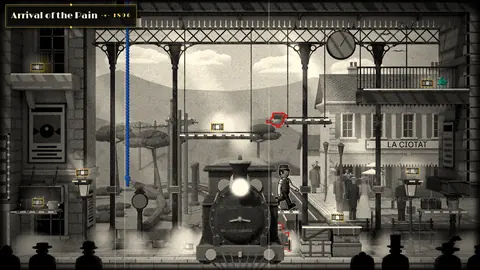 1896
Arrival of a Train at La Ciotat
Our room: Arrival of the Pain
-
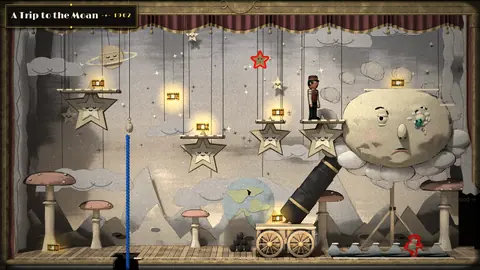 1902
A Trip to the Moon
Our room: A Trip to the Moan
-
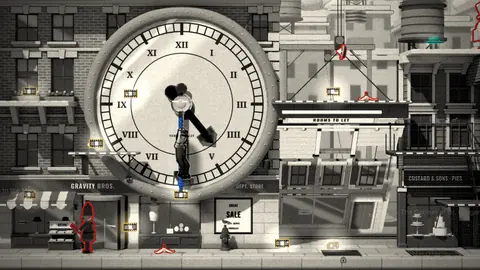 1923
Safety Last!
Our room: Safety Second
Free, in a desktop browser or as a download for Windows, Mac and Linux.
Quick answers
What is Suspense (1913) about?
A woman alone in a house with her baby telephones her husband as a tramp breaks in. The tramp cuts the line, and the husband steals a car and races home with the police behind him, arriving as the tramp breaks through the last door.
Who directed Suspense (1913)?
Lois Weber and Phillips Smalley, who were married, share the direction. Weber also wrote the film and played the wife, and the historian Shelley Stamp regards her as the creative lead of the partnership.
Was Suspense the first film to use a split screen?
No. It is among the early examples, and the historian Kevin Brownlow says the three-part frame, or triptych, had been developed earlier in Denmark.
Is Lon Chaney in Suspense (1913)?
It seems not. He is sometimes listed in an uncredited part, but the Chaney researcher Jon Mirsalis withdrew his own identification of him as the tramp after a frame-by-frame study, and the Silent Era database says he does not appear.
Is Suspense a remake of The Lonely Villa?
It tells the same basic tale. Both belong to a run of films traced to André de Lorde's play Au téléphone (1901), along with Edison's Heard Over the Phone (1908).
Was Lois Weber the highest-paid director in Hollywood?
Reportedly, for a time. The Academy Museum says she was reportedly the highest-paid director in the industry in 1916, and the historian Shelley Stamp says so for a time, on the word of Photoplay magazine.
Did Alice Guy-Blaché teach Lois Weber?
Alice Guy-Blaché and her husband Herbert Blaché later claimed to have given Weber her start in the industry. That is their own account, and it is a claim about a first job rather than about lessons.
Is Suspense (1913) in the public domain?
In the United States, yes: the Silent Era database lists it so. Modern transfers and recorded scores can have rights of their own.
Sources and further reading
- Suspense (1913): credits, format and surviving prints, The Progressive Silent Film List, Silent Era
- Suspense (1913) on home video, Silent Era, on the camera work, the prints and the discs
- Shelley Stamp on Lois Weber, Shelley Stamp, interviewed by Allison Tyra, Infinite Women podcast, transcript
- Lois Weber, Shelley Stamp, Women Film Pioneers Project, as republished by Infinite Women
- Lois Weber Productions, Academy Museum of Motion Pictures, Hollywood Past and Present
- When the Highest Paid Hollywood Director Was a Woman, Sasha Archibald, Literary Hub, 2019, reprinted from The Point
- Suspense (1913 film), Wikipedia: the plot, the play behind it, the critics and the Registry, for the points given here as reported
- Lois Weber, Wikipedia: her early life and the Blachés' claim, for the points given here as reported