
Palace Picture House · Programme note
L'Inferno 1911
A Milan company spent years putting Dante's Hell on screen, copied Gustave Doré's engravings, and sold the result to the world.
By HertzyPertzy · Updated · 5 minute read
In short
L'Inferno is an Italian silent film of 1911, made by Milano Films and directed by Francesco Bertolini, Adolfo Padovan and Giuseppe de Liguoro. It follows Dante and Virgil through the first part of the Divine Comedy, with Hell drawn closely from Gustave Doré's engravings and brought to life by superimposed exposures. Many sources call it the first full-length Italian feature film. It was a hit at home and abroad, and it still survives only in damaged and incomplete prints, patched together by archives.
Watch the film
The whole film: 63 minutes, silent, with English intertitles and no music. A YouTube upload of the English-language print, source unstated.
Played from Wikimedia Commons, which hosts this copy as a public-domain work. Nothing is fetched from there until you press play. If it will not play here, it will on their page.
- Original title
- L'Inferno, released in the United States as Dante's Inferno
- Released
- Premiere at the Teatro Mercadante in Naples in March 1911: 1 March by most sources, 10 March by one. United States roadshows by Monopol Film Company from 1912
- Made by
- Milano Films. Directors Francesco Bertolini, Adolfo Padovan and Giuseppe de Liguoro; cinematographer Emilio Roncarolo, as most sources credit it
- Cast
- Salvatore Papa (Dante), Arturo Pirovano (Virgil), Augusto Milla (Lucifer), Giuseppe de Liguoro, Attilio Motta, Emilise Beretta
- Made
- Begun in 1909, by one account; sources give a production of two to three years and a cost of 100,000 lire, or about a million by another count
- Length
- About 65 to 71 minutes in the surviving prints, depending on the source and the speed; an original of about five reels
- Format
- Silent, 35 mm, 1.33:1; black and white with tinting; Italian intertitles
- Copyright
- Public domain in the United States, as sources list it. Modern restorations and recorded scores have rights of their own
What happens on screen
The film follows the first part of Dante's Divine Comedy. Dante, lost in a dark wood, is met by the poet Virgil, who offers to lead him through Hell. The two pass the gate, cross the river with the boatman, and descend through the circles one by one. The damned are punished according to their sins, and Dante meets some of them. At the bottom stands Lucifer, played by Augusto Milla. Salvatore Papa plays Dante and Arturo Pirovano plays Virgil.
It is a series of tableaux more than a plot, and the audience was expected to know the poem. The intertitles are in Italian and do not translate Dante's lines. The film has come down to us tinted, and the festival that screened it notes colours such as indigo for the realm of Pluto and red for burning souls.
Doré's Hell, and how it was filmed
The film's look was borrowed. The filmmakers took Gustave Doré's engravings for the Divine Comedy, published in 1857 and known around the world, as their model, and Hell is arranged to match his plates: winged demons, a horned Pluto, the Furies. The novelist Matilde Serao is reported to have compared the film to Doré's work. Padovan, a Dante scholar, is credited with shaping its faithfulness to the poem.
The effects were made in the camera. The San Francisco Silent Film Festival describes double, triple and even quadruple exposures, used to build Hell's imagery, and the film also shows horned demons and beasts devouring the damned. One modern reviewer finds some of it crude and some of it ambitious.
Making it, and selling it
Milano Films, a Milan company, put years into the picture. By the San Francisco Silent Film Festival's account, work began in 1909, and the film took over two years, and by some counts over three, to finish. The cost was unprecedented for Italy. One programme note gives 100,000 lire and another account reports about a million, so the figure is uncertain. Three men share the direction. Francesco Bertolini and Adolfo Padovan designed it, and Giuseppe de Liguoro, who also acts, was among its directors.
The first showing was at the Teatro Mercadante in Naples in March 1911. Most sources say 1 March, and one gives 10 March. The distributor Gustavo Lombardo ran a large publicity campaign, and the film sold well in Italy and abroad. In the United States it was handled by Monopol Film Company, which put it out as Dante's Inferno in roadshows from 1912, and the critic W. Stephen Bush is named as one of those who promoted it. One account says it earned over two million dollars there, but that figure is not firmly sourced.
The first Italian feature?
The film is widely called the first full-length Italian feature. The Italian Cultural Institute in New York and the University of Notre Dame both put it that way, and the scholar John P. Welle is cited for the same view. The San Francisco Silent Film Festival is more careful: it ranks the film as the second feature-length film in history, after the Australian The Story of the Kelly Gang (1906). Whether a film counts as a feature depends on where the line of length is drawn, so the title is best read as a statement about its length and ambition.
One account says its length gave cinema owners a reason to raise their prices.
Difficult scenes
Two parts of the picture need a plain word. First, many of the damned appear naked, as they do in Doré's plates, and reviewers have noted the nudity. Second, the eighth circle includes a short, unflattering scene of Muhammad, whose chest bursts open to spill out his entrails. This follows Dante, who places him among the sowers of discord in the eighth circle. Many Muslim viewers will find the image offensive.
Surviving prints and later scores
The film exists today in prints that were damaged, cut and censored. A restoration of 2004 combined British and American prints, from the BFI National Archive and the Library of Congress, and came out on a British DVD with a score by Edgar and Jerome Froese of Tangerine Dream. A new digital restoration from the Cineteca di Bologna, made at L'Immagine Ritrovata, followed for the centenary in 2011, with the shots put back in order and the original tinting recovered. It has been shown with a score by Edison Studio, with Marco Dalpane at the piano, and with a score for saxophone and electronics by Marco Castelli. Further releases with new scores have been announced since.
Why it matters
It put a long literary work on screen. A programme of an hour or more, built on a great poem, showed that cinema could carry a serious subject at length.
It was an Italian export. The film sold well abroad, and the United States saw it as a roadshow attraction.
It shows how a book becomes a picture. Doré gave the filmmakers a ready-made Hell, and they made the engravings move.
It is an old film in a young medium. Its effects are made in the camera, and its tableaux and tinting belong to the cinema of its day.
On the same programme
Some of these films are rooms you can play
These notes come from Reel Trouble, a comedy platformer through film history. Every room in it is a movie set, built from scratch as a parody of a real film, and a fall is never a death: it is a retake.
-
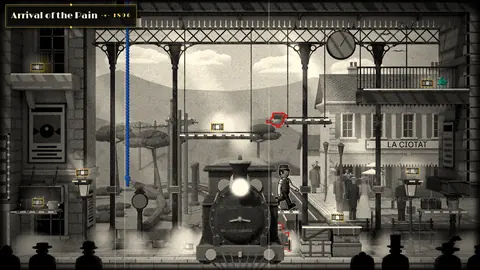 1896
Arrival of a Train at La Ciotat
Our room: Arrival of the Pain
-
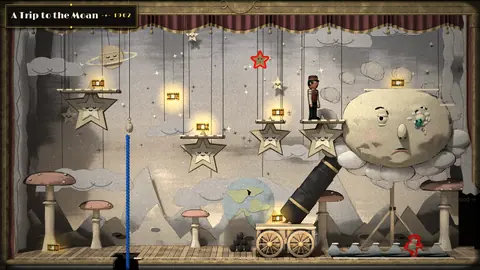 1902
A Trip to the Moon
Our room: A Trip to the Moan
-
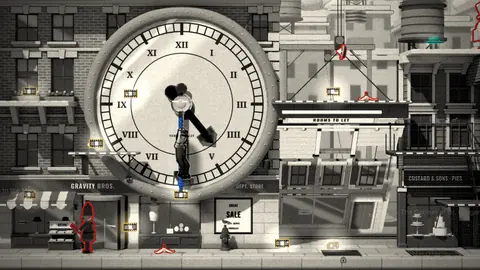 1923
Safety Last!
Our room: Safety Second
Free, in a desktop browser or as a download for Windows, Mac and Linux.
Quick answers
Is L'Inferno (1911) the first Italian feature film?
Many sources call it the first full-length Italian feature film, and the San Francisco Silent Film Festival places it among the very first features anywhere. The claim depends on how a feature is defined, so treat "first" as a description of its length and ambition, not a proven record.
Who directed L'Inferno (1911)?
Three men share the credit: Francesco Bertolini, Adolfo Padovan and Giuseppe de Liguoro. Padovan was a Dante scholar, and de Liguoro also appears on screen.
How long is L'Inferno (1911)?
The restored prints run about 65 to 71 minutes, depending on the source and the projection speed. One archive lists 66 minutes at 16 frames a second.
How did L'Inferno (1911) make its effects?
Mainly by superimposition. The festival's notes describe double, triple and even quadruple exposures, used to float the damned and the demons through Hell, together with colour tinting.
Did L'Inferno copy Gustave Doré?
Closely. The film borrowed the look of Doré's engravings for Dante's poem, including his winged demons and horned Pluto, and contemporary critics compared the two.
Where was L'Inferno (1911) first shown?
At the Teatro Mercadante in Naples, in March 1911. Most sources give 1 March, and one gives 10 March.
Is L'Inferno (1911) in the public domain?
Sources list it as public domain in the United States. Restorations and the scores recorded for them can have rights of their own.
Sources and further reading
- L'Inferno, San Francisco Silent Film Festival, programme note
- L'Inferno, Wikipedia, for the credits, the premiere, the American run, the Muhammad scene and the DVD and Blu-ray releases
- L'Inferno (1911), Silent Era, film database: release, cast, prints and rights
- L'Inferno (1911), Antti Alanen, Film Diary, 2011, on the Cineteca di Bologna restoration, its cost and its foreign sales
- Film: L'Inferno (1911), Notre Dame, Dante at Notre Dame, screening note
- L'Inferno di Dante, film muto, Italian Cultural Institute, New York, screening note on the 2011 restoration
- Dante's Inferno (1911), Moria, film review, on the cast and the nudity