Palace Picture House · Programme note
The Wonderful Wizard of Oz 1910
A thirteen-minute Chicago one-reeler, with a pantomime cow and a papier-mâché cyclone, is the oldest Oz on screen that anyone can still watch.
By HertzyPertzy · Updated · 5 minute read
In short
The Wonderful Wizard of Oz is an American silent short of 1910, made by the Selig Polyscope Company and credited to director Otis Turner. It runs about thirteen minutes and is the earliest surviving screen version of L. Frank Baum's 1900 book. It leans as much on Baum's 1902 stage musical as on the novel, which is why a cow called Imogene walks into Oz. Three more Selig Oz films followed in 1910, and by most accounts none of them survives. The film is in the public domain in the United States.
Watch the film
It is not played on this page: see where to watch it.
Find where to stream, rent or buy it, on JustWatch.
- Release
- 24 March 1910, United States, as most listings give it
- Made by
- Selig Polyscope Company; William Selig credited as producer
- Director
- Otis Turner (the director and writer credits are marked unconfirmed in some listings)
- Cast
- Bebe Daniels, Hobart Bosworth, Robert Z. Leonard, Eugenie Besserer, Winifred Greenwood, Lillian Leighton, Olive Cox; which actor plays which part is partly a matter of scholarly inference
- Source
- L. Frank Baum's novel The Wonderful Wizard of Oz (1900) and the 1902 stage musical made from it
- Length
- One reel, about 13 minutes at 18 frames a second (some listings and reviewers say 10 to 15)
- Format
- Silent, 35 mm, black and white, with English intertitles
- Copyright
- Listed as public domain in the United States. Modern scores and restorations can carry rights of their own
The story
A cyclone lifts Dorothy and her pet cow Imogene out of Kansas and drops them in Oz. Here the Scarecrow is already with her, and so is Toto. The Wizard, in this telling, has announced his retirement and offered his crown to anyone who can free him from the spell of the witch Momba. The party sets off, picks up a Tin Woodman and a Cowardly Lion, and fights the witch with the help of the good witch Glinda.
The story hurries, and a viewer who has not read the book can lose the thread. The film seems to assume that its audience already knows Oz.
From book to stage to screen
L. Frank Baum published The Wonderful Wizard of Oz in 1900. In 1902 he turned it into a musical comedy that opened in Chicago on 16 June, and the Library of Congress notes that its New York run in 1903 was one of the great hits of its day, touring for about another decade. Baum later tried the screen himself with The Fairylogue and Radio-Plays (1908), a travelling show of live actors, hand-tinted slides and film in which he appeared in person. It cost more than full houses could repay and folded within months.
The Selig film is a separate thing. Because Selig Polyscope had a hand in the Fairylogue as well, it was long assumed that the 1910 films were cut from the same footage. That idea fell away once the 1910 film was found: it bears little resemblance to what survives of the Fairylogue. One account says the film was made without Baum's direct input, to meet an obligation to Selig that followed his financial troubles. That rests on one account, and the exact terms are not clear.
What the film does borrow is the stage show. Imogene the cow is a pantomime animal from the musical, where she stood in for Toto, and she is not in the book. Many of the costumes and much of the make-up recall the stage production. Other changes are the film's own. The Scarecrow joins Dorothy before she reaches Oz, there are more companions than the usual four, and the Wicked Witch of the West gives way to Momba, probably a spelling of Mombi, a witch from Baum's later books.
Making it
Selig Polyscope opened a studio in Edendale, Los Angeles, in 1909. Otis Turner, who had directed a stage version of the story, is credited as director, though some listings call that credit unconfirmed.
The credits name Bebe Daniels, Hobart Bosworth, Robert Z. Leonard, Eugenie Besserer, Winifred Greenwood, Lillian Leighton and Olive Cox, without saying who played whom. The Oz historian Mark Evan Swartz concludes that Daniels, then eight or nine, was Dorothy. Scott Simmon, writing about the print, gives her age as nine. Bosworth is generally thought to be the Wizard, and Leonard has been named as the Scarecrow or the Tin Woodman, so sources differ.
The effects are those of the stage. The cyclone is a large papier-mâché ball with the actors fixed to it, the sets are painted, people are swung on wires, and a few tricks are done by stopping the camera. One reviewer finds it primitive beside the work Georges Méliès had done years before. By one account the witch's lair is guarded by giant spiders and flying amphibians, not flying monkeys.
What survives
The film exists, and that was not guaranteed. It is a 35 mm print of about 13 minutes, preserved by George Eastman House, with English intertitles. It appeared in 2004 on the DVD set More Treasures from American Film Archives, with a score adapted by Martin Marks from Paul Tietjens's music for the 1902 stage show. A copy is on the Internet Archive too.
Running times in reference works vary, from ten to fifteen minutes.
The other Oz films of 1910
Selig made three more Oz one-reelers in 1910, so that the Library of Congress counts four in all. Dorothy and the Scarecrow in Oz was released about three weeks after the first. The Land of Oz followed on 19 May, according to a catalogue of silent films, and John Dough and the Cherub completed the set. All three are known only from catalogue entries, based on trade-press descriptions. One catalogue lists the survival of The Land of Oz as unknown, but most accounts call all three lost.
Why it matters
It is the oldest Oz you can watch. Baum's own 1908 show is gone, and the other silent Oz films of the period are lost. Scott Simmon calls it the first surviving film of Baum's Oz.
It shows how Oz was known in 1910. The cow and the costumes come from the stage musical, which was a second way into Oz beside the book.
It is a long way from 1939. No songs, no colour, no ruby slippers, a cow where Toto might be. The 1939 film does not use the stage songs either.
It is free to use. The film is listed as public domain in the United States and the film circulates online.
On the same programme
Some of these films are rooms you can play
These notes come from Reel Trouble, a comedy platformer through film history. Every room in it is a movie set, built from scratch as a parody of a real film, and a fall is never a death: it is a retake.
-
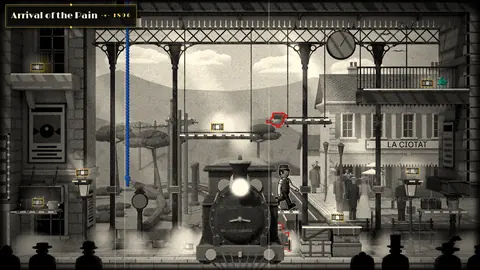 1896
Arrival of a Train at La Ciotat
Our room: Arrival of the Pain
-
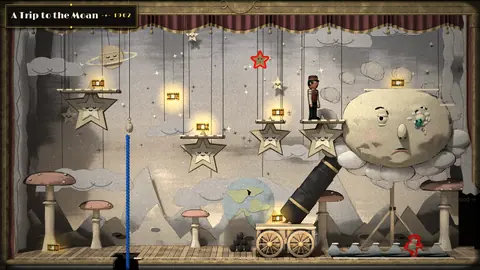 1902
A Trip to the Moon
Our room: A Trip to the Moan
-
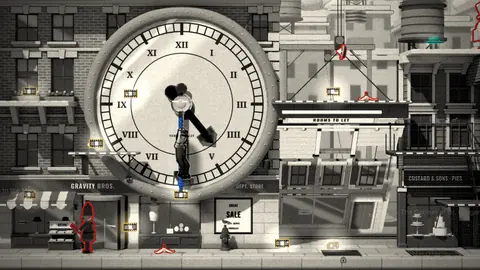 1923
Safety Last!
Our room: Safety Second
Free, in a desktop browser or as a download for Windows, Mac and Linux.
Quick answers
Was there a Wizard of Oz film before 1939?
Yes, several. The earliest that survives is the Selig Polyscope one-reeler of 1910, which runs about 13 minutes. Baum's own 1908 Fairylogue and Radio-Plays, which mixed live actors, slides and film, is lost.
Who played Dorothy in the 1910 Wizard of Oz?
Bebe Daniels, then about nine years old. The credits do not say who plays whom, so her part rests on the work of Oz scholars, but her name is the one always given.
Who was Imogene the cow?
A pantomime cow, played by a performer in an animal costume, who comes from the 1902 stage musical, where she took the place of Toto. She is not in Baum's novel.
How long is the 1910 Wizard of Oz?
About 13 minutes, one reel. Some listings give a different figure, and older prints and slower or faster projection speeds make the exact running time vary.
Did the 1910 film have sequels?
Selig made three more Oz films in 1910: Dorothy and the Scarecrow in Oz, The Land of Oz and John Dough and the Cherub. They are known from catalogues and trade notices, and by most accounts all three are lost.
Is the 1910 Wizard of Oz in the public domain?
In the United States, yes: film databases list it so, as a work of 1910. Baum's novel is also out of copyright there. Any modern score or restoration may be protected separately.
How is the 1910 film different from the 1939 film?
Almost entirely. It is a stage-style short with no songs, a cow, a witch called Momba and painted sets, while the 1939 MGM feature is in colour and has its own songs and look. The two share a story, not a style.
Sources and further reading
- The Wonderful Wizard of Oz (1910 film), Wikipedia: release date, credits, the 2004 release, the sequels
- The Wonderful Wizard of Oz (1910), Turner Classic Movies
- Otis Turner: The Wonderful Wizard of Oz (1910) with Bebe Daniels as Dorothy, Antti Alanen, Film Diary, quoting Scott Simmon's note on the print
- The Wizard of Oz (1910), Richard Scheib, Moria
- The Fairylogue and Radio-Plays, Wikipedia
- The Wizard of Oz: An American Fairy Tale, Library of Congress exhibition
- The Land of Oz (1910), Silent Era, Progressive Silent Film List
- Selig Polyscope Company, Wikipedia
- Copyright status of The Wizard of Oz and related works in the United States, Wikipedia