
Palace Picture House · Programme note
Steamboat Bill, Jr. 1928
Buster Keaton's last independent film ends with a house front falling on him, and a window the height of a man is all that saves him.
By HertzyPertzy · Updated · 6 minute read
In short
Steamboat Bill, Jr. is an American silent comedy of 1928, credited to Charles Reisner, with Buster Keaton as an uncredited co-director and star. Keaton plays a soft college boy sent to join his gruff riverboat father, played by Ernest Torrence. It ends in a cyclone, and in the shot of a two-ton house front falling around Keaton, who stands where an open window will pass over him. It lost money, it was the last film Keaton made with a free hand, and in 2016 it joined the National Film Registry.
Watch the film
The whole film: 70 minutes, silent, with no music. A YouTube upload of unstated source.
Played from Wikimedia Commons, which hosts this copy as a public-domain work. Nothing is fetched from there until you press play. If it will not play here, it will on their page.
- Released
- 12 May 1928, United States (United Artists)
- Made by
- Directed by Charles Reisner, with Buster Keaton as uncredited co-director. Produced by Joseph M. Schenck for Buster Keaton Productions. Story by Carl Harbaugh. Photographed by Dev Jennings and Bert Haines. Technical director Fred Gabourie
- Cast
- Buster Keaton (Willie Canfield Jr.), Ernest Torrence (his father, Steamboat Bill), Tom Lewis, Marion Byron
- Shot
- In 1927 on the Sacramento River in California, where three blocks of city were built to stand for a Mississippi river town. The station scenes were filmed at Freeport
- Cost and takings
- Negative cost put at over $404,000, domestic takings at about $359,000. Estimates of the budget differ: one gives a range of $300,000 to $404,282
- Length and format
- About 70 minutes, 8 reels. 35 mm, black and white, silent, English intertitles
- Registry
- Added to the US National Film Registry in 2016
- Copyright
- Public domain in the United States. Duke's Center for the Study of the Public Domain says it went into the public domain in 1956 through non-renewal. It may still be protected elsewhere, and restorations and new scores have rights of their own
The story
Willie Canfield Jr. (Buster Keaton) is a college boy who comes home to join his father, Steamboat Bill, an old river pilot who is not at all pleased with what he finds. The father is huge, rough and sure that a son should be tougher. Willie, small, polite and out of place, is the son he has. A rival with a smart new steamboat is ruining the family business, and the rival's daughter catches Willie's eye.
The picture is set on the Mississippi but was shot on the Sacramento River in California. Keaton's crew built three blocks of a river town, River Junction, on the bank, and a pier that is said to have cost more than $100,000 on its own. The shoot ran through 1927. It was held up when Keaton broke his nose in a baseball game, by one account.
The father
Charles Reisner is the credited director, a man who had worked on several Chaplin films. Keaton went uncredited as co-director, though the film is generally treated as his. Technical director Fred Gabourie designed the sets and rigged the gags, and had to re-rig them when the plot changed.
The father is Ernest Torrence, a tall Scottish actor, born in Edinburgh in 1878, who trained as a singer and came to Hollywood from Broadway. He was a favourite for villains and bullies, and here he is both fearsome and, in the end, moving. The final reconciliation of father and son is central to the picture. Torrence died in 1933, at 54, after surgery. He made some 49 films.
The hat shop
The father takes his son shopping, because the boy's cap offends him. In the shop, hats are handed in from off screen and Willie tries each one, while the camera stands where a mirror would. Critics have long loved it. A reviewer for Judge thought it worth the price of admission, and Pauline Kael later described Keaton turning into one movie type after another with each hat.
One of the hats is Keaton's own trademark pork-pie. He puts it on, looks startled, and takes it off at once. Keaton, by this time, had given up wearing it on screen. Another hat blows off his head as he leaves the shop.
The cyclone
The film was planned to end in a flood. A real Mississippi flood in 1927 made that a poor idea: one account says producer Joseph Schenck forced the cut, another that the studio dropped it, and that Keaton, already over schedule and over budget, offered a cyclone. His crew drove the wind with six large propellers powered by Liberty aircraft engines, and used cranes and cables to lift buildings and props, and Keaton clinging to a tree trunk. The sequence also brings in his vaudeville childhood, with a disappearing cabinet and a ventriloquist's dummy.
The cyclone is the last third of the picture, and in it comes the shot everybody remembers. A house front falls toward Keaton, who stands on a spot marked in the ground, and the open window in it passes around him. By most accounts the front was real, about two tons, not a model. The window is said to have left him about two inches on each side. Ropes held the wall upright until three men on the roof cut them as the director called for action.
How the crew felt is told two ways. Keaton later said that cameramen, electricians and extras prayed during the shot, and that he did too. Another account says that many of them left the set rather than watch. Keaton had tried the gag before, in his shorts, with far flimsier scenery. This time he is said to have done it more or less out of anger, and remarked afterwards that he would never otherwise have tried it. It was a bad moment: the day before the shot, by the San Francisco Silent Film Festival's account, Schenck told him that his studio was closing.
The flop, and the end of the studio
The cyclone cost heavily. One source puts it at an extra $25,000, another at a third of the whole budget, and the two do not agree. The picture opened in the United States in May 1928, on a negative cost put at over $404,000, and took only about $359,000 at home. It was the biggest loser among Keaton's United Artists films. Reviews were mixed: Variety loved it, while the New York Times found it a gloomy comedy.
It was the last film Keaton made in charge of everything, from the idea to the cutting room. Schenck, his producer and brother-in-law, closed Buster Keaton Productions around the end of the shoot and moved him to MGM. The reasons usually given are Schenck's wish to concentrate on United Artists, the pull of the big studios and the coming of sound. The disappointing takings of The General and College are said to have weighed on both men's minds, though one historian does not blame them for the move. At MGM he was cast mostly as an actor, and he later called the move the worst mistake of his life.
Why it matters
It holds the most famous stunt in screen comedy. A real wall, a real window and a man who does not move. Keaton's reaction, a pause, a rub of the neck and a wary look back as he walks away, is half the joke.
It was rediscovered. It flopped, and Kael called it one of his least-known features and possibly among his best. The Library of Congress chose it for the National Film Registry in 2016, and critics today often call it his most mature film.
It may have lent a cartoon its title. Disney's Steamboat Willie came six months after Keaton's film, in November 1928, and it is often called a parody of it. Both names may equally come from an old song, "Steamboat Bill", and some writers think the likeness stops at the title.
It belongs to everyone, in the United States at least. Its copyright was not renewed and lapsed in 1956, by the account of Duke's public domain centre.
On the same programme
Some of these films are rooms you can play
These notes come from Reel Trouble, a comedy platformer through film history. Every room in it is a movie set, built from scratch as a parody of a real film, and a fall is never a death: it is a retake.
-
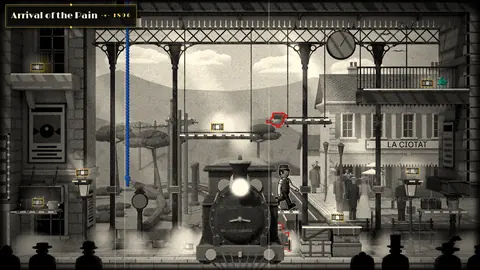 1896
Arrival of a Train at La Ciotat
Our room: Arrival of the Pain
-
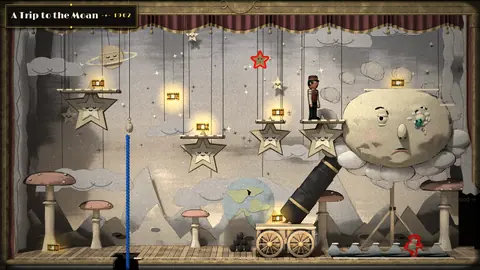 1902
A Trip to the Moon
Our room: A Trip to the Moan
-
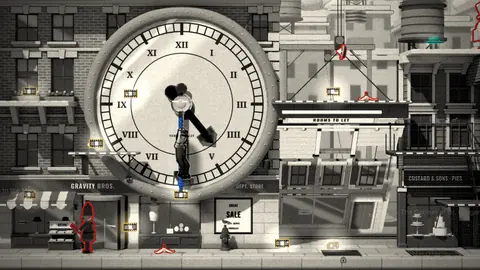 1923
Safety Last!
Our room: Safety Second
Free, in a desktop browser or as a download for Windows, Mac and Linux.
Quick answers
What is Steamboat Bill, Jr. about?
Willie Canfield Jr. comes home from college to join his father, a gruff old river pilot, who is ashamed of him and tries to toughen him up. A rival's new steamboat, a love affair across the feud and a cyclone give the son his chance to prove himself.
How did Buster Keaton survive the falling house in Steamboat Bill, Jr.?
He stood on a marked spot where an open window in the falling wall would pass over him. By most accounts the front was a real two-ton wall, held up by ropes that men on the roof cut when the cameras ran, and the window left him about two inches on each side.
Was the house front in Steamboat Bill, Jr. real?
Yes, by the usual accounts: a genuine house front, not a model, rigged by Keaton's technical director Fred Gabourie. Earlier versions of the gag in Keaton's shorts used much lighter scenery.
Did Steamboat Bill, Jr. make money?
No. One account puts its negative cost at over $404,000 and its American takings at about $359,000, the biggest loss among Keaton's United Artists features.
Was Steamboat Bill, Jr. Buster Keaton's last independent film?
Yes. It was the last film he made under his own control. Joseph Schenck, his producer and brother-in-law, shut down the independent studio around the end of the shoot, and Keaton moved to MGM.
Is Steamboat Willie a parody of Steamboat Bill, Jr.?
It is often said to be, and Disney's cartoon came six months after Keaton's film. But both titles may owe as much to the old song "Steamboat Bill", and some writers doubt that the link goes beyond the name.
Is Steamboat Bill, Jr. in the National Film Registry?
Yes. The Library of Congress added it in 2016.
Is Steamboat Bill, Jr. in the public domain?
In the United States, yes: the Duke Center for the Study of the Public Domain says its copyright lapsed in 1956 because it was not renewed. Restorations and recorded scores can have rights of their own, and it may be protected in other countries.
Sources and further reading
- Steamboat Bill, Jr., Wikipedia, for the release date, credits, budget figures, the cyclone's cost, the cut flood ending and the Steamboat Willie link
- Steamboat Bill, Jr. (1928), Turner Classic Movies
- Behind the Camera: Steamboat Bill, Jr., Turner Classic Movies, on the shoot, the studio's closure, the cost and the takings
- Trivia: Steamboat Bill, Jr., Turner Classic Movies, on the stunt, the hat scene and the locations
- The Critics' Corner: Steamboat Bill, Jr., Turner Classic Movies, on the reviews, the hat shop and Torrence
- Steamboat Bill, Jr., San Francisco Silent Film Festival, essay
- Steamboat Bill, Jr., Senses of Cinema, Great Directors / Cteq
- Anatomy of a Scene: Buster Keaton's narrow escape in Steamboat Bill, Jr., Far Out Magazine
- Public Domain Day 2024, Duke Center for the Study of the Public Domain
- Ernest Torrence, Wikipedia