
Palace Picture House · Programme note
Plane Crazy 1928
Walt Disney lost his rabbit, found a mouse, and could not sell the mouse's first film until a second cartoon with sound made it worth a second look.
By HertzyPertzy · Updated · 5 minute read
In short
Plane Crazy is a short American cartoon of 1928, directed by Walt Disney and Ub Iwerks, in which Mickey Mouse builds a plane in imitation of Charles Lindbergh and takes Minnie for a flight. It was the first Mickey Mouse cartoon made, though not the first released: it was shown silent in 1928, found no distributor, and came out with a soundtrack in 1929, after Steamboat Willie had made Mickey a success. The silent version entered the US public domain on 1 January 2024.
Watch the film
The whole film: about 6 minutes, from the 1929 sound re-release with its soundtrack muted, so silent, with no music.
Played from Wikimedia Commons, which hosts this copy as a public-domain work. Nothing is fetched from there until you press play. If it will not play here, it will on their page.
- Released
- Silent test screening in Hollywood on 15 May 1928 (one source says 17 May); general release with sound on 17 March 1929
- Made by
- Disney Cartoons, Hollywood. Directed by Walt Disney and Ub Iwerks
- Animation
- Ub Iwerks, by most accounts the only animator
- Characters
- Mickey Mouse, Minnie Mouse and, briefly, Clarabelle Cow
- Music
- Soundtrack added in the winter of 1928 to 1929; the score is credited to Carl Stalling, recorded in October 1928
- Length
- About six minutes, one reel
- Format
- Black and white; first made silent, reissued with synchronised sound
- Copyright
- The silent 1928 version entered the US public domain on 1 January 2024; the sound version, which carries a 1929 notice, on 1 January 2025. Mickey Mouse as a trade mark remains Disney's
The story
Mickey Mouse decides to fly like Charles Lindbergh. His first aeroplane is a wreck, which he promptly flies into the ground. He rebuilds it from a roadster, bits of the wreckage and a turkey's tail, and Minnie, who has come to see him off, gives him a horseshoe for luck. They take off together.
The plane is not under control for long. Mickey, flying a few feet above ruin, turns his attention to Minnie and tries to kiss her. She does not want to be kissed. She jumps out with her bloomers as a parachute and floats down. Mickey crashes, and the horseshoe, flung off in the struggle, comes back like a boomerang and knocks him out. Clarabelle Cow rides the plane briefly on the way. The whole thing runs about six minutes.
It is worth saying plainly what the kiss is. This early Mickey is a pest, pushy and mischievous, and the film is built round a joke at Minnie's expense. He had yet to become the polite figure of later years. Her refusal is the plot.
After Oswald
The film exists because of a loss. In 1928 Disney made cartoons about Oswald the Lucky Rabbit for the distributor Charles Mintz, who worked with Universal. When Disney went to New York to ask for better terms, Mintz offered less, and Disney refused. Mintz hired most of his animators away. Disney, by the usual account, thought of a new character on the train home, a mouse that he and Ub Iwerks would own outright. By one account he first called it Mortimer, and his wife talked him into Mickey.
Iwerks stayed, and for Plane Crazy he worked apart from the studio's other animators, who were still finishing the last Oswald films for Mintz. He is credited with animating the film himself, and by one account he drew some 700 drawings a day. Sources differ over details: one puts the whole job at about two weeks, another counts more than 8,000 drawings from April 1928. Hugh Harman and Rudolf Ising are sometimes said to have helped, which is only speculation. The pilot's theme was chosen to ride Lindbergh's fame: he had flown the Atlantic alone in 1927.
The silent film was reported to have cost about $1,772. Disney filed for copyright on 26 May 1928.
A test screening and no takers
The film was shown to a theatre audience and possible distributors in Hollywood on 15 May 1928, by most accounts. A Mental Floss article gives 17 May and a single day in Los Angeles. By one account Disney coached the organist on how to accompany it, and the audience laughed and applauded. An executive from MGM saw it. No distributor made an offer. Disney's agent in New York, E. J. Denison, tried and, by one account, withdrew.
Disney tried again with a second silent Mickey, Gallopin' Gaucho, and the two films did not sell either. Then he turned to a third, Steamboat Willie, with a synchronised soundtrack, released in November 1928. It was a hit, and it made Mickey a star. Plane Crazy was the first Mickey film made and the third released.
The sound version
The film was given a soundtrack in the winter of 1928 to 1929. Carl Stalling is credited with the score, recorded on 26 October 1928, and another account puts the new soundtrack in December 1928. The sound film opened at the Mark Strand Theatre in New York on 17 March 1929. Columbia Pictures reissued it after Disney changed distributors.
How much the sound version changed the picture is unknown. The original silent version is not publicly available, so the copies in circulation are the later ones.
Who owns the mouse
Under United States law the silent version, registered in 1928, became public domain on 1 January 2024. Duke's Center for the Study of the Public Domain, whose list names it beside Steamboat Willie, notes that the Catalog of Copyright Entries says as much. The sound version was registered in 1930, but the copies in circulation carry a 1929 notice in Roman numerals, and the Center reckons the earlier date counts: 1 January 2025.
That frees the early Mickey and Minnie as they appear in these films. It does not free later versions of Mickey, which keep their own new creative additions under copyright. Disney's trade marks are a separate matter: they do not expire on a fixed schedule, and they restrict uses that would mislead the public about who made a work. Outside the United States the position differs by country, and the Center says the first Mickey and Minnie appear to be free in the UK and much of the EU, with exceptions such as Germany. Check before you assume.
As for Oswald, Disney got him back in 2006 in a trade with NBCUniversal, which received the sportscaster Al Michaels.
Why it matters
It is where Mickey begins. The mouse who became the most famous cartoon character in the world made his first film here, with Minnie at his side and Clarabelle Cow as a passing extra.
It shows a studio saved by a hunch. The film that failed in 1928 sold in 1929, once sound had made Steamboat Willie a success. The same cartoon, with a soundtrack, found its audience.
It shows how much one animator did. Iwerks, drawing alone and fast, gave Disney a character from nothing in a matter of weeks.
It is a test case for the public domain. When the silent film entered the US public domain, the early Mickey and Minnie became free to reuse as they appear in it, while Disney's trade marks stayed in force. The line between the two is what readers now ask about.
On the same programme
Some of these films are rooms you can play
These notes come from Reel Trouble, a comedy platformer through film history. Every room in it is a movie set, built from scratch as a parody of a real film, and a fall is never a death: it is a retake.
-
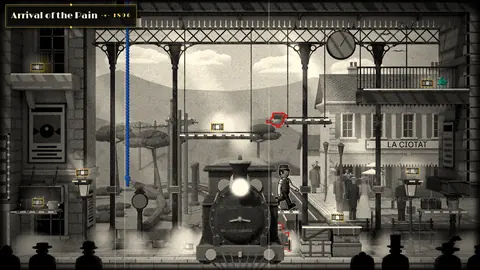 1896
Arrival of a Train at La Ciotat
Our room: Arrival of the Pain
-
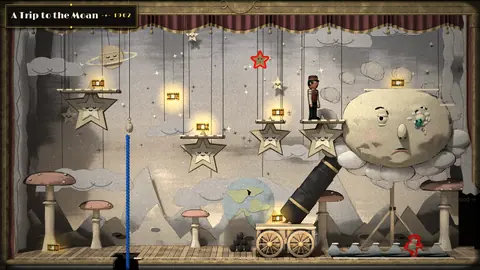 1902
A Trip to the Moon
Our room: A Trip to the Moan
-
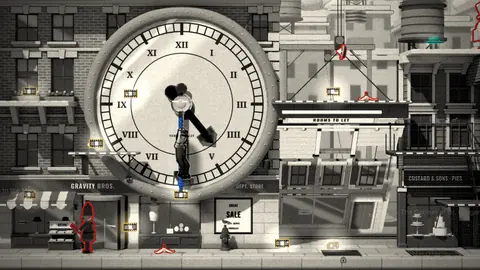 1923
Safety Last!
Our room: Safety Second
Free, in a desktop browser or as a download for Windows, Mac and Linux.
Quick answers
Was Plane Crazy the first Mickey Mouse cartoon?
It was the first made, but not the first released. It was finished silent in 1928, failed to find a distributor, and reached cinemas with sound in 1929, after Steamboat Willie.
Who animated Plane Crazy?
Ub Iwerks, by most accounts working alone and fast, apart from the studio's other animators. Some writers wonder whether Hugh Harman and Rudolf Ising helped, but that is guesswork.
What is Plane Crazy about?
Mickey builds a plane, copying Charles Lindbergh, and takes Minnie up in it. He tries to kiss her, she leaps out with her bloomers as a parachute, and Mickey crashes.
Why did Disney make Mickey Mouse?
In 1928 Disney lost the rights to Oswald the Lucky Rabbit to the distributor Charles Mintz, and most of his animators went with Mintz. By the usual account he then came up with a new character he would own.
When was Plane Crazy first shown?
As a silent test at a Hollywood theatre on 15 May 1928, by most accounts. One article gives 17 May. The sound version opened in New York on 17 March 1929.
Is Plane Crazy in the public domain?
In the United States the silent 1928 version is, since 1 January 2024, and Duke's Center for the Study of the Public Domain expects the sound version, with its 1929 notice, to follow on 1 January 2025. Disney's trade marks are a separate matter.
Can I use Mickey Mouse now?
Duke's Center says only the early characters as they appear in these films are free, not later versions, and that Disney's trade mark rights do not expire on a fixed date. They restrict uses that would mislead people about who made a work.
Sources and further reading
- Plane Crazy, Wikipedia: dates, plot, production, copyright registrations
- Public Domain Day 2024, Center for the Study of the Public Domain, Duke University School of Law
- Mickey Mouse: what enters the public domain, Center for the Study of the Public Domain, Duke University School of Law, on copyright and trade marks
- 11 High-Flying Facts About Plane Crazy, Stacy Conradt, Mental Floss, 2017
- Plane Crazy About Mickey Mouse, MousePlanet: production, screening and release history
- How Walt Disney launched the cartoon character Mickey Mouse, History Hit
- Oswald the Lucky Rabbit, Wikipedia: the loss of Oswald in 1928 and its return to Disney in 2006