
Palace Picture House · Programme note
Steamboat Willie 1928
Walt Disney lost one cartoon rabbit, made a mouse, sold his car to give him sound, and the result became free to copy in 2024.
By HertzyPertzy · Updated · 6 minute read
In short
Steamboat Willie is a seven-and-a-half-minute American cartoon of 1928, directed by Walt Disney and animated almost entirely by Ub Iwerks. It was the first Mickey Mouse cartoon released, though the third made, and it opened in New York on 18 November 1928. Careful sources do not call it the first cartoon with sound; they say it was the first with sound tightly synchronised to the action, and the first to win real attention. Its copyright ran out in the United States on 1 January 2024.
Watch the film
The whole cartoon: seven and a half minutes, with its sound, in Disney's own transfer.
Played from Wikimedia Commons, which hosts this copy as a public-domain work. Nothing is fetched from there until you press play. If it will not play here, it will on their page.
- Premiere
- 18 November 1928, Colony Theatre, New York, on a bill with the feature Gang War
- Made by
- Walt Disney (director, story) and Ub Iwerks (animation, and by most accounts the story too), at the Walt Disney Studio, Hollywood. Wilfred Jackson animated a scene of Minnie, and Les Clark is credited with another
- Voice
- Walt Disney himself: Mickey's squeaks and the parrot's lines
- Music
- "Turkey in the Straw" and "Steamboat Bill". Sources differ on the arranger: Carl Stalling is named in the Library of Congress essay, Wilfred Jackson and Bert Lewis elsewhere
- Sound system
- Pat Powers's Cinephone, recorded in New York in September 1928; distributed by Powers's Celebrity Productions
- Length and format
- About seven and a half minutes, black and white, 35 mm, 1.33:1, with synchronised soundtrack
- Honours
- Added to the United States National Film Registry in 1998
- Copyright
- Public domain in the United States since 1 January 2024: this film and Mickey and Minnie as they appear in it. Later versions of the characters and Disney's trade marks are not free. Other countries have their own terms
The story
A steamboat on a river. Mickey Mouse is at the wheel, whistling. Captain Pete, a large cat in a captain's cap, orders him off the bridge and aims a kick. Mickey blows a raspberry, Pete misses, and Mickey slips on a bar of soap. A parrot laughs at him, so he throws a bucket of water over it.
At Podunk Landing the boat takes on a cow, which Mickey loads by shoving hay down its throat. Minnie runs up too late, and Mickey hauls her aboard with the cargo crane, hooked by her bloomers. She drops a ukulele and her sheet music, and a goat eats both. Turning the goat's tail makes it play "Turkey in the Straw", and the two of them then play the livestock like a band: a cat's tail, a goose's throat, a row of piglets, a sow. Pete is not amused, and Mickey ends up peeling potatoes. The parrot returns, and a half-peeled potato sends it into the river.
Almost everything is pantomime. The only plain speech is the parrot's, "Help! Help! Man overboard!", and it was spoken by Walt Disney himself.
Where Mickey came from
Disney's distributor in 1928 was Charles Mintz, and the character was Oswald the Lucky Rabbit, who was owned by Universal. In February Disney went to New York to negotiate and found that Oswald was not his to keep. Mintz had also signed most of Disney's animators. The story goes that Walt thought up a mouse on the train home. Dave Smith, the Disney company's first archivist, says only that Walt "may have been recalling" a mouse that lived in his Kansas City studio, and that after his return he "met with several of his staff members, and they came up with Mickey Mouse". Ub Iwerks was tasked with designing the character.
Two silent Mickey cartoons followed, Plane Crazy and The Gallopin' Gaucho, and Disney could not sell either to a distributor. The Jazz Singer had opened the previous autumn, and Disney bet on sound. Steamboat Willie was the third Mickey cartoon made and the first released.
Who made it
Disney and Iwerks are credited as directors. Iwerks animated almost the whole film himself, by Smith's account. Wilfred Jackson animated Minnie running along the bank, his first animation, and Les Clark is credited with the hay-and-cow scene. Smith says Carl Stalling, a friend from Kansas City, composed the score. Other accounts name Jackson and Bert Lewis as arrangers, so the credit is not settled. The cartoon cost $4,986.69 according to Roy Disney's ledger. To pay for it Walt took out a new mortgage and, by his archivist's account, sold his car, a Moon.
The title nods at Buster Keaton's Steamboat Bill, Jr., also of 1928. Mickey whistles "Steamboat Bill", and the other tune is the folk song "Turkey in the Straw".
The sound
Nothing like this had been done, so Disney's team felt their way. Jackson suggested a metronome, and made the first bar sheet to lay out sound against pictures. To test the idea Disney put a projector outside a studio window with a bedsheet for a screen. Behind the sheet his staff made simple noises, and Jackson played the two tunes on a harmonica. An audience of staff wives liked it.
Disney found nobody on the West Coast to record it, so he went to New York. He passed over the big systems and settled with Pat Powers, who sold a process called Cinephone. The first recording, on 15 September 1928, went badly: the orchestra, of 15 to 17 players depending on the source, with three sound-effects men, could not keep up with the picture. A bouncing ball was added to the film so the conductor could follow it. The second session, two weeks later, worked. The band is usually named as the Green Brothers Novelty Band, conducted by Carl Edouarde.
Premiere and reception
Harry Reichenbach, who ran the Colony Theatre on Broadway, offered a two-week run. The cartoon opened on 18 November 1928, ahead of the feature Gang War. Reviews were warm: Variety praised the synchronisation, and the New York Times found it fun. Disney was paid $500 a week, and the film made the studio's name. Disney later counted 18 November as Mickey's birthday.
In the 1950s one gag was reportedly cut for television: the sow played like an accordion. The uncut cartoon is now on home video and Disney's streaming service.
What "first" means
Disney's own archive calls it the first cartoon with synchronised sound. Film historians are more careful. The Fleischer studio put sound into its Song Car-Tunes from 1924, though without perfect sync. Paul Terry's Dinner Time also had sound, came out in October 1928, and did not do well. Variety, in 1928, is reported to have said it was not the first synchronised cartoon but the first to attract favourable attention.
Public domain
Under the original 56-year term, Steamboat Willie would have lapsed in 1984. The 1976 law lengthened it, so that it was due to expire in 2004. Then the 1998 Copyright Term Extension Act added twenty years, to 95 in all, and the film entered the United States public domain on 1 January 2024. Duke's Center for the Study of the Public Domain is clear on the limits. What is free is this film and the silent Plane Crazy, and Mickey and Minnie as they look in them. Not free: later versions, such as the Mickey of Fantasia, and Disney's trade marks on the name and images. Outside the United States other terms apply.
Why it matters
It made Disney. Smith calls the success "phenomenal", and says it put Walt Disney in the animation business to stay.
It showed what synchronised sound could do for a cartoon. Every squeak, whistle and note lands on the action it belongs to. Music that follows the picture beat for beat is still called mickey-mousing.
It is a lesson in who owns a character. The loss of Oswald is why Mickey exists, and the question of how long Disney could keep him hung over American copyright law for decades. Critics nicknamed the 1998 extension the Mickey Mouse Protection Act.
It is where Mickey Mouse begins. Disney has counted 18 November 1928 as his birthday ever since, and in 1998 the Library of Congress added the film to the National Film Registry.
On the same programme
Some of these films are rooms you can play
These notes come from Reel Trouble, a comedy platformer through film history. Every room in it is a movie set, built from scratch as a parody of a real film, and a fall is never a death: it is a retake.
-
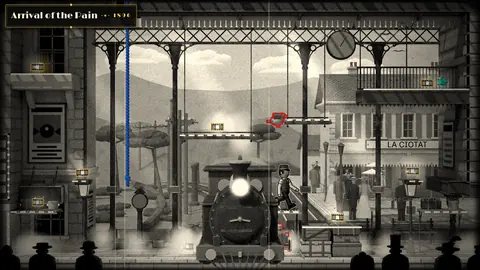 1896
Arrival of a Train at La Ciotat
Our room: Arrival of the Pain
1896
Arrival of a Train at La Ciotat
Our room: Arrival of the Pain
-
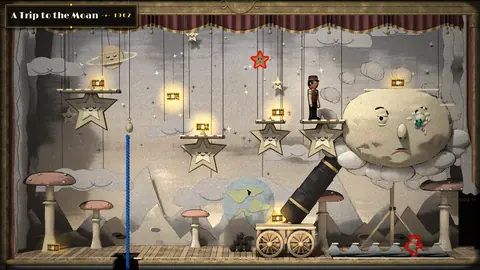 1902
A Trip to the Moon
Our room: A Trip to the Moan
1902
A Trip to the Moon
Our room: A Trip to the Moan
-
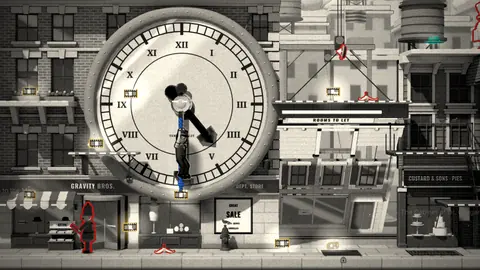 1923
Safety Last!
Our room: Safety Second
1923
Safety Last!
Our room: Safety Second
Free, in a desktop browser or as a download for Windows, Mac and Linux.
Quick answers
What happens in Steamboat Willie?
Mickey pilots a river steamboat while whistling, and Captain Pete throws him off the bridge. At a landing Mickey takes on a cow and hoists Minnie aboard by her bloomers. Then they play the animals as instruments to "Turkey in the Straw", until Pete sends Mickey to peel potatoes.
Was Steamboat Willie the first Mickey Mouse cartoon?
It was the first released, but the third made. Plane Crazy and The Gallopin' Gaucho were made first, in 1928, as silent films, and no distributor would take them.
Was Steamboat Willie the first cartoon with sound?
No. The Fleischer brothers' Song Car-Tunes had sound from 1924, and Paul Terry's Dinner Time had sound too, in October 1928. Disney's claim is the first cartoon with sound closely synchronised to the picture that made a hit.
Who created Mickey Mouse?
Walt Disney conceived him in 1928 after losing the rights to Oswald the Lucky Rabbit, and Ub Iwerks designed and animated him. Disney's own archive says Iwerks was tasked with designing the character, with input from Walt.
Is Steamboat Willie in the public domain?
In the United States, yes, since 1 January 2024. That covers this film and Mickey and Minnie as they look in it. Later versions and Disney's trade marks remain protected, and other countries have their own rules.
When was Steamboat Willie released?
It opened at the Colony Theatre in New York on 18 November 1928, a date Disney has used since as Mickey's birthday.
Why is it called Steamboat Willie?
The setting is a nod to Buster Keaton's Steamboat Bill, Jr. of 1928, and Mickey whistles the old song "Steamboat Bill". Willie is a pet form of Bill, so the mouse is a small Steamboat Bill.
Were scenes cut from Steamboat Willie?
One gag, in which Mickey pulls piglets' tails and plays the sow like an accordion, is reported to have been cut in the 1950s for television. The full version is back on home video and on Disney's streaming service.
Sources and further reading
- Steamboat Willie, Dave Smith, Chief Archivist Emeritus of the Walt Disney Company, essay for the Library of Congress National Film Preservation Board
- Mickey, Disney, and the Public Domain: a 95-year Love Triangle, Jennifer Jenkins, Duke Center for the Study of the Public Domain
- Public Domain Day 2024, Duke Center for the Study of the Public Domain
- Steamboat Willie, D23, the official Disney fan club's A to Z
- National Film Registry, D23, the official Disney fan club's A to Z
- The Evolution of Mickey Mouse, The Walt Disney Family Museum
- Secrets of Steamboat Willie, Mouse Planet, citing Michael Barrier and Roy Disney's ledger
- Steamboat Willie (1928) by Walt Disney, file page, Wikimedia Commons, on its source and rights
- Steamboat Willie, Wikipedia: the plot, the reviews, the staff, the early sound cartoons and the cut scene, given here as reported