
Palace Picture House · Programme note
The General 1926
Buster Keaton's Civil War chase put a real locomotive into a river, lost money, helped end his independence, and now tops many lists of great comedies.
By HertzyPertzy · Updated · 6 minute read
In short
The General is a 1926 American silent comedy directed by Buster Keaton and Clyde Bruckman, in which Keaton plays a Confederate engineer who chases the Union spies who have stolen his locomotive. It was shot in Oregon, with real trains and a real bridge to burn. It was expensive, reviewed coolly and lost money, and soon afterwards Keaton gave up his independent studio. It was in the first class of films chosen for the National Film Registry in 1989, and critics now rank it among the best comedies ever made.
Watch the film
The whole film: 76 minutes, silent, with no music.
Played from Wikimedia Commons, which hosts this copy as a public-domain work. Nothing is fetched from there until you press play. If it will not play here, it will on their page.
- Release
- Sources differ on the first showing: Tokyo on 31 December 1926, or El Paso, Texas, on 25 December (the AFI Catalog). New York and general release: 5 February 1927
- Made by
- Directed by Buster Keaton and Clyde Bruckman. Produced by Joseph M. Schenck for Buster Keaton Productions, distributed by United Artists. Written by Keaton, Bruckman, Al Boasberg and Charles Smith. Photographed by Dev Jennings and Bert Haines
- Cast
- Buster Keaton (Johnnie Gray), Marion Mack (Annabelle Lee), Glen Cavender (the Union captain), Jim Farley, Frederick Vroom, and Keaton's father Joe Keaton
- Based on
- The 1862 Andrews Raid, or Great Locomotive Chase, as told in William Pittenger's memoir; the AFI Catalog gives Daring and Suffering (Philadelphia, 1863)
- Shot
- Cottage Grove, Oregon, from early summer 1926 to September, on the Oregon, Pacific and Eastern Railway, with some other shooting in California
- Cost and takings
- The budget is said to have grown from $400,000 to about $750,000. Takings in the United States are usually given as about $474,000
- Length and format
- About 77 minutes (AFI Catalog: 7,500 feet, 8 reels). 35 mm, black and white, silent
- Copyright
- Public domain in the United States: Duke's Center for the Study of the Public Domain notes that the copyright was apparently not renewed in the 1950s, and films of 1926 became free there in any case on 1 January 2022. It may still be protected in other countries, and restorations and new scores have rights of their own
The story
Johnnie Gray (Buster Keaton) is a railway engineer in Georgia at the start of the Civil War. He loves two things: his locomotive, The General, and Annabelle Lee (Marion Mack). When war comes, Johnnie tries to enlist and is turned away, on the sensible grounds that he is worth more to the army driving a train. Annabelle takes this to mean that he is a coward, and will not speak to him until he is in uniform.
A year later, Union spies slip into the South and steal The General while its passengers are at lunch. Annabelle happens to be aboard. Johnnie chases them north, first on foot, then on a handcar, then on another engine. He rescues Annabelle, takes back his train, and rides south again with the Union army behind him. He warns the Confederate lines of the coming attack and wins the battle more or less by accident. At the end he gets a uniform and the girl.
The real chase
The plot comes from fact. In 1862 a party of Union raiders seized a Confederate locomotive called the General in Georgia and ran north with it, wrecking the line as they went, and were chased by Southern railwaymen. It is known as the Andrews Raid, or the Great Locomotive Chase. William Pittenger, one of the raiders, wrote it up, and the AFI Catalog names his book, Daring and Suffering, published in Philadelphia in 1863, as the film's source.
Keaton turned the story round. Pittenger's book is the raiders' account, and the film's hero is one of the pursuers. The reason usually given is that Keaton did not think an audience would accept Southerners as the villains. Modern critics who admire the film as a comic masterpiece also point out what that choice means: the Confederacy is the home side, its cause is never questioned, and slavery goes unmentioned. In that it is typical of the American cinema of its day.
The shoot in Oregon
Keaton and Clyde Bruckman directed, with Joseph Schenck producing for Keaton's own company and United Artists distributing. Dev Jennings and Bert Haines photographed it. Keaton took the company to Cottage Grove, Oregon, in the summer of 1926. By one account the real General, by then a museum piece in Tennessee, was not to be had for a comedy about the war. Oregon offered old logging railways with the narrow track of the 1860s, forest that could pass for Georgia, and lower costs.
The company came with cannon, costumes and carriages, and bought or borrowed locomotives from the Oregon, Pacific and Eastern Railway: two or three period engines, depending on the source. About 500 men of the Oregon National Guard played both armies in the battle scenes. The wood-burning engines set the dry country alight more than once, and one fire is said to have taken 600 men to put out, Keaton among them.
The stunts were Keaton's own. He sits on the coupling rod between the driving wheels while the engine moves off. He rides the cowcatcher holding a railway sleeper, and throws it to knock another off the track ahead. He was knocked unconscious during the shoot, and a brakeman's foot was run over, which led to a lawsuit.
The bridge
The great shot is the Union train crossing a bridge that Johnnie has set on fire. The bridge gives way and a full-size locomotive falls into the Row River. A trestle was built for it, and several cameras filmed the single take. The town took the day off to watch, and thousands of people are said to have lined the banks.
The shot cost about $42,000, and it is regularly called the most expensive single shot of the silent era. The AFI Catalog words it more carefully: the most expensive scene in silent films up to that time. The engine lay in the riverbed for years as a curiosity. By most accounts it was cut up for scrap during the Second World War, and bits of track and steel are said to show at low water still.
The flop
The film was expensive for a Keaton picture. Its budget is said to have grown from $400,000 to about $750,000, and its American takings are usually given as about $474,000. The first reviews were cool: Variety thought it a flop, and the New York Times found less fun in it than in his earlier films. Sources differ over where it was first shown. It reached New York, and general release, on 5 February 1927.
The loss did not end Keaton at once. He made College and Steamboat Bill, Jr. after it. In 1928 Schenck, his brother-in-law, closed Keaton's studio and moved him to MGM, where he had far less say over his films. Keaton is said to have called it the worst mistake of his career.
Why it matters
It was rediscovered. Critical acclaim, says the AFI Catalog, began in the 1960s. In the Sight and Sound critics' poll it was 8th in 1972 and 10th in 1982. The Library of Congress chose it for the first class of the National Film Registry in 1989.
It put a real train in a real river. No model and no trick: a locomotive fell off a burning bridge, and the audience watched it fall.
It is the standard by which screen comedy is measured. Orson Welles called it the greatest comedy ever made, the greatest Civil War film ever made, and perhaps the greatest film ever made.
On the same programme
Some of these films are rooms you can play
These notes come from Reel Trouble, a comedy platformer through film history. Every room in it is a movie set, built from scratch as a parody of a real film, and a fall is never a death: it is a retake.
-
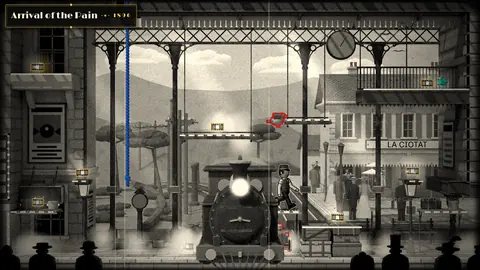 1896
Arrival of a Train at La Ciotat
Our room: Arrival of the Pain
1896
Arrival of a Train at La Ciotat
Our room: Arrival of the Pain
-
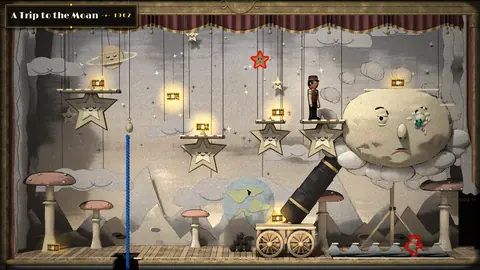 1902
A Trip to the Moon
Our room: A Trip to the Moan
1902
A Trip to the Moon
Our room: A Trip to the Moan
-
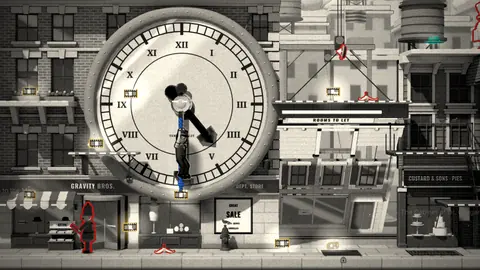 1923
Safety Last!
Our room: Safety Second
1923
Safety Last!
Our room: Safety Second
Free, in a desktop browser or as a download for Windows, Mac and Linux.
Quick answers
What is The General (1926) about?
Johnnie Gray, a Confederate railway engineer, loves his locomotive The General and a young woman named Annabelle Lee. When Union spies steal the engine with Annabelle aboard, he chases them north in another train, then rides the General back south, with the enemy behind him and the Confederate army ahead.
Is The General based on a true story?
Yes, loosely. It borrows from the Andrews Raid, or Great Locomotive Chase, of 1862, when Union raiders seized a Confederate locomotive named the General and were pursued. The main source was William Pittenger's account of it, which AFI lists as a book of 1863.
Why did Buster Keaton tell it from the Confederate side?
The book it comes from was written by one of the Union raiders. Keaton is said to have believed that an audience would not accept Southerners as the villains, so he made one of the pursuers his hero. Critics today point out that the film, like much American cinema of its time, treats the Confederate cause kindly and never mentions slavery.
How much did the train crash in The General cost?
About $42,000, according to the AFI Catalog, which calls it the most expensive single scene shot in silent films to that date. Other writers repeat the figure and the claim. A real locomotive was sent through a burning bridge into the Row River, filmed once with several cameras.
Was the locomotive in The General really destroyed?
Yes. It went into the river with the bridge. By most accounts the wreck lay there for years as a sight for visitors and was taken for scrap during the Second World War.
Did The General lose money?
Yes, by the usual figures. It cost far more than the average Keaton feature, its first reviews were poor, and it is said to have taken about $474,000 in the United States against a budget near $750,000.
Did The General end Buster Keaton's career?
Not at once, but it is seen as a turning point. After more films that lost money, Joseph Schenck closed Keaton's studio in 1928 and moved him to MGM, where he lost the control he had enjoyed. He later called the move a bad mistake.
Is The General in the public domain?
In the United States, yes: its copyright was apparently not renewed in the 1950s, and films of 1926 became free there in any case on 1 January 2022. It may still be protected in other countries, and restorations and recorded scores can have rights of their own.
Sources and further reading
- The General (1926): credits, production notes, release, AFI Catalog of Feature Films, American Film Institute
- Public Domain Day 2022, Jennifer Jenkins, Duke Center for the Study of the Public Domain
- The General: the greatest comedy of all time?, British Film Institute
- Buster Keaton: The General, a feature on the shoot, Alta Journal, Julian Smith
- How Buster Keaton filmed The General, John Bengtson, Silent Locations
- Bits of 1926 Hollywood train wreck, Offbeat Oregon
- The General (1926), San Francisco Silent Film Festival
- The General, Independent Cinema Office
- The General (film), EBSCO Research Starters
- The General (1926 film), Wikipedia, for the budget and takings, the first reviews and the accidents on the shoot