
Palace Picture House · Programme note
The Flying Ace 1926
A white Florida producer made an aviation thriller for Black audiences, with a woman pilot in it, and shot almost all the flying with the planes on the ground.
By HertzyPertzy · Updated · 6 minute read
In short
The Flying Ace is an American silent film of 1926, made in Jacksonville, Florida, by the white producer Richard E. Norman with an all-Black cast. It is a race film, made for Black audiences: a First World War pilot, back home as a railroad detective, hunts a stolen payroll and a rival aviator. Almost all of its flying was filmed with the planes on the ground. Its woman pilot is said to be loosely based on Bessie Coleman, who died in a crash at Jacksonville in April 1926. It is the only one of Norman's features known to survive, and joined the National Film Registry in 2021.
Watch the film
It is not played on this page: see where to watch it.
Find where to stream, rent or buy it, on JustWatch.
- Released
- 1926, in the United States; the exact date is not on record
- Made by
- Norman Film Manufacturing Company, Jacksonville, Florida. Produced and directed by Richard E. Norman
- Cast
- J. Laurence Criner (Captain Billy Stokes), Kathryn Boyd (Ruth Sawtelle), Steve "Peg" Reynolds (Stokes's one-legged mechanic), with local players in smaller parts
- Filmed
- In and around Jacksonville, Florida, at Norman's studio and on location
- Length
- Six reels. Sources give 60 or 65 minutes
- Format
- Silent, black and white, with English intertitles
- Preservation
- Held by the Library of Congress and added to the US National Film Registry in 2021. A restored print was shown at the San Francisco Silent Film Festival in 2010
- Copyright
- Public domain in the United States since 1 January 2022, when works of 1926 entered it. Music added to modern copies can have rights of its own
The story
Captain Billy Stokes (J. Laurence Criner) is a decorated First World War pilot, nicknamed the Flying Ace, who has gone back to work as a railroad detective. At Mayport, Florida, a paymaster arrives carrying a $25,000 railroad payroll and then disappears. Stokes goes after the money, and after a rival pilot, Finley Tucker, who is also interested in Ruth Sawtelle (Kathryn Boyd). Tucker flies off with Ruth, drugged. Stokes follows in his own plane. When Tucker's burns, Stokes lowers a rope ladder so she can climb across, and Tucker parachutes down into the arms of the law. Steve "Peg" Reynolds plays Stokes's one-legged friend, the flight mechanic.
It runs about an hour, six reels, and it is a straight crime story with an air chase on top. There is no villain called racism in it. The essayist Allyson Nadia Field notes that, unlike Oscar Micheaux's Within Our Gates (1920), it is set in an all-Black world without the realities of Jim Crow. Norman, she writes, bet that audiences wanted fantasy and escape.
Race films, and a white producer
Race films were made in the United States from the 1910s to the early 1950s, with Black casts, for Black audiences, outside the Hollywood studios. Some companies were Black-owned, among them the Lincoln Motion Picture Company and Micheaux's. Many more were financed, and often written and directed, by white people. Historians treat the two kinds differently. Some films from white-owned companies were criticised for stereotypes, and many promoted middle-class values of education and industry.
Richard E. Norman was white, born in Middleburg, Florida, in 1891. He started with "home talent" films for white audiences in the Midwest, in which local people were put on screen, and bought a studio in Jacksonville in 1920. He saw a market that Hollywood ignored. Between 1919 and 1928 his company made all-Black films, seven race features by the festival's count, eight features by another. Accounts say his motives were not only commercial, and cite the state of race relations. Black performers, many of them from the Lafayette Players of Harlem, such as Criner and Boyd, were shut out of mainstream films, and Norman gave them leading roles. He was also the owner, with the money and the final say, which is the usual caution about white-owned race cinema. Both things are on the record.
Aviation, and Bessie Coleman
The film came out in the years of the aviation craze, before Charles Lindbergh's flight of 1927 and the public interest that followed. Black Americans could not fly for the United States military until the Second World War, but there were Black pilots. Eugene Bullard flew for France. Bessie Coleman, born on 26 January 1892 in Atlanta, Texas, went to France to train and on 15 June 1921 earned her licence from the Fédération Aéronautique Internationale. She is described as the first Black American woman to hold a pilot's licence.
Her film career was short. By the Smithsonian's account she was offered a leading role in a film called Shadow and Sunshine, accepted, and then turned it down on learning that it opened with her in rags. "No Uncle Tom stuff for me!" she is quoted as saying. The refusal, the museum says, drew a hostile reaction and ended her film work.
On 30 April 1926 she died at Jacksonville in a plane crash while preparing for an air show there the next day. Her link to Norman is thinly sourced. The essays say he first planned an aviation film with another stunt pilot, Edison C. McVey, that fell through, and that he then approached Coleman. One account adds that she had written to Norman wanting a film about her life, but that rests on a single source, and it is unclear whether they ever met. Accounts agree that Ruth Sawtelle is loosely based on her. That is the only link, and nobody has shown that the character was written for her. Norman is said to have used the publicity of her death to sell the picture.
Flying on the ground
The advertising called it "the greatest airplane thriller ever filmed". By most accounts nearly all of it was shot on the ground. Norman built a full-scale mock-up of a Curtiss JN-4, the type Coleman flew, and the camera was turned upside down to make a parked plane look as if it were flying inverted. One account says that apart from one brief sequence the whole film was shot on the ground. A festival essay of 2025 goes further, finding the flying convincing and entertaining "even if the plane never left the ground". Criner, a stage actor, could not fly.
The film cost more than planned. It was a financial success for Norman and for Black exhibitors, and Norman kept it in circulation for the better part of a decade.
Survival and the studio
Norman's studio is said to have made eight features and many shorts. Only The Flying Ace is known to survive. The Library of Congress holds a copy. A restored print was shown at the Castro Theatre at the San Francisco Silent Film Festival in July 2010, and the Librarian of Congress added the film to the National Film Registry in 2021. Its exact release date is not on record.
The studio's buildings in the Arlington district of Jacksonville survive too. They were added to the National Register of Historic Places in 2014 and designated a National Historic Landmark on 31 October 2016. The Norman Studios Silent Film Museum runs the site.
Why it matters
It is the one Norman feature left. The rest of his work is lost, so a whole studio's output is judged on a single film.
It shows what Black audiences were offered. Field argues that race films gave Black viewers characters with the range of experiences that white characters had in mainstream cinema, and this is a film in which Black people are pilots, detectives and heroes.
It shows how silent cinema faked the sky. A full-size mock-up, a parked plane and a camera turned upside down were enough to sell "the greatest airplane thriller ever filmed".
On the same programme
Some of these films are rooms you can play
These notes come from Reel Trouble, a comedy platformer through film history. Every room in it is a movie set, built from scratch as a parody of a real film, and a fall is never a death: it is a retake.
-
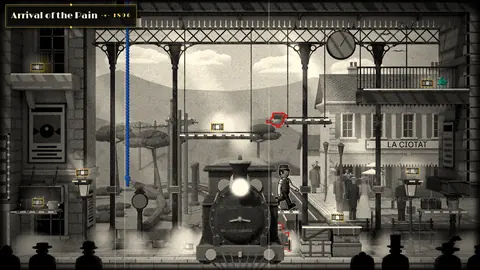 1896
Arrival of a Train at La Ciotat
Our room: Arrival of the Pain
-
 1902
A Trip to the Moon
Our room: A Trip to the Moan
-
 1923
Safety Last!
Our room: Safety Second
Free, in a desktop browser or as a download for Windows, Mac and Linux.
Quick answers
What is The Flying Ace (1926) about?
Captain Billy Stokes, a First World War pilot nicknamed the Flying Ace, returns to work as a railroad detective. When a $25,000 payroll and its paymaster vanish, he pursues a rival pilot, Finley Tucker, who is also interested in Ruth Sawtelle. The climax is in the air.
What is a race film?
A film made in the United States, roughly from the 1910s to the early 1950s, with a Black cast and for Black audiences, outside the Hollywood studios. Some companies were Black-owned, such as Oscar Micheaux's. Many were financed, and often written and directed, by white people.
Was Richard Norman a Black film-maker?
No. Norman, born in Middleburg, Florida, was a white producer who began with "home talent" films for white audiences and then turned to Black audiences, in which he saw an untapped market. He made all-Black films from 1919 to 1928.
Was The Flying Ace based on Bessie Coleman?
Only loosely, and on thin evidence. The character Ruth Sawtelle is said to be loosely based on Coleman, and Norman is said to have approached her about a film before her death. She took no part in the production.
Did anyone really fly in The Flying Ace?
By most accounts, almost nothing. The film was advertised as the greatest airplane thriller ever filmed, but nearly all of it was shot on the ground, with the camera turned upside down to suggest altitude. Accounts mention one brief exception.
Is The Flying Ace the only Norman Studios film that survives?
Yes, it is generally described as the only surviving feature of Norman's race films. The Library of Congress holds a copy, and it was added to the National Film Registry in 2021.
Where is Norman Studios?
In the Arlington district of Jacksonville, Florida. The site was added to the National Register of Historic Places in 2014 and designated a National Historic Landmark on 31 October 2016.
Is The Flying Ace in the public domain?
In the United States, yes. Works published in 1926 entered the public domain there on 1 January 2022. Duke's Center for the Study of the Public Domain notes that music added to a modern copy might still be copyrighted.
Sources and further reading
- The Flying Ace, San Francisco Silent Film Festival, 2025 programme, with the essay by Allyson Nadia Field: Norman, the cast, Coleman, the flying
- The Flying Ace, San Francisco Silent Film Festival, 2010 programme, with the essay by Megan Pugh
- The Flying Ace, Wikipedia: plot, production, the ground shooting, the Coleman connection, the Registry
- Norman Studios, Wikipedia: Norman's career, the studio, the landmark dates
- The Flying Ace, Norman Studios Silent Film Museum, Jacksonville
- Race film, Wikipedia: what the term covers, white-owned and Black-owned companies
- Bessie Coleman, Wikipedia: her birth, licence, death and the film she left
- Bessie Coleman: Five Stories You May Not Know, Smithsonian National Air and Space Museum, 2021
- Public Domain Day 2022, Duke Center for the Study of the Public Domain