
Palace Picture House · Programme note
Wings 1927
A director who had flown in the war filmed real dogfights over Texas with army pilots, and the result won the first award the Academy gave for a best production.
By HertzyPertzy · Updated · 6 minute read
In short
Wings is a 1927 American silent film directed by William A. Wellman for Paramount, about two small-town friends who become fighter pilots in the First World War. Wellman, a former combat pilot, shot the flying for real with US Army help, with cameras on the aircraft and the stars in the cockpits. It was a long roadshow hit and won the Academy's first award for the best production, at the first ceremony in 1929. It was long thought lost, and was restored by Paramount in 2012.
Watch the film
It is not played on this page: see where to watch it.
Find where to stream, rent or buy it, on JustWatch.
- Premiere
- Most sources give 12 August 1927 at the Criterion Theatre, New York, after a preview in San Antonio in May 1927; one database gives 12 April. Los Angeles followed in January 1928, and the wide US release was in January 1929
- Made by
- Directed by William A. Wellman. Story by John Monk Saunders; screenplay by Hope Loring and Louis D. Lighton; titles by Julian Johnson; photographed by Harry Perry; produced by Lucien Hubbard for Paramount
- Cast
- Clara Bow (Mary Preston), Charles "Buddy" Rogers (Jack Powell), Richard Arlen (David Armstrong), Jobyna Ralston (Sylvia Lewis), with Gary Cooper in a small part as Cadet White, El Brendel and Roscoe Karns
- Studio and cost
- Paramount Famous Lasky Corporation. Budget about 2 million dollars. Shot at Kelly Field and nearby sites in and around San Antonio, Texas, from 7 September 1926 to 7 April 1927
- Length
- Sources differ on the 1927 version: about 111 minutes in one account, about 141 in another. The 2012 restoration runs about 144 minutes
- Format
- 35 mm, black and white with colour tints, silent, with an orchestral score; some sequences were shown with the Magnascope enlarged-screen process, and flames were hand-coloured by the Handschiegl process
- Honours
- The Academy's first award for the best production, at the first ceremony, 16 May 1929, plus the award for engineering effects. Added to the US National Film Registry in 1997
- Copyright
- Public domain in the United States since 1 January 2023, as Duke's Center for the Study of the Public Domain lists it. Paramount's 2012 restoration is the version most easily found, and its new score and sound effects are modern work, so this page links to no free copy
The story
Jack Powell (Charles "Buddy" Rogers) and David Armstrong (Richard Arlen) live in the same small town and both love Sylvia (Jobyna Ralston), who loves David. Jack is wanted by Mary Preston (Clara Bow), the girl next door, who sees none of it. When the United States enters the First World War, both young men join the air service, and Mary follows as an ambulance driver.
The two start as rivals and end as friends. The film moves from training camp to the front in France, takes in a drunken leave in Paris, a ground battle at Saint-Mihiel and long dogfights, and ends in a mistake that costs one of them his life. Gary Cooper has a short part as a cadet, killed early.
Real planes, real pilots
Paramount hired William A. Wellman because he had flown in the war. He joined the Lafayette Flying Corps in 1917, was shot down by anti-aircraft fire in March 1918, and limped for the rest of his life.
The studio moved to San Antonio, the centre of army flight training. The War Department helped on conditions: the men were insured, Paramount paid for any damage, and the filming had to count as training. Six planes and their pilots came from Selfridge Field, among them Lieutenant Clarence "Bill" Irvine, who planned the dogfights and, by most accounts, devised an airborne camera system. Scenes were shot at Kelly Field and at Camp Stanley, where shells scarred the ground into a battlefield. The ground battle used thousands of soldiers, and sources differ on how many.
The flying was done in the air. A camera was mounted on the front of a two-seat plane, with a pilot behind the actor. Arlen flew his own aircraft, and Rogers, who was not a pilot, took lessons so that he could be filmed close up in the cockpit.
Weather was the enemy. By one account the crew waited 18 days in a row for suitable conditions, and Wellman is said to have scrapped the first two months of footage. The shoot ran from September 1926 to April 1927, about nine months, against about a month for a typical film of the time. The budget was about 2 million dollars. A San Antonio historian has put the army's contribution at far more, about 16 million, a single estimate, and the film also served the Air Corps as a recruiting poster.
The cost in lives and bones was real. By most accounts one Army Air Service pilot was killed in a crash during production. The stunt pilot Dick Grace broke his neck when a plane meant to turn over on landing came down differently, and Irvine then took his place in a battle scene. Several extras were also reported to have been badly hurt during the Saint-Mihiel battle, after the financier Otto Kahn is said to have wandered on set and disturbed Wellman's timing of the explosions. That story rests on a single biography.
Premiere and roadshow
A preview was held in San Antonio in May 1927. Most sources put the New York premiere at the Criterion Theatre on 12 August 1927, and one database gives 12 April. It then ran there for 63 weeks, by one account. It opened in Los Angeles in January 1928 and was widely released in January 1929. It was a roadshow, shown in single theatres at higher prices.
Some sequences were projected with Magnascope, which magnified the picture onto a much larger screen for the dogfights, and the flames in the air battles were coloured by hand with the Handschiegl process. Sound arrived in stages, and sources differ on when. One listing gives a sound re-release in 1927, with General Electric's Kinegraphone, later RCA Photophone, while other accounts place the sound version later. It has music and effects but no speech.
As David dies, Jack kisses him on the cheek. Some critics call it the first male kiss in a major film; others dispute that and name earlier candidates.
The first award
The Academy of Motion Picture Arts and Sciences began as a banquet on 11 January 1927 at the Ambassador Hotel in Los Angeles. Louis B. Mayer of MGM gathered 36 people, and all of them are counted as founders. The first awards ceremony was held on 16 May 1929 in the Blossom Room of the Hollywood Roosevelt Hotel, for films released between August 1927 and August 1928.
Wings won two awards: the one then called Outstanding Picture, for the best production, and one for engineering effects, which went to Roy Pomeroy. It is generally described as the first best-picture winner, and it is the only film of the silent era to take the top award. But a second prize, for unique and artistic production, went to Sunrise the same night, and at the time the two were treated as equals. The next year the Academy dropped that category and made the Wings prize its highest honour. By one account Wellman was not invited to the ceremony, after quarrels with the studio.
Lost, then restored
For many years Wings was thought to be lost. A print was found at the Cinémathèque française in Paris, in a year that accounts give differently. The original negative is gone. In 2012 Paramount released a restoration from a duplicate negative in its own vaults, chosen after a worldwide search because it was the most complete. Whole reels were scratched and decayed. The orchestral score was recorded again, from a copy held by the Library of Congress. The sound designer Ben Burtt and Skywalker Sound recreated the effects. The tints and flames were put back. It came out on DVD and Blu-ray in January 2012.
Why it matters
It set the standard for air films. By most accounts its dogfights became the benchmark for the flying pictures that followed, and the actors and cameras were really up there.
It is part of the start of the film awards. It was the first picture to be named best by the Academy, and its tie with Sunrise is still argued over.
It shows how a film is saved. A print survived in Paris, a duplicate negative survived in a vault, and a studio with a centenary to mark put the two together. It has been in the American public domain since 2023, though the version most people can find is the 2012 restoration.
On the same programme
Some of these films are rooms you can play
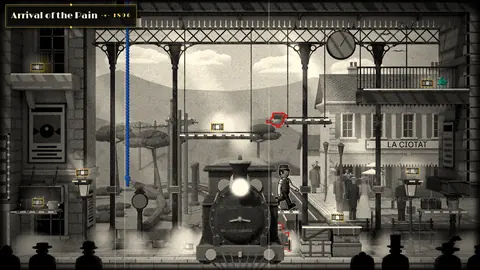
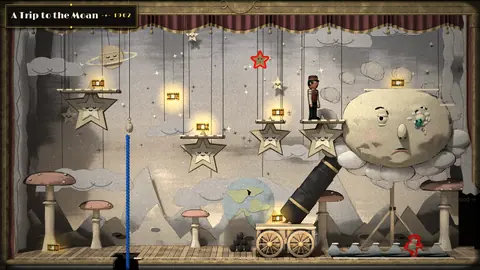
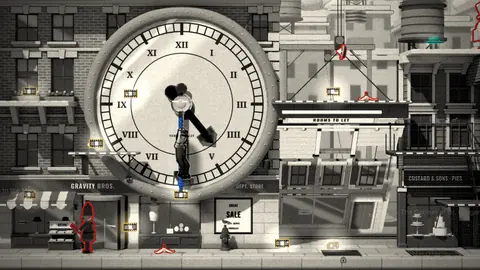
These notes come from Reel Trouble, a comedy platformer through film history. Every room in it is a movie set, built from scratch as a parody of a real film, and a fall is never a death: it is a retake.
-
 1896
Arrival of a Train at La Ciotat
Our room: Arrival of the Pain
-
 1902
A Trip to the Moon
Our room: A Trip to the Moan
-
 1923
Safety Last!
Our room: Safety Second
Free, in a desktop browser or as a download for Windows, Mac and Linux.
Quick answers
What is the 1927 film Wings about?
Two young men from a small town, Jack and David, both love the girl next door, Sylvia, and both join the air service in the First World War. Mary, who loves Jack, follows them to France as an ambulance driver. The friends become rivals and then comrades, and the film ends in tragedy over the front.
Did Wings win the first Best Picture award?
Yes, in a way. At the first ceremony on 16 May 1929 it won the Academy's award then called Outstanding Picture, for the best production. The Academy also gave a separate award to Sunrise, and the following year dropped that category and treated the Wings award as its top honour.
Is Wings the only silent film to win Best Picture?
It is the only film of the silent era to win the top award. A modern film that is almost entirely silent, The Artist (2011), won the same award in 2012.
Were the planes in Wings real?
Yes. The flying was done in the air with real aircraft and army pilots, over Texas, with cameras mounted on the planes. The scouts were army training and fighter types dressed up as French and German machines.
Did anyone die making Wings?
By most accounts, one Army Air Service pilot was killed in a crash during production, and the stunt pilot Dick Grace broke his neck in another. Several extras were also reported injured during the staged battle.
Was Wings a lost film?
It was long believed lost. A print turned up at the Cinémathèque française in Paris, and Paramount restored the film from a duplicate negative in its own vaults. The original negative is gone. The restoration came out on DVD and Blu-ray in January 2012.
Is Wings in the public domain?
In the United States, yes, since 1 January 2023, when films published in 1927 entered it. Paramount's 2012 restoration includes a re-recorded score and recreated sound effects, which are new work.
Who was in Wings?
The stars were Clara Bow, Charles "Buddy" Rogers and Richard Arlen, with Jobyna Ralston. Gary Cooper has a short part as a cadet who is killed early on, and it helped start his career.
Sources and further reading
- Wings (1927 film), Wikipedia, for the cast, the production dates, the release history, the restoration and the points given here as "by most accounts"
- Public Domain Day 2023, Jennifer Jenkins, Duke Center for the Study of the Public Domain
- San Antonio soars again with Wings restoration, Texas Public Radio, 26 January 2012, on the shoot in San Antonio, the War Department's terms and the restoration
- Wings DVD and Blu-ray kick off Paramount centennial, Home Media Magazine, on the elements used for Paramount's restoration
- Wings (1927), Military Goggle Box, on the aircraft, the army pilots and the accidents
- Wings (1927): Progressive Silent Film List, Silent Era, on the premiere date it gives, the running time, the print holdings and the sound re-release
- William A. Wellman, Wikipedia, on his war service
- Academy of Motion Picture Arts and Sciences, Wikipedia, on the founding banquet of 11 January 1927
- The 1st Academy Awards, 1929, Academy of Motion Picture Arts and Sciences, on the ceremony, its date and venue, and the winners