
Palace Picture House · Programme note
The Phantom Carriage 1921
A Swedish drunkard dies on New Year's Eve and is made to drive Death's cart, in a film whose see-through ghosts amazed 1921 audiences and shaped Ingmar Bergman.
By HertzyPertzy · Updated · 5 minute read
In short
Körkarlen (The Phantom Carriage) is a Swedish silent film of 1921, directed by Victor Sjöström, who also plays the drunkard David Holm. It adapts Selma Lagerlöf's novel and the old belief that the last person to die each New Year's Eve must drive Death's carriage for the year to come. Julius Jaenzon's double exposures made ghosts look transparent and free to move, and the film's tale of flashbacks inside flashbacks has been admired ever since. Ingmar Bergman said it influenced him, and cast Sjöström in Wild Strawberries.
Watch the film
It is not played on this page: see where to watch it.
Find where to stream, rent or buy it, on JustWatch.
- Original title
- Körkarlen ("The Wagoner"). Shown in Britain as Thy Soul Shall Bear Witness!, in the United States as The Stroke of Midnight
- Released
- 1 January 1921, at the Röda Kvarn cinema in Stockholm, and the same day at the Cosmorama in Gothenburg
- Made by
- AB Svensk Filmindustri. Director and writer Victor Sjöström; camera Julius Jaenzon; editor Eugen Hellman; producer Charles Magnusson
- Cast
- Victor Sjöström (David Holm), Astrid Holm (Edit), Hilda Borgström (Anna), Tore Svennberg (Georges)
- Based on
- Selma Lagerlöf's 1912 novel Körkarlen, in English Thy Soul Shall Bear Witness!
- Filmed
- May to July 1920 in the newly opened Råsunda studios (Filmstaden) at Solna, near Stockholm
- Length
- About 103 to 107 minutes, depending on the version and speed. One restored print runs 1,937 metres, from an original said to be 2,126 metres
- Copyright
- Public domain in the United States, as a film first published in 1921. In Sweden and the EU, Sjöström's death in 1960 would put protection to the end of 2030 on the usual 70-year rule. Restorations and recorded scores have rights of their own
The story
On New Year's Eve a Salvation Army sister named Edit lies dying in a slum. She asks to see David Holm, a drunkard with a cough, whom she once tried to help. Holm is in a graveyard with two drinking companions, telling them of an old legend: the last person to die on New Year's Eve must drive Death's carriage for the year ahead. A fight breaks out, he is struck on the head, and as the clock strikes twelve his spirit stands up out of his own body.
The carriage arrives. Its driver is Georges, once Holm's friend and drinking partner, who died a year before. Georges takes Holm through his own life: the family he left, the wife Anna who tried to hold things together, the brother who went to prison. Edit, seen in these memories, has blamed herself for his ruin. The story is a redemption tale told in four long flashbacks, and one of them is told inside another.
It is a bleak film that turns, late, towards mercy. Holm learns that Anna is about to harm herself and the children to escape him. Given a chance to return, he wakes among the graves and runs.
The novel and the legend
The film follows Selma Lagerlöf's novel Körkarlen of 1912, which draws on Swedish folklore and uses a Christian frame. One critic calls it essentially a variation on Dickens's A Christmas Carol: a hard man shown the lives he has spoiled by a visitor from the other side. A studio deal of 1917 had committed Svensk Filmindustri to filming Lagerlöf's books. Sjöström had made three country stories from her work, and he proposed this urban one. He is said to have read the script to her at her home in April 1920.
The legend of the carriage is told as an old belief, and the film uses it as the engine of the plot. In the American version of 1922, re-edited and retitled The Stroke of Midnight, the legend was held back until about halfway through the film.
Making the ghosts
Filming ran from May to July 1920, and it was the first picture made in Svensk's brand-new studio at Råsunda, near Stockholm. Sjöström then spent months in the laboratory. The ghosts are the film's marvel: transparent figures who stand behind a chair, walk through a wall, or sit beside a living man. The effect was made in the camera with double, triple and, by one account, quadruple exposures. A hand-cranked camera had to run at the same speed on every pass, which is why the work was so slow.
Julius Jaenzon, the cinematographer, had used double exposure before, in Sir Arne's Treasure (1919), and the team had tried mirror and exposure tricks in earlier films. Critics value the idea more than the trick: the living and the dead, the material and the spiritual worlds, share the same room. One critic singles out a dissolve from a family picnic to a drunken party as its most moving piece of trickery.
The axe
The scene people remember is not supernatural. Holm, drunk, chops down the kitchen door with a hatchet to reach his wife, who has locked herself in with the children. One critic argues the scene's power outweighs the redemption at the end. It has been compared with a similar door-splitting scene in The Shining (1980), and the comparison is often made rather than proved: nobody has shown that the later film's makers had it in mind.
Release and afterlife
The film opened on 1 January 1921 at the Röda Kvarn in Stockholm, and the same day in Gothenburg. It is said that about 100,000 Stockholmers saw it in its first two months, roughly a quarter of the city. It went abroad the following year, to London, Germany, France and America. A British trade paper, The Bioscope, wrote that it would add dignity and importance to the art of cinema.
The film survives in incomplete form. In 1975 the Swedish Film Institute made a new duplicate negative from two prints, a shortened black-and-white one and a tinted one with English titles. Later restorations carry scores by modern composers, and each score is a work of its own.
Sjöström went to Hollywood in 1923, where he worked as Victor Seastrom, directing among others Greta Garbo and Lillian Gish. He returned to Sweden when sound arrived, and he died in Stockholm on 3 January 1960. Jaenzon died in 1961.
Why it matters
It made the ghost a matter of light. By one festival's account, the film shows the living and the dead in one space, side by side. The effect was made in the camera, years before the optical printer.
It told its story in layers. Memories inside memories, controlled by a driver who is both guide and judge, give a ghost story the shape of a conscience.
It shaped a great director. Bergman, by most accounts, saw it as a boy and went on watching it. He cast Sjöström in Wild Strawberries (1957), and the tradition of Death as a figure on the road runs on into The Seventh Seal. A festival page also names it as an influence on Nosferatu, a claim to treat with care, since the two films are only a year apart.
It is a film about drink, not only about death. Its picture of an alcoholic and the family he wrecks is plain, and it still holds.
On the same programme
Some of these films are rooms you can play
These notes come from Reel Trouble, a comedy platformer through film history. Every room in it is a movie set, built from scratch as a parody of a real film, and a fall is never a death: it is a retake.
-
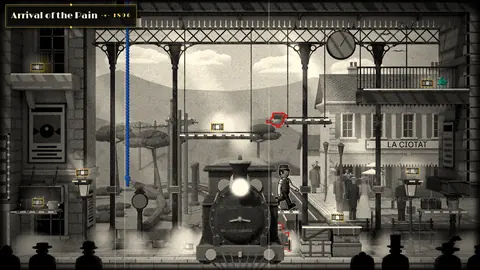 1896
Arrival of a Train at La Ciotat
Our room: Arrival of the Pain
-
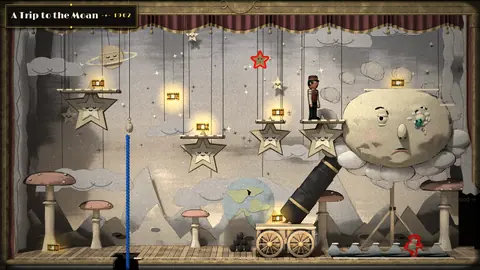 1902
A Trip to the Moon
Our room: A Trip to the Moan
-
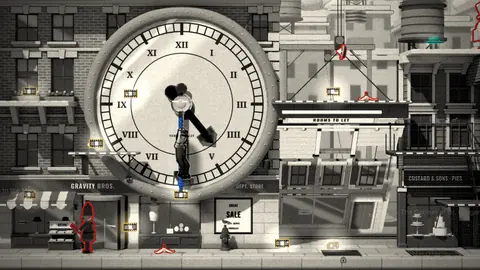 1923
Safety Last!
Our room: Safety Second
Free, in a desktop browser or as a download for Windows, Mac and Linux.
Quick answers
What is The Phantom Carriage about?
David Holm, a drunken and abusive man, is struck down on New Year's Eve and finds that Death's carriage has come for him. Its driver shows him the damage he has done and gives him a chance to put one thing right.
What is the legend of the phantom carriage?
The film's legend says that the last person to die on New Year's Eve must drive the carriage of Death for the whole of the following year, collecting the souls of the dead.
Who made The Phantom Carriage?
Victor Sjöström directed it, wrote the script and played the lead. Julius Jaenzon was the cinematographer, and the company was AB Svensk Filmindustri.
How were the ghosts in The Phantom Carriage made?
By multiple exposures made in the camera. Jaenzon and Sjöström layered several exposures on the same film, so the ghosts look transparent, can walk behind solid things and move through the room.
Is The Phantom Carriage based on a book?
Yes: Selma Lagerlöf's novel of 1912, Körkarlen, which came out in English in 1921 as Thy Soul Shall Bear Witness!. A Swedish studio had agreed to film her novels in 1917.
What was Ingmar Bergman's link to The Phantom Carriage?
Bergman said the film influenced his work and, by most accounts, watched it every year. He cast Sjöström as the old professor in Wild Strawberries (1957), Sjöström's last film role.
How long is The Phantom Carriage?
Sources give from about 103 to 107 minutes. Older prints are incomplete, and the running time changes with the projection speed.
Is The Phantom Carriage in the public domain?
The 1921 film is in the public domain in the United States. In Sweden and the EU protection runs for 70 years after the death of the last of its main creators; Sjöström died in 1960. Restorations and scores are separate works.
Sources and further reading
- The Phantom Carriage, Wikipedia: credits, plot, production dates, release, restorations and the comparisons made with later films
- The Phantom Carriage, SF Studios, 100 years of Råsunda: the premiere, production number 1 and Bergman's devotion
- Lawyer: "Those are life's little difficulties, you see!", Senses of Cinema, 2010: the novel, the structure, the double exposures and the axe scene
- The Phantom Carriage, San Francisco Silent Film Festival: the multiple exposures and Bergman
- Körkarlen, Il Cinema Ritrovato: the surviving print, its length and tints
- Victor Sjöström, Wikipedia: his life, his Hollywood years as Victor Seastrom and his death in 1960
- Julius Jaenzon, Wikipedia: the cinematographer and his double-exposure work