
Palace Picture House · Programme note
Häxan 1922
A Danish director made a lecture on witch-hunting that mixed history, horror and argument, played the Devil himself, and was banned in many places.
By HertzyPertzy · Updated · 6 minute read
In short
Häxan (Witchcraft Through the Ages) is a silent film of 1922 written and directed by Benjamin Christensen, who also plays the Devil. It is a lecture in chapters on the belief in witches, with pictures from old books and acted scenes, and it argues that many accused "witches" were people we would now call ill. The Swedish company Svensk Filmindustri paid for it, and it is described as the costliest Scandinavian silent film. It was cut or banned in many places and lost money, then grew into a cult classic.
Watch the film
It is not played on this page: see where to watch it.
Find where to stream, rent or buy it, on JustWatch.
- Original title
- Häxan, Swedish for "The Witch". Shown in English as Witchcraft Through the Ages
- Premiere
- 18 September 1922, in Stockholm, Helsingborg, Malmö and Gothenburg on the same day. Denmark followed on 7 November 1922
- Made by
- Written and directed by Benjamin Christensen for AB Svensk Filmindustri, with a mostly Danish cast and crew
- Cast
- Benjamin Christensen (the Devil), Clara Pontoppidan (Sister Cecilia), Astrid Holm (Anna), Maren Pedersen (Maria the Weaver), Oscar Stribolt, Tora Teje, Elith Pio
- Filmed
- February to October 1921 by most accounts, mostly at night in a studio in Hellerup, north of Copenhagen, which Svensk Filmindustri had bought and refitted
- Cost
- Sources give between 1.5 and 2 million Swedish kronor, about 2 million in the film's own infobox. Described as the most expensive Scandinavian silent film
- Length
- About 105 minutes in the current restoration; about 75 minutes in the 1968 version with narration by William S. Burroughs
- Copyright
- Treated as public domain in the United States, as a 1922 film. In Denmark, Sweden and the rest of the EU it stays protected until the end of 2029, seventy years after Christensen's death in 1959, so this page links to no free copy
A lecture with pictures
Christensen called Häxan a cultural history lecture, and it is built like one. It is told in seven chapters, by most accounts, though one Swedish source says four. The first, about 13 minutes long, is a talk illustrated with pictures of statues, paintings and woodcuts from old books. The rest are acted: a witch's brew, a sabbath, a trial, a convent gone wrong, and at the end the modern world.
The lecture has a thesis. The film claims that what the Middle Ages called witchcraft was often illness and delusion, and that women of the sort who were once burned would today be treated in hospitals. Christensen, who appears himself as a guide, presses the point and breaks off to say so. The film also claims that millions died. Its titles speak of over eight million burned, a figure modern historians put far lower: the Danish film historian Casper Tybjerg says about 50,000, and another scholar about 80,000.
Later critics have found the thesis dated, since it leans on ideas about sexual repression and hysteria once common in medicine. It is also a plea for pity. In the words of one reading, the film shows its witches as poor women, and the people who hunted them as the real danger.
The books behind it
Christensen is said to have found a copy of the Malleus Maleficarum in a Berlin bookshop. This was the handbook for inquisitors written in the 1480s by the cleric Heinrich Kramer, a guide to spotting, questioning and convicting witches. Christensen then spent the years from 1919 to 1921, by one account, reading witch-hunting manuals, engravings and treatises. The Danish Film Institute counts about 70 books. The premiere's playbill carried a bibliography, and the film treats the old text as evidence against its authors.
Christensen as the Devil
The director plays the Devil himself, and plays him with relish: horned and hoofed, in a look said to come from old paintings of hell. An intertitle says that he takes many shapes. One cast listing also gives Christensen a brief turn as Jesus Christ. Other roles went to a mix of amateurs and established players, among them Clara Pontoppidan, Tora Teje and Oscar Stribolt.
Made in Denmark, paid for in Sweden
Christensen was a Danish director. Häxan was financed by Svensk Filmindustri of Sweden, which gave him complete freedom and bought a studio in Hellerup, north of Copenhagen, and refitted it. Most of the film was shot there, mainly at night, from early 1921. One effect, the witches flying, joined about 75 witches photographed separately, blown about by an aeroplane propeller, with a miniature town on a huge turntable.
Sources differ on the cost. The figure given is between 1.5 and 2 million kronor, and it is called the most expensive film of the Scandinavian silent era. The historian Casper Tybjerg is quoted as calling it probably the most expensive Scandinavian film of the whole silent era.
It opened on 18 September 1922, on the same day in Stockholm, Helsingborg, Malmö and Gothenburg. Critics did not know what to make of it, audiences stayed away, and Svensk Filmindustri did not get its money back.
What is shown, and the bans
The film shows torture. Accused women are tortured under questioning, and the film shows a hanged man. It shows naked witches at the sabbath, a demon embracing a naked woman, and nuns in a state of frenzy. Swedish censors demanded cuts before release, among them a finger on a hanged man's hand and the embrace of the demon, both since restored. Elsewhere the film met worse. Censors in Germany, France and the United States objected to the cruelty, the nudity, the sexual scenes and the attacks on the clergy, and many countries refused it outright. The Catholic Church read it as anti-Catholic.
Reviewers were divided in the same way. A Danish critic in Berlingske Tidende objected to what it saw as satanic, perverted cruelty. Variety praised its vision and also called it \"absolutely unfit for public exhibition\". Dave Kehr wrote that it was a pretext for sadistic pornography, though he found its nude and scatological scenes grew sinister with time. Others read the nuns' scenes as a critique of the repression of sex, and the film as sympathetic to its women. The film's own claim is that it shows cruelty in order to condemn it; critics still disagree about how well it keeps that promise.
It reached New York at the Fifth Avenue Playhouse, in 1929 by most accounts, 1930 in one listing, under the title Witchcraft Through the Ages.
The Burroughs version and the cult
In 1941 the film was reissued with a new introduction by Christensen. A separate, later work followed: a shortened cut of about 75 minutes, supervised by the filmmaker Antony Balch, with most of the titles replaced by narration spoken by William S. Burroughs and a jazz score by Daniel Humair. It was shown in 1968, though one source says 1967. Running the film faster cut its length from about 104 minutes.
Christensen went on to Hollywood and gothic thrillers, and died in 1959. The film, meanwhile, was taken up by the Surrealists and by horror fans, and its reputation has grown ever since.
Why it matters
It is a film that argues. It joins lecture, drama and fantasy in a way few films of 1922 tried, and it has been called a claimant to the title of first documentary, though Nanook of the North is the usual choice.
It pitied the accused. Its thesis is dated, but its sympathy for poor women who were hunted is plain.
It shaped horror. Filmmakers of later witch and horror films, Robert Eggers among them, have cited it.
It was a censor's case. Its cuts and bans show how such films were handled in the 1920s, and some of the cut shots have since been restored.
On the same programme
Some of these films are rooms you can play
These notes come from Reel Trouble, a comedy platformer through film history. Every room in it is a movie set, built from scratch as a parody of a real film, and a fall is never a death: it is a retake.
-
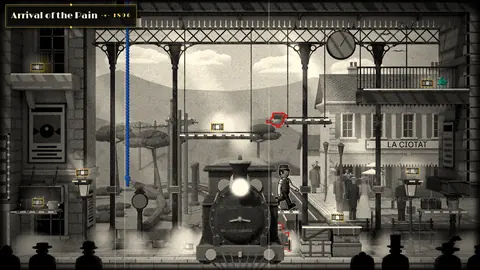 1896
Arrival of a Train at La Ciotat
Our room: Arrival of the Pain
-
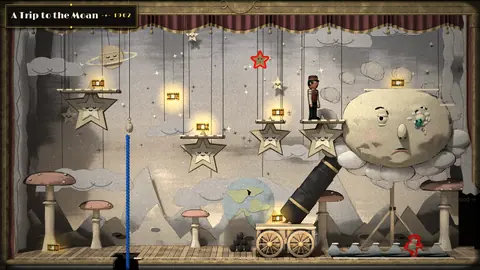 1902
A Trip to the Moon
Our room: A Trip to the Moan
-
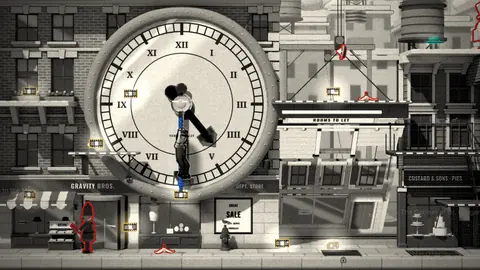 1923
Safety Last!
Our room: Safety Second
Free, in a desktop browser or as a download for Windows, Mac and Linux.
Quick answers
What is Häxan about?
It is a lecture in chapters on how people have believed in witches and the Devil, from the Middle Ages on. Pictures from old books are followed by acted scenes of witch trials. It ends by arguing that many of the accused were ill, not wicked.
Who played the Devil in Häxan?
The director, Benjamin Christensen, who also wrote the film. He is horned and hoofed, in a look said to be modelled on the hell of old paintings, and an intertitle tells us the Devil takes many shapes.
Was Häxan banned?
In many countries it was cut or banned for its torture, nudity and attacks on the Church. In the United States it was kept out for years and reached New York only in 1929 or 1930, depending on the source.
Is Häxan a documentary?
Not in the usual sense. Its first chapter is a lecture on pictures from old books, but most of it is staged and fantastical. It is better called an essay film, part documentary, part horror.
What is the Burroughs version of Häxan?
A shortened version of about 75 minutes, released as Witchcraft Through the Ages and supervised by Antony Balch. It has narration by the writer William S. Burroughs and a jazz score by Daniel Humair. It is a later work, not the film of 1922.
What book is Häxan based on?
Christensen drew chiefly on the Malleus Maleficarum, a handbook for witch-hunters of the 1480s, which he found in a Berlin bookshop. He read many other books and pictures of witch-hunting and cited a bibliography at the premiere.
Was Häxan made in Sweden or Denmark?
Both. Swedish money paid for it and it opened in Sweden first, but it was shot in Denmark by a Danish director with Danish actors.
Is Häxan in the public domain?
In the United States, yes. In Denmark, Sweden and the rest of the EU, Christensen's death in 1959 puts the end of protection at the close of 2029. Restorations and new scores can have rights of their own.
Sources and further reading
- Häxan, Wikipedia, with the reviews and critics' readings reported there as given
- Häxan: Witchcraft Through The Ages (1922), The Public Domain Review, on the sources, the seven chapters and the 1968 version
- Witchcraft Through the Ages, SF Studios, 100 years of Swedish film
- Benjamin Christensen, Danish Film Institute, silent film theme page
- Häxan, San Francisco Silent Film Festival, programme essay
- Insider info: Häxan (1922), Turner Classic Movies, on the cost, the Swedish cuts and the Burroughs version
- The satanic foreign film that was banned in the U.S., JSTOR Daily
- Häxan (1922), Silent Era, progressive silent film list, on length and cast