Palace Picture House · Programme note
The Wizard of Oz 1939
MGM's Technicolor fantasy lost money on release, nearly lost its best song, and became the film that television taught a nation to watch every year.
By HertzyPertzy · Updated · 7 minute read
In short
The Wizard of Oz is a 1939 American musical fantasy from Metro-Goldwyn-Mayer, directed mainly by Victor Fleming and starring Judy Garland as Dorothy, a Kansas girl carried by a twister to the land of Oz. It is based on L. Frank Baum's 1900 novel, but ends by making Oz a dream. It cost MGM a great deal, did not turn a profit until a reissue in 1949, and then became a yearly ritual on American television. The Library of Congress says it has been seen by more viewers than any other film, and it was in the first National Film Registry list in 1989.
Watch the film find where to stream, rent or buy it, on JustWatch (opens in a new tab)
- Released
- August 1939 in the United States. Principal photography ran from 13 October 1938 to 16 March 1939
- Made by
- Metro-Goldwyn-Mayer. Produced by Mervyn LeRoy. Directed mainly by Victor Fleming, after Richard Thorpe, with George Cukor as adviser and King Vidor finishing the Kansas scenes. Credited screenplay: Noel Langley, Florence Ryerson, Edgar Allan Woolf
- Cast
- Judy Garland (Dorothy), Ray Bolger (Scarecrow), Bert Lahr (Cowardly Lion), Jack Haley (Tin Man), Margaret Hamilton (the Wicked Witch of the West), Frank Morgan (Professor Marvel and four more parts), Billie Burke (Glinda)
- Music
- Songs by Harold Arlen and E. Y. "Yip" Harburg; score by Herbert Stothart. "Over the Rainbow" won the Oscar for Best Original Song
- Colour
- Three-strip Technicolor for Oz. The Kansas scenes and the credits were filmed in black and white and toned sepia, by most accounts
- Cost and takings
- Budget about $2.77 million. About $3 million on first release, which did not make a profit; lifetime gross given as about $25.6 million
- Length
- About 102 minutes, 101 by some counts
- Copyright
- Still in copyright in the United States. Sources give 95 years from publication, so it is expected to enter the public domain on 1 January 2035. L. Frank Baum's 1900 book is in the public domain, but the film's own words, images and music are separate. This page links to no free copy
The story
Dorothy Gale (Judy Garland) lives on a Kansas farm, shown in sepia. Her dog Toto bites a landowner, Almira Gulch, who comes with an order to have him put down. Dorothy runs away, and a twister lifts the house and drops it in Munchkinland, in colour, on the Wicked Witch of the East. The Yellow Brick Road leads to the Emerald City and the Wizard.
On the road she picks up a Scarecrow who wants brains, a Tin Man who wants a heart and a Cowardly Lion who wants courage. The Wizard sets a price: bring him the broomstick of the Wicked Witch of the West. Dorothy's bucket of water melts the Witch, the Wizard turns out to be a showman behind a curtain, and the film ends in Kansas with its most quoted line, "There's no place like home."
Baum's book, and the films before
The film is based on L. Frank Baum's novel of 1900. Two things changed. In the book Dorothy's magic shoes are silver; for the film they became ruby, which sources say was done so they would show up against the yellow road in Technicolor. And in the book Oz is a real country. The film makes it a long dream, on the reasoning, it is said, that audiences of 1939 would not accept a fantasy played straight.
It was not the first Oz film. The earliest surviving one is a 13-minute short made by Selig Polyscope in 1910, drawing on Baum's book and his 1902 stage musical. In 1925 Larry Semon made a feature-length silent version for Chadwick Pictures: Dorothy is eighteen, the three companions are farmhands in disguise, and Oliver Hardy plays a Tin Woodman who turns villain. It was not a success.
Four directors and a crowd of writers
Mervyn LeRoy produced, with Arthur Freed. Richard Thorpe directed for about eleven days in October 1938 and was replaced. George Cukor stayed a few days as an adviser, directing nothing. Victor Fleming took over until he left for Gone with the Wind, and King Vidor directed the last ten days, among them the Kansas scenes.
The credited writers are Noel Langley, Florence Ryerson and Edgar Allan Woolf. By the Library of Congress's count there were ten screenwriters in all, and others, among them Herman J. Mankiewicz and Yip Harburg, are named as contributors.
Casting changed too. Buddy Ebsen was first the Tin Man, having swapped parts with Ray Bolger. He had a toxic reaction to the aluminium dust in his make-up and was taken to hospital, on oxygen for two weeks by one account. Jack Haley took over, with a paste in place of the powder. Frank Morgan played Professor Marvel, the Wizard, the gatekeeper, the coachman and the guard.
Two injuries are documented. During Margaret Hamilton's exit from Munchkinland the flame came early and set fire to her copper-based green make-up, causing third-degree burns to her hands and face, and she was away for about three months. Her stunt double Betty Danko was badly hurt later, when a smoke device failed in the broomstick shots. Judy Garland, who was sixteen, was corseted to look younger, and biographers record that the studio kept her on pills to hold her weight down.
Colour and song
Oz was shot in three-strip Technicolor, and Kansas in black and white toned sepia. Colour was not new in 1939: features had been made in three-strip Technicolor since 1935. The film is remembered for how it used colour, not for being first. By most accounts the moment when Dorothy opens the door was done without an optical effect: the inside of the farmhouse was painted sepia and filmed in colour, and a stand-in in a sepia dress steps aside to let Garland through.
Harold Arlen and Yip Harburg wrote the songs. After test screenings MGM considered cutting "Over the Rainbow", reportedly because it made the Kansas section too long and was thought undignified for a girl in a barnyard. Freed, LeRoy and Fleming fought to keep it. It won the Oscar for Best Original Song, and Herbert Stothart's music won for score.
Money, prizes and television
It was one of MGM's most expensive productions, at about $2.77 million, and it took about $3 million on first release, not enough to make a profit. The reissue of 1949 is said to have put it in the black.
At the Oscars of 29 February 1940 it lost Best Picture to Gone with the Wind, the film Victor Fleming had left it to direct. It won for its song and its score, and Garland received the special Juvenile Award.
The change came with television. CBS first broadcast it on 3 November 1956, with a Nielsen rating of 33.9, and a repeat in December 1959 drew more. Yearly showings turned it into a ritual.
The legends, sorted
The hanging Munchkin. Nothing of the kind is on screen. The shape in the trees in the forest scene is a large bird, said to have been on loan from the Los Angeles Zoo, and the story took hold only when poor home-video copies came out. No Munchkin actor died on set.
The Munchkin actors' behaviour. About 30 of the roughly 124 performers came from a European troupe then billed as Singer's Midgets. In 1967 Garland claimed they were drunks who had to be collected in butterfly nets. A fellow performer, Margaret Pellegrini, disputed this, saying only a couple of young men from Germany drank beer. It is recollection against recollection.
The asbestos snow. Often repeated, and not settled. Asbestos was in common use on film sets of the time, and it is widely reported that the snow falling on the poppy field was made of it. Other accounts say gypsum. Asbestos is also said to have been used for the Witch's burning broomstick.
Pink Floyd. The notion that The Dark Side of the Moon (1973) is a soundtrack to the film appeared in a Fort Wayne newspaper in August 1995. Gilmour called it work by a man with too much time on his hands, and Waters called it nonsense. Critics put it down to apophenia, seeing patterns where there are none.
Why it matters
It may be the most watched film there is. The Library of Congress says that because of its many television showings between 1956 and 1974 it has been seen by more viewers than any other film. That is the Library's claim.
It is on the registers. It was chosen for the first National Film Registry list in 1989. Since 2007 it has also been on UNESCO's Memory of the World register.
It showed what colour was for. Sepia Kansas and Technicolor Oz turn a technical novelty into the meaning of the story. The opening of that door is still the example everyone reaches for.
On the same programme
Some of these films are rooms you can play
These notes come from Reel Trouble, a comedy platformer through film history. Every room in it is a movie set, built from scratch as a parody of a real film, and a fall is never a death: it is a retake.
-
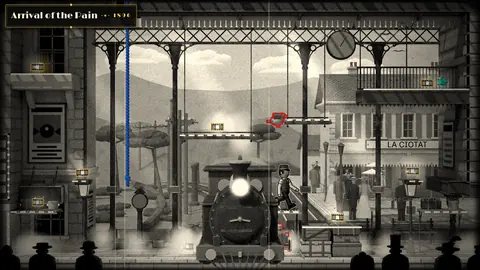 1896
Arrival of a Train at La Ciotat
Our room: Arrival of the Pain
1896
Arrival of a Train at La Ciotat
Our room: Arrival of the Pain
-
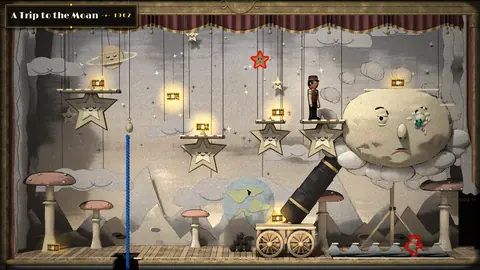 1902
A Trip to the Moon
Our room: A Trip to the Moan
1902
A Trip to the Moon
Our room: A Trip to the Moan
-
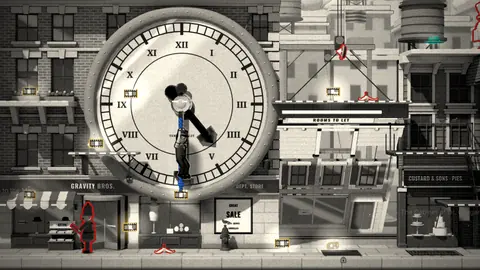 1923
Safety Last!
Our room: Safety Second
1923
Safety Last!
Our room: Safety Second
Free, in a desktop browser or as a download for Windows, Mac and Linux.
Quick answers
What is The Wizard of Oz (1939) about?
Dorothy, a girl on a Kansas farm, is carried by a twister to the land of Oz. She follows the Yellow Brick Road to the Emerald City with a Scarecrow, a Tin Man and a Cowardly Lion, melts the Wicked Witch of the West, and wakes up at home in Kansas.
Who directed The Wizard of Oz?
Victor Fleming directed most of it, from November 1938 to March 1939. Richard Thorpe was first and was replaced after about eleven days. George Cukor advised for a few days without directing scenes, and King Vidor directed the last ten days, including the Kansas scenes.
Why did Buddy Ebsen leave The Wizard of Oz?
He was cast as the Tin Man, but had a toxic reaction to the aluminium dust in his make-up and was taken to hospital. Jack Haley replaced him, in make-up changed to a paste. Ebsen's voice stays in the group singing.
Was the Wizard of Oz a flop?
It was not a flop with critics or audiences, but it cost about $2.77 million and took about $3 million on its first release, which did not turn a profit. By most accounts it only paid its way after the 1949 reissue.
Is there a hanging Munchkin in The Wizard of Oz?
No. The shape in the trees in the forest scene is described as a large bird, and viewers who read it as a person hanging did so from low-quality home video copies. No Munchkin actor died on the set.
Why are Dorothy's slippers ruby and not silver?
In Baum's book they are silver. For the film they became ruby, and sources say the change was made to show up against the yellow road in Technicolor. Adrian, MGM's head costume designer, is usually credited with the change.
Is The Wizard of Oz in the public domain?
The 1939 film is not. Sources give it as entering the United States public domain on 1 January 2035, 95 years after publication. Baum's 1900 novel is in the public domain.
Does Dark Side of the Moon really match The Wizard of Oz?
Fans say so, but the band deny any link. The idea appeared in an American newspaper in 1995. Pink Floyd's David Gilmour, Roger Waters and Nick Mason have rejected it, and critics put it down to the mind finding patterns.
Sources and further reading
- The Wizard of Oz, Peter Keough, essay for the National Society of Film Critics' The A List (2002), Library of Congress National Film Preservation Board, on four directors and ten writers
- A Whiz of a Wiz, Library of Congress Information Bulletin, March 2000, on the viewing figure and the 1989 registry
- The Wizard of Oz (1939 film), Wikipedia, for the production dates, the casting, the injuries, the box office, the television broadcasts and the cut songs
- 12th Academy Awards, Wikipedia, on the 1940 ceremony, the winners and Gone with the Wind
- The Wonderful Wizard of Oz (1910 film), Wikipedia, on Selig Polyscope's film and its survival
- The Wizard of Oz (1925 film), Wikipedia, on Larry Semon's silent version
- Munchkin, Wikipedia, on the 1939 Munchkin actors and the stories told about them
- The Dark Side of the Rainbow, Wikipedia, on the Pink Floyd pairing and the band's replies
- The Wonderful Public Domain of Oz, Internet Archive blog, 17 November 2025, on Baum's books and the early films
- The Wizard of Oz and the public domain, Theatrehaus, 2019, on the film's copyright term and Baum's book