
Palace Picture House · Programme note
Un Chien Andalou 1929
Two Spanish friends swapped dreams, banned any image that could be explained, and made a short film that opened the cinema to the Surrealists.
By HertzyPertzy · Updated · 5 minute read
In short
Un Chien Andalou (An Andalusian Dog) is a French silent short of 1929, about a quarter of an hour long, directed by Luis Buñuel from a script he wrote with Salvador Dalí. It grew out of two dreams and a rule that no image should have a rational explanation. A razor seems to slit an eye in its first minutes. First shown to Paris Surrealists in June 1929, it then ran for months at Studio 28, launched Buñuel's career and still shapes how film speaks the language of dreams.
Watch the film
It is not played on this page: see where to watch it.
Find where to stream, rent or buy it, on JustWatch.
- Original title
- Un chien andalou ("An Andalusian Dog")
- Released
- Shown to an invited audience at the Studio des Ursulines, Paris, on 6 June 1929; public run at Studio 28 from the autumn of 1929 (sources give 1 or 28 October)
- Made by
- Luis Buñuel (director, producer, editor), script by Buñuel and Salvador Dalí; paid for, by most accounts, by Buñuel's mother
- Cast
- Simone Mareuil, Pierre Batcheff; Buñuel and Dalí both appear in small uncredited parts
- Filmed
- About two weeks in 1929 (one source says March 1928), in Paris studios, with the seaside scenes at Le Havre
- Length
- Sources give 16, 17 or 21 minutes, depending on the print and its speed
- Format
- Silent, 35 mm, black and white, with French title cards; sound added later
- Copyright
- In the public domain in the United States since 1 January 2025. In France and the EU it remains protected: Buñuel died in 1983 and Dalí in 1989
Two dreams and one rule
Un Chien Andalou began, its makers said, as a swap of dreams. Buñuel told Dalí of a dream in which a cloud sliced the moon in half, like a razor blade through an eye. Dalí answered with one of a hand crawling with ants. Buñuel declared that this was the film. The writing is placed at Dalí's home at Cadaqués over the 1928 Christmas holiday, and was said to take about a week. Both dreams are known mainly from the pair's own tellings.
They also set a rule. In Buñuel's words, as quoted in recent accounts, no idea or image that might lend itself to a rational explanation of any kind would be accepted. Whatever came up had to be something neither man could account for. That is why the film defeats summary, and why so many viewers have found it funnier than they expected.
What is on screen
Early on, a razor appears to slit a woman's eye. The shot is brief and the viewer is left to imagine the rest. The eye was in fact a calf's, bleached and lit hard so that it passed for human. Earlier writers named other animals, but recent sources agree on a calf. Buñuel later said he told Dalí the scene had made him feel sick.
After that nothing follows from anything. A hand swarms with ants. Simone Mareuil and Pierre Batcheff play the young woman and the young man. Buñuel and Dalí both appear in small uncredited parts.
Title cards break up the film, but they tell you nothing. After the razor comes "Eight years later". Others give the time of day or leaps of several years, forward and back, which fits no calendar. A late one reads "In the springtime", before the closing image of two figures half buried in sand. The title cards behave like the rest: they sound like information and are not.
Making it
Buñuel's mother is generally named as the money. He feared no producer would back him, and he is reported to have spent some of it on Paris nightlife before shooting. The film was made in about two weeks, with the seaside scenes at Le Havre and the rest in Paris studios. Sources give it a crew of five or six. Buñuel edited it himself, and Jean Rouch is cited for the story that he did so in his kitchen after the money ran out. Dalí joined late, and by one account his own contribution was wax poured into the eyes of stuffed donkeys.
Paris, 1929
The first showing took place at the Studio des Ursulines in Paris on 6 June 1929, before an invited audience that was largely the Surrealist group around André Breton. Pablo Picasso, Le Corbusier and Jean Cocteau are named among those present, though reports differ on exactly who came. Buñuel played the sound himself from behind the screen, on gramophone records, reportedly a mix of Wagner and tangos.
His own story is that he stood there with stones in his pockets. Accounts of what they were for differ: to throw at the Surrealists if they rejected the film, or at anyone who started a riot. Either way they were not needed. The audience applauded, and Buñuel was welcomed into the group. It is a good story, and it comes from Buñuel.
The public run began at Studio 28 in the autumn, on 1 October in the Pompidou's account and 28 October in another. It then played for around eight months, and the cinema became a destination for audiences who liked to be shocked. Tales of fainting and miscarriages are often told but are probably exaggerated. Buñuel and Dalí turned on the film's success, objecting that it had pleased the very audience they despised.
Sound and afterlife
The soundtrack most prints carry is a later work. By the English-language record it was added to a print in 1960 under his supervision, and uses an excerpt from Wagner's Tristan und Isolde and two Argentine tangos; another account gives 1961. The film was restored by the Centre Pompidou in 1993.
Why it matters
It brought Surrealism to the cinema. The Pompidou credits it with opening the doors of cinema to the movement, and it gave Buñuel his career. His next film with Dalí, L'Âge d'or (1930), caused riots and was banned. He worked in France, Spain and, from 1936, Mexico, and returned to Spain for Viridiana (1961).
It put dream logic on film. Its abrupt leaps without narrative links have been traced to David Lynch and Monty Python, and Akira Kurosawa named it among his favourites. Ken Dancyger has argued that it may be an ancestor of the music video. David Bowie showed it before every concert of his 1976 tour, and the Pixies' song "Debaser" borrows from it.
It is cheap and it works. Roger Ebert called it an inspiration for low-budget independent film: a short paid for by a mother and shot in two weeks.
On the same programme
Some of these films are rooms you can play
These notes come from Reel Trouble, a comedy platformer through film history. Every room in it is a movie set, built from scratch as a parody of a real film, and a fall is never a death: it is a retake.
-
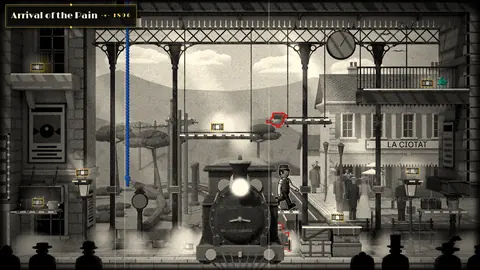 1896
Arrival of a Train at La Ciotat
Our room: Arrival of the Pain
-
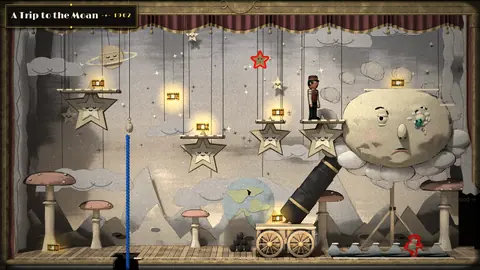 1902
A Trip to the Moon
Our room: A Trip to the Moan
-
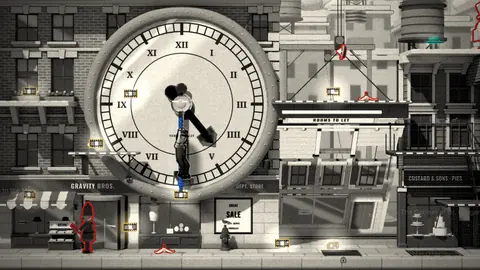 1923
Safety Last!
Our room: Safety Second
Free, in a desktop browser or as a download for Windows, Mac and Linux.
Quick answers
What is Un Chien Andalou about?
It has no story to retell. A series of dreamlike scenes with a young man and a young woman, linked by dream logic rather than cause and effect, opens with a razor and an eye and ends on a beach. Its makers refused any image that could be explained.
Why is it called An Andalusian Dog?
No dog appears in the film. One account ties the title to a Spanish saying that an Andalusian's howl signals a death.
Is the eye in Un Chien Andalou real?
The eye that is cut was a calf's, lit brightly and made up to look like a woman's. Earlier writers named other animals, but recent sources say a calf.
How long is Un Chien Andalou?
Between 16 and 21 minutes depending on the source: 17 is the figure most often given for the production, and the length varies with the print and the projection speed.
Who wrote and directed Un Chien Andalou?
Luis Buñuel directed, produced and edited it. He wrote the script with Salvador Dalí, who also appears briefly on screen.
Who composed the music for Un Chien Andalou?
Nobody wrote an original score. At the first screenings Buñuel played records, reportedly Wagner and tangos. A soundtrack of Wagner's Liebestod and two tangos was added to the film in 1960 under his supervision, by one account; some sources say 1961.
Did Un Chien Andalou get banned?
Sources differ. One says informers demanded a ban but it was never banned in France; the Pompidou says it was officially banned until 1981.
Is Un Chien Andalou in the public domain?
In the United States, yes, since 1 January 2025, when American copyright on 1929 films ended. In France and the EU its authors' rights are still running, since Buñuel died in 1983 and Dalí in 1989.
Sources and further reading
- Un Chien Andalou, Wikipedia (English): production, cast, premiere, soundtrack and reception, as reported
- Un chien andalou, Wikipédia (French): length, screenings, the 1960s soundtrack, the stones
- Focus sur Un chien andalou de Luis Buñuel, Centre Pompidou, Paris
- Luis Buñuel's Un Chien Andalou Shocks Parisian Audience, EBSCO Research Starters
- Buñuel and Dalí Champion Surrealism in An Andalusian Dog, EBSCO Research Starters
- Luis Buñuel & Salvador Dalí's Un Chien Andalou: The Short Surrealist Film That Revolutionized Cinema (1929), Open Culture
- Luis Buñuel: Un Chien Andalou facts, High on Films