Palace Picture House · Programme note
The Skeleton Dance 1929
Four skeletons dance in a graveyard to a score written first, and a cartoon about music, not a mouse, becomes the start of Disney's Silly Symphonies.
By HertzyPertzy · Updated · 6 minute read
In short
The Skeleton Dance is a five-and-a-half-minute American cartoon of 1929, produced and directed by Walt Disney, animated for the most part by Ub Iwerks, with a score by Carl Stalling. It was the first of Disney's Silly Symphonies, a series of cartoons built around music rather than around a star character. Skeletons climb out of their graves at midnight, dance, and play each other's bones like instruments until the dawn sends them home. It is a landmark of animation timed to its music, and the film entered the US public domain on 1 January 2025.
Watch the film
The whole film: about 6 minutes, a collector's 16 mm print with its 1929 soundtrack, the film's own music and effects.
Played from Wikimedia Commons, which hosts this copy as a public-domain work. Nothing is fetched from there until you press play. If it will not play here, it will on their page.
- Original title
- The Skeleton Dance, the first of Disney's Silly Symphonies
- Released
- Shown in Los Angeles and San Francisco in June 1929, and in New York from July; the date usually given for the general release is 22 August 1929
- Made by
- Walt Disney Productions, Hollywood. Produced and directed by Walt Disney; animation chiefly by Ub Iwerks, with Les Clark and Wilfred Jackson also credited; music by Carl Stalling
- Distributor
- Pat Powers' Celebrity Productions at first; Columbia Pictures took on the Silly Symphonies in August 1929
- Filmed
- Animated in Hollywood from January 1929, over about six weeks; the soundtrack was recorded in New York in February 1929
- Length
- About 5 minutes 30 seconds
- Format
- Black and white, 35 mm, with a recorded soundtrack of music and effects, no dialogue
- Copyright
- Public domain in the United States since 1 January 2025, as the Duke Center for the Study of the Public Domain lists it. Disney's trade marks, such as Mickey Mouse, are separate, and restorations and recorded scores can have rights of their own
The story
There is no plot, only a night's work. A graveyard at midnight. Then four skeletons climb out of the ground and begin to dance.
They kick, wobble, link arms and shake themselves apart, and the cartoon never stops being funny about how a skeleton is put together. One loses his skull and chases it. One plays another's ribs and spine as a xylophone, striking the bones with a pair of thigh bones. At dawn the whole company goes back to its graves.
It is about five and a half minutes of black and white, with a score and sound effects but nobody speaking. The dancing has a macabre pedigree, the old medieval picture of Death leading everyone to the grave. The cartoon removes the sermon and keeps the dance.
A cartoon built on music
The idea came from the composer. Carl Stalling had been a cinema organist in Kansas City, where Walt Disney met him in the early 1920s. In 1928 Disney hired him as his studio's first music director, and Stalling moved to California. By most accounts it was Stalling who proposed a cartoon built around a piece of music, with the pictures drawn to fit the score instead of the other way about. Dancing skeletons were his suggested test.
Disney was not at once sure. A letter of September 1928 is quoted in accounts of the film, saying the idea was growing on him. The practical result was a score written before any drawing began, with the action timed to its beats: kicks and footfalls land on the notes. Stalling is credited with composing and arranging it. He also helped with the timing method. In a forerunner of what came to be called the click track, a strip of film punched with holes made clicks on the soundtrack for the animators and musicians to follow, though one account gives that credit to the sound-effects man Jimmy MacDonald.
What the music actually is gets muddled. It is often said to be Saint-Saëns' Danse macabre, which seems the obvious choice for skeletons. Much of the score is Stalling's own, a brisk fox-trot. The piece it borrows from by name in most accounts is Edvard Grieg's march that English-speaking writers call the "March of the Dwarfs", elsewhere the troll march. Some accounts also credit a nod to Saint-Saëns, and others do not mention him. Sources differ, and the sound track is not a plain quotation of either.
Iwerks at the desk
Ub Iwerks had worked with Disney since the early 1920s, and by most accounts animated nearly all of this film himself, starting in January 1929 and finishing in about six weeks. Other animators are credited too: Les Clark said later that he drew the skeleton playing the xylophone, and Wilfred Jackson is credited with a rooster. The count of who drew what is therefore not as tidy as "alone", though Iwerks is always the main hand. By one report the finished negative cost about $5,485.
The soundtrack was recorded in New York, at the studio of Pat Powers, in the last two weeks of February 1929.
The skeletons are the other half of the achievement. Iwerks made them comic rather than frightening. Writers on the film say this took most of the horror out of the old death-dance imagery.
Finding a screen
The film was not an instant booking. To attract a national distributor for the new series, the Disney brothers arranged for it to play at the Carthay Circle Theatre in Los Angeles and the Fox Theatre in San Francisco in June 1929. One account says it ran in Los Angeles with Murnau's Four Devils. It reached New York's Roxy from July.
It then went down well with the trade. Variety reviewed it in July 1929 and liked its joke about one skeleton playing another's spine in xylophone fashion. It also warned parents not to bring their children. In early August 1929 Columbia Pictures agreed to distribute the Silly Symphonies, and a return engagement at the Roxy that September is recorded as the first in that theatre's history. Accounts therefore give the first showing in different months.
The distribution story itself varies by source. Some accounts say the film took months to find a booking, others say it was on screens quickly. What is agreed is that it was a hit and that Columbia took the series. In March 1931 it was reported banned in Denmark for being too macabre.
After the dance
Stalling and Iwerks did not stay long. Both left Disney, by most accounts in about 1930, when Pat Powers hired them away. Iwerks set up his own studio. Stalling worked with him for a time and then joined Warner Bros., where he scored hundreds of Looney Tunes and Merrie Melodies. Iwerks returned to Disney in 1940 as a specialist in special effects. He later remade the film in colour as The Skeleton Frolic (1937) for Charles Mintz's Columbia-owned studio, for the Color Rhapsodies series.
In 1994 a book, The 50 Greatest Cartoons, based on a vote of about a thousand animation professionals, ranked The Skeleton Dance eighteenth.
Why it matters
It put the music first. Duke's Center for the Study of the Public Domain lists it as the first Silly Symphony short from Disney. Writers on the film say its real novelty is the planning: the score before the drawings, the action cut to the beat, not the use of synchronised sound itself.
It did without a star. Mickey Mouse is nowhere in it. A cartoon carried by rhythm and invention, with a cast of anonymous skeletons, showed the studio could sell more than one character.
It is the work of two people who then left. Iwerks and Stalling made it and were gone within a year or so.
You may use it. It entered the US public domain on 1 January 2025. The Internet Archive, among others, has welcomed anyone to remix it. Disney's trade marks are a separate matter.
On the same programme
Some of these films are rooms you can play
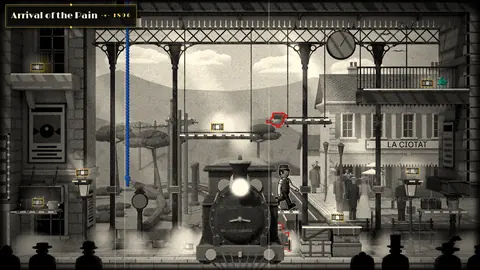
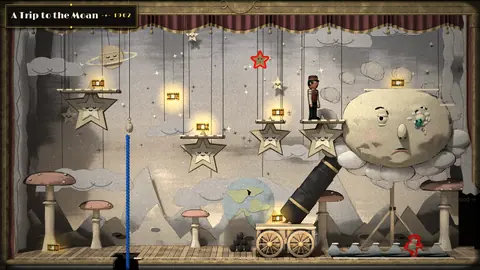
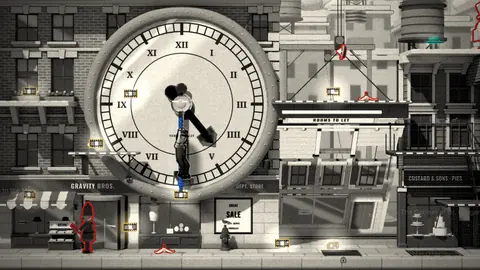
These notes come from Reel Trouble, a comedy platformer through film history. Every room in it is a movie set, built from scratch as a parody of a real film, and a fall is never a death: it is a retake.
-
 1896
Arrival of a Train at La Ciotat
Our room: Arrival of the Pain
-
 1902
A Trip to the Moon
Our room: A Trip to the Moan
-
 1923
Safety Last!
Our room: Safety Second
Free, in a desktop browser or as a download for Windows, Mac and Linux.
Quick answers
Who made The Skeleton Dance?
Walt Disney produced and directed it. Ub Iwerks animated most of it, by most accounts almost alone, and Carl Stalling wrote the music.
What music is in The Skeleton Dance?
Carl Stalling composed and arranged the score. It borrows from Edvard Grieg's piece usually called "March of the Dwarfs" (also known as the troll march), and some accounts add a nod to Saint-Saëns' Danse macabre, which other accounts leave out.
Was The Skeleton Dance the first Silly Symphony?
Yes. Duke's Center for the Study of the Public Domain calls it the first Silly Symphony short from Disney. The series then ran for years.
Is Mickey Mouse in The Skeleton Dance?
No. The Silly Symphonies had no regular star. The film is a dance of skeletons.
When was The Skeleton Dance released?
It played in Los Angeles and San Francisco in June 1929 and in New York in July. The date most often given for its release is 22 August 1929, after Columbia took over distribution.
Why was The Skeleton Dance banned in Denmark?
A report of March 1931 said Danish authorities banned it as too macabre. In 1929 the trade paper Variety had already warned parents not to bring their children.
Is The Skeleton Dance in the public domain?
In the United States, yes, since 1 January 2025, when 1929 works entered it. Mickey Mouse and other Disney characters remain trade marks, and a restoration or a recorded score can have rights of its own.
How long is The Skeleton Dance?
About five and a half minutes. It is a single reel of black and white with music and sound effects but no spoken words.
Sources and further reading
- The Skeleton Dance, Wikipedia, for the release, the credits, the cost and the later history
- Public Domain Day 2025, Duke Center for the Study of the Public Domain
- Public Domain Spotlight: The Skeleton Dance, Chris Freeland, Internet Archive blog, 13 January 2025
- The Skeleton Dance, Voted the 18th Best Cartoon of All Time, Is Now in the Public Domain, Open Culture, January 2025
- Don't bring your children: The Skeleton Dance (1929), Fiction Machine, 5 January 2025
- Silly Symphonies 1929-1935, San Francisco Silent Film Festival
- Skeleton Dance, The (film), D23, the official Disney fan club encyclopedia
- Carl Stalling, Wikipedia, on his years with Disney and the click track
- The Skeleton Dance, British Film Institute, collections record