
Palace Picture House · Programme note
Man with a Movie Camera 1929
Dziga Vertov's city film has no story, no actors and no intertitles, was called camera hooliganism in 1929, and was voted the best documentary ever in 2014.
By HertzyPertzy · Updated · 6 minute read
In short
Man with a Movie Camera (Chelovek s kinoapparatom) is a Soviet silent film of 1929 by Dziga Vertov, made at the Ukrainian studio VUFKU. It has no actors, no story and no intertitles: it assembles a day in the life of a city from footage shot in several, and shows the cameraman and the film's editor at work. Critics were divided in 1929, and Sergei Eisenstein is reported to have dismissed it. Since then it has become one of the most admired films ever made, and in 2014 Sight and Sound's critics voted it the greatest documentary of all time.
Watch the film
The whole film: 67 minutes, silent, with no music.
Played from Wikimedia Commons, which hosts this copy as a public-domain work. Nothing is fetched from there until you press play. If it will not play here, it will on their page.
- Original title
- Chelovek s kinoapparatom ("Man with a Movie Camera")
- Released
- Moscow, 9 April 1929, in two cinemas, by the account of the Eye Filmmuseum
- Made by
- VUFKU, the All-Ukrainian Photo Cinema Administration, Ukrainian SSR. Written and directed by Dziga Vertov, who credits himself as "author-supervisor of the experiment"
- Crew
- Mikhail Kaufman (camera), Yelizaveta Svilova (editing, with Vertov); Gleb Troyanski is also credited with photography in some listings
- Filmed
- About three years, in Kyiv, Odesa, Kharkiv and Moscow, as sources give them (some name only three of the four)
- Length
- About 67 to 68 minutes in six parts, one per original reel, depending on the source
- Format
- Silent, black and white; no intertitles beyond an opening statement
- Copyright
- In the public domain in the United States since 1 January 2025 (US works of 1929, per Duke). Vertov died in 1954. Modern scores and restorations are separate works with their own rights
A film with no story
There is no plot, no hero and no heroine. Man with a Movie Camera opens with a statement to the audience: what follows is an experiment in the cinematic communication of real events, made without intertitles, without a story and without theatre. English translations of the wording vary, so it is summarised here. Vertov calls himself the "author-supervisor of the experiment", not the director, and presents the film as an excerpt from a camera operator's diary.
What it shows is a day in the life of a city, from dawn to dusk. People wake, work, marry, divorce and play sport. Trams run, machines turn, motorcycles race. The film runs about 67 or 68 minutes, depending on the source, in six parts, one for each original reel.
Kino-Eye and the rejection of fiction
Dziga Vertov, born Kaufman in 1896 in Białystok, took a name usually translated as "spinning top". In a manifesto of 1922 he launched the Kinoks, a group that set itself apart from ordinary film-makers. His idea, Kino-Eye, was that the camera is a mechanical eye which sees the world better than a human one, and that the editing room then builds meaning from what it saw.
He rejected fiction. Acted drama, he argued, was another opiate of the masses and a corrupting influence on a working-class audience. His earlier newsreel series Kino-Pravda had tried to put that into practice. Man with a Movie Camera is the same belief at feature length, and at its most daring.
The trio and the studio
Three people made it. Vertov was the author. His brother Mikhail Kaufman was the cameraman, and is the man we see climbing, crouching and filming. Yelizaveta Svilova, Vertov's wife, was the editor and, on later films, his assistant and co-director. The BFI's film page notes a critic's argument that all three deserve authorship credit, and calls them the Kino-Eye Council of Three. Svilova is part of the film too: it shows an editor at work with strips of film.
The studio was VUFKU, the Ukrainian film administration. By most accounts Vertov went south because Sovkino, the Soviet company in Moscow, had dismissed him in 1927 and the central authorities would not back him. VUFKU supplied no accompaniment, and Vertov had a score arranged in haste, less than two weeks before the Moscow premiere on 9 April 1929.
One city from several
Shooting took about three years, and sources do not agree on the list of places. One account names Moscow, Kyiv, Kharkiv and Odesa. The Eye Filmmuseum says the film was shot mostly in Kyiv, Odesa and Moscow. One critic names Odesa, Kharkiv and Kyiv. The BFI's page speaks only of unidentified cities. That vagueness is the point: the film cuts them into a single imagined city, a "city symphony" in the company of Cavalcanti's Rien que les heures (1926) and Ruttmann's Berlin (1927).
The tricks
Vertov used nearly everything the camera could do: double and multiple exposure, split screens, fast and slow motion, freeze frames, reversed footage, stop motion, jump cuts, extreme close-ups and tracking shots. The cameraman is superimposed into a giant beer glass and onto a mountain-sized camera. In a stop-motion shot an unmanned camera stands up on its tripod and walks away. The film is also commonly described as showing an audience in a cinema watching, which turns the camera on the whole business of film-making. Its pace is put at about 1,775 shots, more than four times that of a typical feature of the day.
Critics have also pointed out that some scenes were staged, among them a woman dressing and the chess pieces, which sit oddly with the promise of life as it is.
Mocked, then crowned
The first reactions were mixed. Some reviewers acclaimed it, and Soviet cinemagoers are said to have liked it. Others objected to its fast cutting, its self-reference and its devotion to form over content. Sergei Eisenstein is reported to have called it pointless camera hooliganism, and Mordaunt Hall of The New York Times complained, in September 1929, that Vertov took no account of how long the eye can hold an image. By the 1930s the film and its director had fallen out of favour in the Soviet Union, and both were neglected for decades. Vertov died in Moscow on 12 February 1954.
The revival came from critics. In Sight and Sound's 2012 poll of all films it ranked 8th, and 9th in 2022. In 2014 the magazine ran its first documentary poll, and the critics put Man with a Movie Camera first, with 100 votes from 237 critics, curators and academics.
The film has also collected scores. The Alloy Orchestra wrote one in 1995, Michael Nyman in 2002, and The Cinematic Orchestra another the same year. In 2024 Richard Bossons and Leo Geyer reconstructed, from Vertov's cue notes, the music played at the 1929 premiere. All of these are separate, later works: Vertov's film was silent.
Why it matters
It is a film about filmmaking. The cameraman and the editor are in the picture, and by most accounts so is the audience, long before that became a habit of modern cinema.
It made editing the author. The meaning sits not in an actor or a plot but in the cut, and Svilova's cutting is why its rhythms work.
It is a record of a vanished present. Whatever was staged, the streets, trams and crowds of the late 1920s are there.
It is now free in the United States. Works of 1929 entered the American public domain on 1 January 2025, and Vertov died in 1954. Modern scores and restorations keep rights of their own.
On the same programme
Some of these films are rooms you can play
These notes come from Reel Trouble, a comedy platformer through film history. Every room in it is a movie set, built from scratch as a parody of a real film, and a fall is never a death: it is a retake.
-
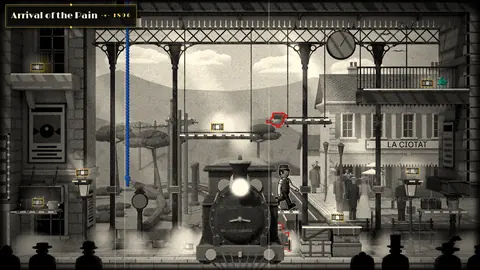 1896
Arrival of a Train at La Ciotat
Our room: Arrival of the Pain
-
 1902
A Trip to the Moon
Our room: A Trip to the Moan
-
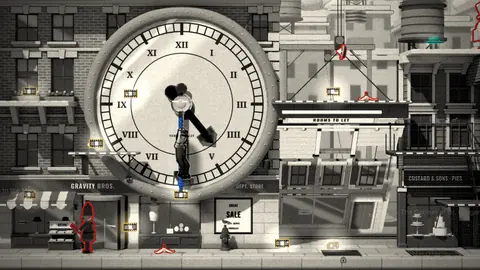 1923
Safety Last!
Our room: Safety Second
Free, in a desktop browser or as a download for Windows, Mac and Linux.
Quick answers
What is Man with a Movie Camera about?
It has no plot. It follows a day in the life of a city from dawn to dusk, cutting between people at work and play, machines, traffic and the cameraman filming them. The city is assembled from footage of several Soviet cities.
Who made Man with a Movie Camera?
Dziga Vertov directed it. His brother Mikhail Kaufman was the cameraman and the person we see filming, and Vertov's wife Yelizaveta Svilova edited it with him. The three have been called the Kino-Eye Council of Three.
Where was Man with a Movie Camera filmed?
Sources differ on the list. It was shot over about three years in Ukraine and Russia, mostly in Kyiv, Odesa and Moscow, with Kharkiv also named. The film blends them into one imagined city.
Does Man with a Movie Camera have a plot or actors?
No. Its opening statement says it is an experiment in conveying real events on film without the help of intertitles, a story or theatre, and it has no actors. Critics have noted that some shots were nonetheless staged.
Was Man with a Movie Camera the greatest documentary ever?
In 2014 Sight and Sound's first poll of documentaries put it first, with 100 votes from 237 critics, curators and academics. The film also ranked 8th in the magazine's 2012 poll of all films and 9th in 2022.
What is Kino-Eye?
Vertov's idea that the camera is a mechanical eye which can show the world better than the human eye can. With his Kinoks group he rejected acted drama in favour of filmed life, put together in the editing room.
Why did critics dislike Man with a Movie Camera in 1929?
Some reviewers attacked its fast cutting, its self-reference and its interest in form over content. Eisenstein is reported to have called it pointless camera hooliganism, and a New York Times reviewer complained about its pace.
Is Man with a Movie Camera in the public domain?
In the United States, yes: works of 1929 entered the public domain on 1 January 2025. Vertov died in 1954, so a country that protects works for the author's life plus seventy years would see that term end with 2024. Modern scores and restorations are new works with their own rights.
Sources and further reading
- Man with a Movie Camera, Wikipedia, for the credits, the cities, the techniques, the 1929 reviews and the modern scores, given here as reported
- Dziga Vertov, Wikipedia, on his manifesto of 1922, the Kinoks, Sovkino and the Kaufman family
- Dziga Vertov, Senses of Cinema, Great Directors, 2003
- Man with a Movie Camera (1929), British Film Institute, film page
- Critics' 50 Greatest Documentaries of All Time, British Film Institute, Sight and Sound poll, 2014
- Reconstructing the original music for Man with a Movie Camera, Eye Filmmuseum, Amsterdam
- Man with a Movie Camera Found the Mechanical Heartbeat of the Modern World, Paste Magazine
- Public Domain Day 2025, Duke Center for the Study of the Public Domain