
Palace Picture House · Programme note
The Cabinet of Dr. Caligari 1920
A fairground showman, a sleepwalker who kills, a town painted on canvas, and an ending people have argued about for a hundred years.
By HertzyPertzy · Updated · 6 minute read
In short
Das Cabinet des Dr. Caligari (The Cabinet of Dr. Caligari) is a German silent film directed by Robert Wiene and first shown in Berlin on 26 February 1920. A fairground showman, Dr. Caligari, exhibits a sleepwalker called Cesare who foretells deaths, and the deaths follow; then a last scene suggests that the man telling the story is a patient in an asylum. The whole film was shot in a studio on painted canvas sets, with leaning houses and light and shadow painted on. It is generally counted as the film that began German Expressionist cinema, and as an ancestor of the horror film and the psychological thriller.
- Original title
- Das Cabinet des Dr. Caligari
- Released
- 26 February 1920 at the Marmorhaus cinema, Berlin. New York: 3 April 1921. Paris: 14 November 1921
- Made by
- Directed by Robert Wiene; written by Carl Mayer and Hans Janowitz; produced for Decla by Erich Pommer and Rudolf Meinert; photographed by Willy Hameister
- Cast
- Werner Krauss (Dr. Caligari), Conrad Veidt (Cesare), Friedrich Fehér (Francis), Lil Dagover (Jane), Hans Heinrich von Twardowski (Alan)
- Design
- Hermann Warm, Walter Reimann and Walter Röhrig: painted sets, built in the Lixie studio at Weissensee, Berlin
- Length
- Six acts, 1,780 metres. The 2014 restoration, at 18 frames a second, is listed at 75 to 77 minutes
- Format
- Silent, 35 mm, black and white with tinted prints; intertitles in Expressionist lettering
- Copyright
- Public domain in the United States. In Germany and the EU, treated as free by Wikimedia Commons since 1 January 2025. Restorations and scores may have rights of their own
The story
A young man, Francis, sits on a bench and tells an older man what he and his fiancée Jane have been through.
A fair comes to the town of Holstenwall. One showman, Dr. Caligari, exhibits Cesare, a sleepwalker kept in a box like a coffin who, when woken, foretells the future. A town clerk who was rude to Caligari is found stabbed. Francis's friend Alan asks Cesare how long he has to live. Until dawn, says Cesare, and by dawn Alan is dead.
Francis watches the showman's caravan by night. Meanwhile Cesare is in Jane's bedroom with a dagger. He cannot use it. He carries her off across the rooftops, is chased, drops her and dies of exhaustion. The figure Francis saw in the box was a dummy.
Caligari runs to an asylum, and Francis finds that he is its director: a doctor obsessed with an old tale of a man called Caligari who made a sleepwalker kill for him. Shown Cesare's body, he raves and is put in a straitjacket.
Then the film returns to the bench. Francis is a patient in that asylum. So are Jane and Cesare. The man he calls Caligari is its mild director, who says he now knows how to cure him.
Who made it
The script was the first by two writers: Carl Mayer, from Graz, and the Czech-born Hans Janowitz. Janowitz traced it to a murder at a Hamburg fair in 1913; Caligari is said to be modelled on an army psychiatrist Mayer hated. They sold it to the Berlin company Decla in April 1919.
Fritz Lang, by most accounts the first choice, was busy, so Robert Wiene directed, with Erich Pommer and Rudolf Meinert producing. Werner Krauss played Caligari and Conrad Veidt Cesare; Friedrich Fehér was Francis and Lil Dagover Jane. It was shot entirely indoors, in the small Lixie studio at Weissensee, Berlin, between September 1919 and January 1920: sources differ.
For weeks beforehand, posters across Berlin said only "Du musst Caligari werden" ("You must become Caligari"), with no word of a film. The phrase comes from the film, where it haunts the obsessed doctor. It opened at the Marmorhaus cinema on 26 February 1920 and ran for four weeks.
A town painted on canvas
Nothing in Holstenwall stands straight. Houses lean, chimneys tilt, windows are shaped like kites and arrows, and light and shadow are painted directly onto the sets. Three designers did it: Hermann Warm, Walter Reimann and Walter Röhrig. Warm's formula, as Siegfried Kracauer quotes it, was "Films must be drawings brought to life".
This is what "German Expressionism" means on the screen: the picture shows a state of mind, not a place. The style came from German painting and theatre, and Decla sold this as the first Expressionist film.
Why paint it? The accounts do not agree. Warm said the designers proposed it and Wiene agreed at once. Pommer is reported to have said that canvas was chosen mainly because it was cheap, and a much-repeated story adds that electricity was rationed, so the light was painted on. The Murnau Foundation's restoration notes call those involved "less than reliable witnesses".
The quarrel over the frame
For decades the accepted account was Janowitz's. In a memoir begun in exile in 1939, he said that he and Mayer wrote a story with no frame, in which mad authority sends a helpless man out to kill, as the state had sent millions to war, and that the asylum scenes were imposed over their protests. Kracauer built his 1947 book From Caligari to Hitler on that manuscript. The frame, he wrote, turned a revolutionary film into a conformist one, and Caligari was a premonition of Hitler.
Then the script surfaced. The only known copy belonged to Werner Krauss; the Deutsche Kinemathek acquired it from his widow in the 1970s, and it was published in 1995. It already has a frame, but a different one: years later, Francis tells the story to guests at a party. What survives of it has no asylum twist. So the writers wrote neither the frameless story Janowitz remembered nor the film's ending. Who did is not known; Lang and Pommer both claimed a part. Most historians now think the script undermines Kracauer's account; not all agree.
The film is slyer than the quarrel. As Kracauer himself noticed, the asylum of the last scene is as crooked as the town in the tale, so the viewer must decide who is mad.
Reception and restoration
Berlin's critics were nearly all enthusiastic: one evening paper declared the question of whether film could be art settled. New York saw it in April 1921. In Los Angeles that May, American Legion pickets against German imports had it taken off the screen. Paris first saw it in November 1921, at a screening arranged by the critic Louis Delluc, and the French coined a word, caligarisme.
On the screen it was never black and white: prints were tinted. For its 2014 restoration, first shown at that year's Berlin film festival, the Friedrich-Wilhelm-Murnau-Stiftung went back to the camera negative, which lacks its first act, and filled the gaps from prints in archives on three continents. The colours follow the two earliest surviving prints: orange for most scenes, blue-green for night, pink for Jane's room.
The 1920 film is in the public domain in the United States. Wikimedia Commons has treated it as free in the EU since 1 January 2025, counting 70 years from the death in 1954 of Janowitz, who outlived Wiene and Mayer. Restorations and new scores can have rights of their own.
Why it matters
German Expressionist cinema starts here. The film historian David Robinson writes that it "can fairly be reckoned as the beginning" of it, and Kracauer credits it with starting a long line of German films made wholly inside the studio.
It is not the first horror film, but horror owes it a look. Films of Frankenstein, The Student of Prague and The Golem came earlier. The Deutsche Kinemathek traces lines from Caligari to Nosferatu (1922), to the hard shadows of film noir and to Tim Burton.
Its narrator may not be telling the truth. An ending that may expose the whole tale as a delusion set conventions, the Kinemathek says, for the psychological thriller.
It persuaded people that a film could be art. That was the Berlin verdict in 1920, and the film helped German cinema back onto foreign screens after the war. Kracauer still thought its direct influence abroad small: it "stood out lonely, like a monolith".
On the same programme
Some of these films are rooms you can play
These notes come from Reel Trouble, a comedy platformer through film history. Every room in it is a movie set, built from scratch as a parody of a real film, and a fall is never a death: it is a retake.
-
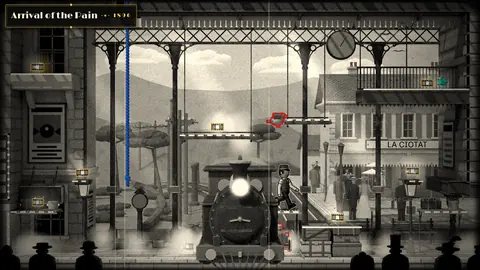 1896
Arrival of a Train at La Ciotat
Our room: Arrival of the Pain
1896
Arrival of a Train at La Ciotat
Our room: Arrival of the Pain
-
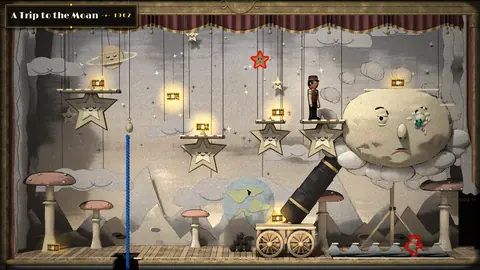 1902
A Trip to the Moon
Our room: A Trip to the Moan
1902
A Trip to the Moon
Our room: A Trip to the Moan
-
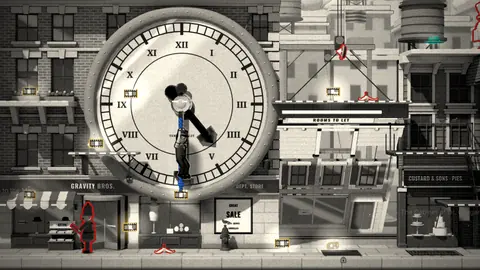 1923
Safety Last!
Our room: Safety Second
1923
Safety Last!
Our room: Safety Second
Free, in a desktop browser or as a download for Windows, Mac and Linux.
Quick answers
What is The Cabinet of Dr. Caligari about?
A fairground showman, Dr. Caligari, exhibits a sleepwalker called Cesare who foretells deaths that then happen. A young man, Francis, traces the murders to Caligari. A final scene suggests that Francis is a patient in an asylum and may have imagined it all.
What is the twist ending of The Cabinet of Dr. Caligari?
The story is told by Francis, and the last scene shows him as an inmate of an asylum whose mild director is the man he calls Caligari. The film does not settle which version is true: the asylum is filmed in the same crooked sets as the tale.
Why does The Cabinet of Dr. Caligari look so strange?
Its designers, Hermann Warm, Walter Reimann and Walter Röhrig, painted the town on canvas in the Expressionist style, with leaning walls and painted light and shadow. Accounts of why differ: art, fashion, a small budget and, in a much-repeated story, rationed electricity.
Is The Cabinet of Dr. Caligari the first horror film?
No. Horror stories had been filmed before, among them an American Frankenstein in 1910 and the German The Student of Prague in 1913. It is generally counted as the first Expressionist film, and as one of the most influential early horror films.
Was the ending of Caligari forced on the writers?
Hans Janowitz said so, and Siegfried Kracauer's book From Caligari to Hitler (1947) made the claim famous. The one surviving script, published in 1995, already has a frame story, though a different one without the asylum twist. Who added the twist is not known.
Is The Cabinet of Dr. Caligari in black and white or colour?
It was shot on black-and-white film, but the prints shown in cinemas were tinted. The 2014 restoration follows the two earliest surviving prints: orange for most scenes, blue-green for night scenes and pink for Jane's room.
How long is The Cabinet of Dr. Caligari?
Six acts, or 1,780 metres of film. The 2014 restoration, which runs at 18 frames a second, is listed at 75 to 77 minutes.
Is The Cabinet of Dr. Caligari in the public domain?
In the United States, yes. In Germany and the EU, Wikimedia Commons has treated the 1920 film as free since 1 January 2025, counting 70 years from the death of Hans Janowitz in 1954. The 2014 restoration and modern scores may have rights of their own.
Sources and further reading
- The Cabinet of Dr. Caligari: brochure for the 2014 digital restoration, with the restorers' notes on the negative, the prints and the colours, Friedrich-Wilhelm-Murnau-Stiftung and Bertelsmann, 2014
- Das Cabinet des Dr. Caligari nach Restaurierung jetzt in digitaler Kinoqualität, Friedrich-Wilhelm-Murnau-Stiftung
- Be Caligari! The Virtual Cabinet: press folder for the centenary exhibition, Deutsche Kinemathek, Berlin, 2020
- Das Cabinet des Dr. Caligari (1919/1920): credits and technical data, filmportal.de
- Caligari, from From Caligari to Hitler (1947), Siegfried Kracauer, as reprinted in Mike Budd (ed.), The Cabinet of Dr. Caligari: Texts, Contexts, Histories, Rutgers University Press, 1990
- The Cabinet of Dr. Caligari: programme notes, with an extract from David Robinson's BFI Film Classics book (2nd edition, 2013), BFI Southbank, January 2022
- De Louis Delluc à Caligari… L'introduction du cinéma allemand en France, Marc Lavastrou, Trajectoires no. 5, 2011
- Dr. Caligari and the Rise of American Nationalism, Mary Mallory, LA Daily Mirror, 2022, on the Los Angeles protest
- The Cabinet of Dr. Caligari (1920), Michael Toole, Turner Classic Movies, for the electricity story
- The Cabinet of Dr. Caligari, Wikipedia, for the contents of the surviving script and the points given here as "reported" or "said"