
Palace Picture House · Programme note
All Quiet on the Western Front 1930
Universal filmed Remarque's novel within a year, built a battlefield on a California ranch, won Best Picture, and saw Goebbels's supporters wreck its Berlin screenings.
By HertzyPertzy · Updated · 6 minute read
In short
All Quiet on the Western Front is a 1930 American war film directed by Lewis Milestone for Universal, from Erich Maria Remarque's novel of 1929. It follows a class of German schoolboys, led into the army by their teacher, through the trenches of the First World War. Lew Ayres plays Paul Bäumer. It won the Academy Awards for Best Picture and Best Director, was banned in Germany after Nazi supporters disrupted its Berlin screenings in December 1930, and survived for decades only in cut versions. It entered the US public domain on 1 January 2026.
Watch the film
It is not played on this page: see where to watch it.
Find where to stream, rent or buy it, on JustWatch.
- Released
- Previewed in Los Angeles on 21 April 1930 and in New York on 25 April; London on 14 June; general US release on 24 August 1930
- Made by
- Universal Pictures. Produced by Carl Laemmle Jr.; directed by Lewis Milestone; dialogue by Maxwell Anderson, screenplay by George Abbott, adaptation by Del Andrews; photographed by Arthur Edeson; music by David Broekman
- Cast
- Lew Ayres (Paul Bäumer), Louis Wolheim (Katczinsky), John Wray (Himmelstoss), Ben Alexander (Kemmerich), Beryl Mercer (Paul's mother)
- Source
- Erich Maria Remarque's novel Im Westen nichts Neues, serialised in a German newspaper in 1928 and published as a book in 1929
- Filmed
- On a battlefield built on about twenty acres of ranch land in Orange County, California, with some 2,000 ex-servicemen as extras; two cameras side by side for English and international sound versions
- Length
- About 152 minutes in the first version; cut again and again afterwards. A restoration of about 133 minutes is reported from 2006
- Honours
- Academy Awards for Outstanding Production (Best Picture) and Best Director at the 3rd ceremony; added to the US National Film Registry in 1990
- Copyright
- In the public domain in the United States since 1 January 2026, as Duke's Center for the Study of the Public Domain lists it. In the EU it stays protected for longer: Milestone died in 1980
The book and the bet
Erich Maria Remarque fought on the Western Front and was wounded five times. His novel Im Westen nichts Neues ran in a German newspaper in 1928 and came out as a book in 1929. By one account it sold 2.5 million copies in eighteen months, in 25 languages.
Carl Laemmle Jr. had just been made head of production at Universal, a twenty-first birthday present from his father, the company's founder. He wanted prestige pictures in place of cheap ones, and his first big project was this novel. Universal bought the rights in 1929. Doubts inside the studio are said to have been strong, and the elder Laemmle, a pacifist by one account, is credited with insisting.
The director was Lewis Milestone, who had won the only Oscar ever given for comedy direction, for Two Arabian Knights (1927). He found the first script too far from the book, and Maxwell Anderson wrote the dialogue. Budget figures range from about 1.2 to nearly 1.5 million dollars.
A battlefield in California
The war was staged on about twenty acres of ranch land in Orange County. Film-location listings name the Irvine Ranch; a magazine of March 1930 says only "down near Balboa". Veterans of the war planned the ground. Trenches were dug, charges were buried and wired to one switchboard, and German guns were brought in. More than 2,000 ex-servicemen were hired as extras, among them German veterans living in Los Angeles.
Two cameras were set side by side, one for an English sound version and one for an international version. Arthur Edeson photographed it, and the long tracking shots across the battlefield are among the film's best-known pictures.
Paul, and the butterfly
Lew Ayres, aged twenty, had played opposite Greta Garbo in The Kiss (1929). John Wray was first slated for Paul, and Douglas Fairbanks Jr. was unavailable. Milestone watched the screen tests and, by his own account, said of Ayres: "I think this is our man." Wray took a supporting part. Ayres became a star and won a Universal contract.
The ending is the film's best-known image. Paul sees a butterfly beyond the lip of his trench and reaches out. A sniper shoots him. Later, by one account, the shot of the hand was made during editing, when the actors were gone, and the hand in it is Milestone's.
Ayres became a pacifist. When America entered the Second World War he was drafted and declared himself a conscientious objector, in March 1942, which caused public outcry. Sources say he had first asked for non-combat service as a medic. He served about three and a half years in the medical corps, in the Pacific, and received three battle stars. His acting career suffered for a time.
Sound, and silence
This was the first winter of the talkies, and many cinemas had no sound equipment. The film was one of the first released both in sound and in silent versions, the silent one for the houses not yet wired. The first version ran about 152 minutes. It was previewed in April 1930, opened in London in June and went on general release in August.
At the third Academy Awards it won Outstanding Production, the prize now called Best Picture, and Best Director for Milestone. It is described as the first sound war film to win Oscars.
Berlin and the bans
The German premiere took place in Berlin in the first week of December 1930. Sources give the date as 4 December or 5 December, and name the Mozart Hall. Joseph Goebbels's Nazi supporters had bought about a third of the tickets. By the account in The Telegraph, Goebbels left his seat about ten minutes in and signalled the others. They shouted slogans and released stink bombs and white mice,. He noted in his diary that the cinema was like a madhouse. There was rioting outside, and trouble went on for several days.
The German film board banned the film within days. One account gives 11 December. The historian Alexander Watson says the stated ground was public order, not any inaccuracy in the film. After small changes, which the German embassy had suggested, a cut version was shown again in September 1931. After the Nazis took power in 1933 it was banned once more. West Germany released it again in April 1952.
Other countries acted too. Italy and Austria banned it in 1931, and other bans are reported in Hungary, Bulgaria and Yugoslavia. In Australia the state of Victoria banned it from 1930 to 1941 as pacifist, though it ran freely in other states. France is said by one source to have banned it until 1963, and by another only to have cut a scene with French women. Remarque himself is said to have edited a German version that cut many overt signs of German militarism.
Cut, and restored
The film then lost about a third of its length by stages. The British censors trimmed it. The 1939 reissue was cut to ten reels, and the reissues of 1950 and 1958 ran 102 minutes. Milestone asked Universal before he died in 1980 to restore it. A Library of Congress restoration of 2006 is reported at 133 minutes with all known surviving footage. One print from Goebbels's own collection is said to have been used in a restoration.
Germany saw a dubbed reconstruction of the original cut on television in 1984; nearly eleven million people are said to have watched. A television remake followed in 1979. Edward Berger's German-language version, with Felix Kammerer, came out on Netflix in 2022 and won four Oscars, among them Best International Feature.
Why it matters
It put the soldier's side of the war on screen. It told the war from the enemy's trenches, with a German boy as its hero, and Hollywood and the public took to it.
It made the battlefield look real. The Smithsonian's air and space museum says Milestone shaped the realistic look of war films, and credits him as an inspiration for Saving Private Ryan (1998).
It shows what a regime fears. A film was banned in Germany for a story of German soldiers. Its books were burned and its screenings wrecked.
It is free in the United States. Duke's Center for the Study of the Public Domain lists it among the films that entered the public domain on 1 January 2026. In the European Union it remains protected.
On the same programme
Some of these films are rooms you can play
These notes come from Reel Trouble, a comedy platformer through film history. Every room in it is a movie set, built from scratch as a parody of a real film, and a fall is never a death: it is a retake.
-
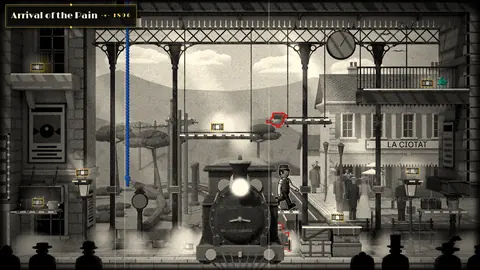 1896
Arrival of a Train at La Ciotat
Our room: Arrival of the Pain
-
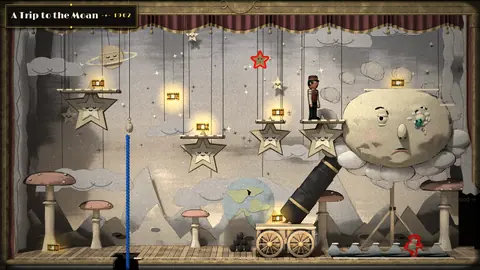 1902
A Trip to the Moon
Our room: A Trip to the Moan
-
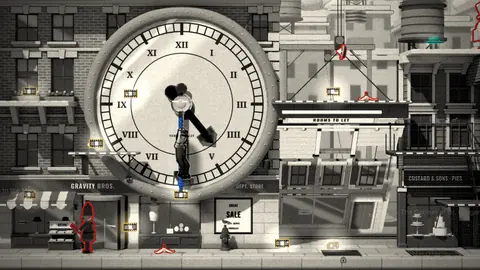 1923
Safety Last!
Our room: Safety Second
Free, in a desktop browser or as a download for Windows, Mac and Linux.
Quick answers
What is All Quiet on the Western Front (1930) about?
A German schoolboy, Paul Bäumer, and his classmates volunteer for the army in 1914 after a teacher's speech. In the trenches they lose their friends and their illusions, and Paul is killed in the last scene, reaching for a butterfly.
Whose hand reaches for the butterfly at the end?
By one account the shot was made during editing, when the actors were no longer available, and the hand is the director Lewis Milestone's, not Lew Ayres's.
Why was All Quiet on the Western Front banned in Germany?
After Nazi supporters under Joseph Goebbels disrupted the Berlin screenings in December 1930, the German film board banned it within days. The stated grounds were public order, according to the historian Alexander Watson. A cut version was shown from 1931 and it was banned again after 1933.
Did All Quiet on the Western Front win Best Picture?
Yes. At the 3rd Academy Awards it won Outstanding Production, the award now called Best Picture, and Milestone won Best Director. It is described as the first sound war film to win Oscars.
Where was All Quiet on the Western Front filmed?
In California. Universal rebuilt a stretch of the front on about twenty acres of ranch land in Orange County, near Balboa and Laguna Beach. Film-location listings name it as the Irvine Ranch.
Was Lew Ayres a conscientious objector?
Yes. After the United States entered the Second World War he declared himself a conscientious objector, which caused public outcry. He then served about three and a half years as a medic and chaplain's assistant, and received three battle stars.
Is there a silent version of All Quiet on the Western Front?
Yes. Not every cinema was wired for sound in 1930, so Universal also issued a version for silent houses, one of the first films released both ways.
Is All Quiet on the Western Front in the public domain?
In the United States, yes, since 1 January 2026. In the European Union it is still protected, because Milestone died only in 1980.
Sources and further reading
- All Quiet on the Western Front (1930 film), Wikipedia: credits, versions, awards, the butterfly shot, the German ban and the bans elsewhere
- Public Domain Day 2026, Duke Center for the Study of the Public Domain
- The Big Idea: All Quiet on the Western Front, Turner Classic Movies, on Laemmle Jr., Milestone and the casting of Ayres
- All Quiet on the Western Front, Turner Classic Movies, on the battlefield and the extras
- All Quiet on the Western Front, Loretta K. Dean, American Cinematographer, March 1930, on the built battlefield near Balboa
- All Quiet, Harry Ransom Center, University of Texas, on Remarque's German cut, the bans and the 1984 broadcast
- Why the 'Jewish treachery' of All Quiet on the Western Front drove Joseph Goebbels mad, Tom Fordy, The Telegraph, 2023, on the Berlin screenings
- Lew Ayres, Wikipedia, on his casting and his conscientious objection
- All Quiet on the Western Front (film), EBSCO Research Starters, on the silent version, the French and German objections and the later versions
- The first significant anti-war movie, Smithsonian National Air and Space Museum