
Palace Picture House · Programme note
Animal Crackers 1930
The Marx Brothers filmed their Broadway hit in Queens, cut most of the songs, then watched the film disappear for years over rights.
By HertzyPertzy · Updated · 6 minute read
In short
Animal Crackers is an American comedy of 1930 directed by Victor Heerman for Paramount, the second film of the Marx Brothers. It is based on their Broadway musical of 1928, with Groucho as the explorer Captain Spaulding and Margaret Dumont as the hostess he insults. A painting goes missing at a Long Island party and nobody much minds. The film dropped most of the stage songs, was kept off American screens for years by a tangle of rights, and came back after a student campaign in the 1970s. It entered the public domain in the United States on 1 January 2026.
Watch the film
The whole film: 98 minutes, with its sound.
Played from Wikimedia Commons, which hosts this copy as a public-domain work. Nothing is fetched from there until you press play. If it will not play here, it will on their page.
- Premiere
- 28 August 1930, Rialto Theatre, New York
- Made by
- Paramount Pictures. Directed by Victor Heerman, produced by Walter Wanger, screenplay by Morrie Ryskind, photographed by George J. Folsey
- Cast
- Groucho, Harpo, Chico and Zeppo Marx, Margaret Dumont, Lillian Roth, Hal Thompson
- Based on
- The Broadway musical Animal Crackers (1928): book by George S. Kaufman and Morrie Ryskind, songs by Bert Kalmar and Harry Ruby
- Filmed
- Paramount's Astoria Studios in Queens, New York. Principal photography began on 28 April 1930 and was complete by mid-June
- Length
- 98 minutes. The 1936 reissue was about a minute and a half shorter
- Format
- Sound (early talkie), black and white, 35 mm, English
- Copyright
- The film has been in the public domain in the United States since 1 January 2026, as Duke's Center for the Study of the Public Domain lists it. The stage musical, its songs and any later restorations are separate works, and the Marx Brothers' names and likenesses are a separate matter again, so this page links to no copy
From the stage
Animal Crackers was a Broadway musical before it was a film. It opened on 23 October 1928 at the 44th Street Theatre and closed in April 1929 after 191 performances. George S. Kaufman and Morrie Ryskind wrote the book, and Bert Kalmar and Harry Ruby the songs. The four Marx Brothers starred, with Margaret Dumont as the hostess. It was their second Broadway show, after The Cocoanuts.
Paramount had bought the sound rights by March 1930 and shot the film at its Astoria Studios in Queens, from 28 April to about mid-June. The brothers had already made their first film, The Cocoanuts, in the same studio the year before. Turner Classic Movies says they played Animal Crackers on stage in the evenings while they filmed by day. That fits the 1929 shoot, when the show was still running. The stage run had closed by the time this film was made, so the story belongs to their first film more than to this one.
Ryskind, who wrote the screenplay, is said to have toured with the brothers to pick out what to keep. Several stage players repeated their roles, among them Dumont. The young lovers were recast, Lillian Roth and Hal Thompson replacing the stage pair. Roth later wrote that she had been sent east as a kind of punishment. She remembered the set as little better than a circus.
What reached the screen
Not much of the music. Most of the songs were dropped and some roles were merged. Heerman is reported to have persuaded the brothers to favour the comedy, and a test screening is said to have backed him. The song that stayed, "Hooray for Captain Spaulding", was kept at Ryskind's urging. "Why Am I So Romantic?" was written for the film.
The plot is thin, and meant to be. At a Long Island party Mrs. Rittenhouse unveils a famous painting, After the Hunt, by a fictional artist. Captain Spaulding, an African explorer played by Groucho, arrives on a stretcher to a chorus of the song. The painting vanishes, and copies of it multiply until Harpo's Professor ends up holding every one. Chico plays the musician Ravelli. In between come Groucho's soliloquies in a parody of a Eugene O'Neill play, a dictated letter to a firm of lawyers, and a pantomime in which Groucho and Dumont say nothing at all.
Sound in 1930
Sound was new and awkward. Directors of early talkies kept camera movement to a minimum. Paper props were soaked in water so that they would not crackle. Music was recorded on the set, not added afterwards, so the middle of a scene could not be cut without a break in the tune. Heerman said the music department chose the takes, once because the clarinet sounded better in one of them. The film is often called stagey. Filmsite says so too, while granting that its quick-fire style is pure Marx Brothers.
The years out of sight
By most accounts, the American rights to the film reverted to its authors in the 1950s. Sources differ on the date of its last regular showing and on the detail of the legal tangle. One account says Paramount held the rights for a fixed period, reportedly forty years. Universal, which had bought the Paramount Marx films, did not think it worth the cost of buying the rights back. Fans knew the film mostly from rumour and rare prints. Around 1972, one small cinema in Westwood, Los Angeles, ran a 16 mm copy under the label of a Marx Brothers film festival.
The campaign to bring it back is credited to a student, Steve Stoliar, who rang Groucho. On 7 February 1974 Groucho appeared at UCLA with the student Committee for the Re-release of Animal Crackers, before about 200 students and more than 2,000 petition signatures. Universal then reached terms with the authors and their estates. Test screenings followed in Los Angeles and New York, and the New York one is reported to have nearly caused a riot. CBS broadcast the film on 21 July 1979.
The cuts, restored
A reissue in 1936 trimmed the film by about a minute and a half to meet stricter enforcement of the Production Code. Gone were a line in the Spaulding song, a gag in which Harpo pulls a slip from under a lady's dress and a joke about a shotgun wedding. By one account that cut version was the only one shown in the United States until 2016. That year Universal restored the film in 4K from a nitrate duplicate negative supplied by the British Film Institute, which still held those passages. Film Forum billed them as footage long thought lost.
Where it stands now
Duke's Center for the Study of the Public Domain lists the film among those that entered the public domain in the United States on 1 January 2026. Only the 1930 film is meant: Duke notes that later restorations may carry new material with rights of their own. By one account the stage musical's songs entered the public domain in the United States in 2024 and its script in 2025. The Marx Brothers' names and images are a different matter from the copyright in any film.
Why it matters
It is a record of a stage hit. It was the last of the brothers' film adaptations of their stage shows, and it keeps the lines of a Broadway comedy that otherwise survives only in scripts and memory.
It gave Groucho his song. An instrumental "Hooray for Captain Spaulding" served as the theme of You Bet Your Life for most of its run, and it became one of his signature songs.
It shows what a rights tangle can do. A hit film was kept from American audiences for years, and was brought back by students with a petition and a telephone.
It is free at last. Since 1 January 2026 the film itself is out of copyright in the United States, with its once-cut lines intact in the restoration of 2016.
On the same programme
Some of these films are rooms you can play
These notes come from Reel Trouble, a comedy platformer through film history. Every room in it is a movie set, built from scratch as a parody of a real film, and a fall is never a death: it is a retake.
-
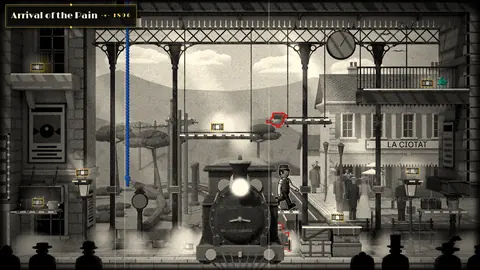 1896
Arrival of a Train at La Ciotat
Our room: Arrival of the Pain
-
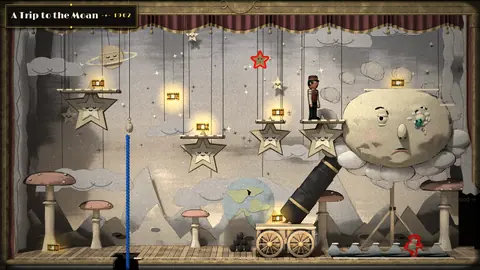 1902
A Trip to the Moon
Our room: A Trip to the Moan
-
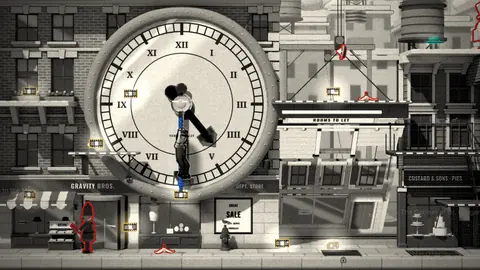 1923
Safety Last!
Our room: Safety Second
Free, in a desktop browser or as a download for Windows, Mac and Linux.
Quick answers
What is Animal Crackers (1930) about?
A society party on Long Island honours the explorer Captain Spaulding, just back from Africa, and unveils a famous painting. The painting is stolen, copies multiply, and the guests spend most of the evening being insulted by Groucho and robbed by Harpo.
Was Animal Crackers a stage show first?
Yes. It opened on Broadway on 23 October 1928 at the 44th Street Theatre, with the four Marx Brothers and Margaret Dumont in the cast. George S. Kaufman and Morrie Ryskind wrote the book, and Bert Kalmar and Harry Ruby the songs.
Who sings Hooray for Captain Spaulding?
The song greets Groucho's Captain Spaulding in both the stage show and the film. An instrumental version later served as the theme of Groucho's quiz show You Bet Your Life for most of its run.
Why was Animal Crackers unavailable for so long?
By most accounts the American rights reverted to the authors in the 1950s, after which the film could not be shown legally in the United States. Universal, which owned the film, reached an agreement with the authors and their estates in 1974.
Is Animal Crackers in the public domain?
The 1930 film has been in the public domain in the United States since 1 January 2026. The stage musical and its songs are separate works with their own dates, and modern restorations can carry rights of their own.
Where was Animal Crackers filmed?
At Paramount's Astoria Studios in Queens, New York, from 28 April 1930 to mid-June. The manor house set built for it was, by one account, the largest made at Astoria up to then.
What was cut from Animal Crackers and later restored?
A 1936 reissue trimmed a line from the Spaulding song, a Harpo gag with a slip and a shotgun-wedding joke, to suit the stricter Production Code. A 2016 restoration from a British Film Institute negative put them back.
Is Margaret Dumont in Animal Crackers?
Yes. Dumont plays Mrs. Rittenhouse, the hostess, as she had on the stage, and she is the target of much of Groucho's insulting.
Sources and further reading
- Animal Crackers (1930 film), Wikipedia: the shoot, the sound recording, the 1936 reissue, the rights history and the 1974 campaign, as reported there
- Animal Crackers (musical), Wikipedia: the Broadway run, authors and cast; the status of the songs and script as stated there
- Public Domain Day 2026, Center for the Study of the Public Domain, Duke University School of Law
- Animal Crackers, Turner Classic Movies, on the stage hit and the Astoria studio
- The Marx Brothers' Animal Crackers, News From ME, on the withdrawn film and its return
- Newly Discovered Marx Bros Footage, BroadwayWorld, 22 September 2016, on the Universal restoration
- Animal Crackers (Screen Deco), Film Forum, New York, notes on the 4K restoration
- Animal Crackers (1930), Filmsite, on the plot and the best-known scenes