
Palace Picture House · Programme note
Hell's Angels 1930
Howard Hughes began a silent flying film in 1927, reshot most of it for sound, made a star of Jean Harlow, and lost four men to the flying.
By HertzyPertzy · Updated · 6 minute read
In short
Hell's Angels is a 1930 American war film produced and directed by Howard Hughes, about two English brothers who become Royal Flying Corps pilots in the First World War. Hughes began it as a silent film in 1927 and, after the arrival of sound, reshot most of the talking scenes with a new leading lady, Jean Harlow. Its air battles, filmed with a fleet of real aircraft, are still the reason to watch it. Four airmen died while it was made, and it entered the public domain in the United States on 1 January 2026.
Watch the film
The whole film: 131 minutes, the roadshow version, from Universal's 4K restoration of a 35 mm dupe negative, with its sound.
Played from Wikimedia Commons, which hosts this copy as a public-domain work. Nothing is fetched from there until you press play. If it will not play here, it will on their page.
- Premiere
- 27 May 1930, Grauman's Chinese Theatre, Hollywood
- Made by
- Produced and directed by Howard Hughes; James Whale staged the dialogue, which Joseph Moncure March wrote. Cinematography by Tony Gaudio and Harry Perry
- Cast
- Ben Lyon, James Hall and Jean Harlow (as Helen)
- Filmed
- From 31 October 1927 as a silent film; largely reshot for sound from about 1929. Flying scenes in California
- Length
- About 131 minutes. The original British release was cut by more than 30 minutes
- Format
- Sound, 35 mm. Black and white, with some tinted scenes and one sequence in two-colour process
- Cost
- Often reported as $4 million; a figure of $2.8 million is given elsewhere. Reported box office, by one account, nearly $18 million
- Copyright
- In the public domain in the United States since 1 January 2026, as Duke's Center for the Study of the Public Domain lists it. Not covered here for other countries; modern restorations have rights of their own
The story
Two English brothers are friends with a German student, Karl, before the First World War, and the war parts them. Both brothers fly for Britain, and Helen, a British siren played by Jean Harlow, is at the centre of their story.
The film then turns to the air. A German Zeppelin raids London. Karl, a German officer aboard, is made to spot for the crew. Pursued by British fighters, the captain has his men jump overboard and cuts Karl's cable himself. A British flyer then dives into the airship and it crashes. The brothers also fly a captured German Gotha bomber.
Who made it
Howard Hughes took the credit as producer and director. It was conceived as a silent film, with Marshall Neilan to direct. Neilan quit after a few weeks, Luther Reed and then Edmund Goulding followed, and Hughes took over. Principal photography began on 31 October 1927.
Hughes directed the air scenes himself, by most accounts from overhead and by radio. The cinematographer Elmer Dyer filmed many of them, and Paul Mantz was the chief stunt pilot. Hughes had a fleet. The Smithsonian says upwards of 50 aircraft were assembled, nearly half of them real First World War machines, and about 75 pilots flew. Other accounts say more than 40 planes, and Hughes himself inflated the number. American biplanes were disguised as British and German types, and a Sikorsky stood in for the Gotha. By one count, 137 pilots took part in the last big flying scene.
Sound, and a new leading lady
Then The Jazz Singer arrived, and a silent war film looked out of date. Hughes, who is said to have spent about $2 million already, kept the flying, added sound effects, and reshot nearly all of the talking scenes. The silent cut was previewed in March 1929. By one account Hughes scrapped it at the urging of the English stage director James Whale, who was brought in to direct the dialogue.
Sources differ on how Whale's credit reads. One reviewer says he was credited with having "staged" the dialogue, which was rewritten by Joseph Moncure March; another account treats the film as his uncredited debut. Either way it was his first film work.
The silent version's Helen was the Norwegian actress Greta Nissen. In a talkie her accent was thought wrong for an English society woman, and she was replaced. She was paid for her work. Jean Harlow, 18 when cast, took the part. Harlow was third-billed in the film but top-billed on the posters. Not everyone rated her acting, but the film made her a star. Its line "Would you be shocked if I put on something more comfortable?" is still quoted.
The flying, and the four men who died
Four men died. They were pilots Al Johnson, C. K. Phillips and Rupert Syme Macalister, and the mechanic Phil Jones. Johnson, carrying parts from Glendale, hit wires while landing at Caddo Field and died of his burns the next day. Phillips crashed an S.E.5 while delivering it to the Oakland location. Macalister, an Australian, died in an accident that was never fully explained. Jones died on 22 March 1929 aboard the Sikorsky doubling for the Gotha: it was crashed on purpose, the pilot Al Wilson bailed out, and Jones, who was running a smoke generator, did not get out in time. Some older accounts speak of two stunt pilots and a mechanic, and sources differ on the count.
Hughes was hurt too. Mantz is said to have warned that the final pull-out was too dangerous for his pilots. Hughes flew it himself, crashed, and suffered a skull fracture and facial injuries that needed surgery.
Colour, money and the premiere
Most of the film is black and white, with some scenes tinted. The Zeppelin's flames are in part-screen colour, and the ball scene is in a two-colour process. By one account that scene was filmed in the Multicolor process and printed by Technicolor, and it is said to be the only colour footage of Harlow.
The cost is disputed. The figure of $4 million was widely reported and is repeated by the Smithsonian, which calls it the most expensive production of its era. One detailed account gives $2.8 million, calls the larger figure a publicity myth, and puts the film below the cost of Ben-Hur (1925). Takings are disputed too: one reviewer says nearly $18 million, while another account gives a rental of $2.5 million and says it did not make back its cost. Turner Classic Movies says only that it was a popular success that could not recoup its costs at first.
The premiere was at Grauman's Chinese Theatre on 27 May 1930, according to the George Eastman Museum, which holds the programme, and TCM, which says a crowd of about 50,000 gathered and a fighter squadron flew over.
Why it matters
It is a record of a lost kind of flying. Real aircraft, flown by real pilots, in formation and in combat. That is why the film is remembered, and why four men are named above.
It shows the talkie panic at its height. A film half-made as a silent was largely remade. It is a plain case of what sound did to an industry.
It made Jean Harlow. Duke's list of the 2026 films describes it as her film debut; other accounts treat it as her first substantial role. By most accounts it made her a star.
It is now free to use in the United States. Duke's Center for the Study of the Public Domain names it among the films that entered the public domain on 1 January 2026. Elsewhere, and for any restoration, other rules apply.
On the same programme
Some of these films are rooms you can play
These notes come from Reel Trouble, a comedy platformer through film history. Every room in it is a movie set, built from scratch as a parody of a real film, and a fall is never a death: it is a retake.
-
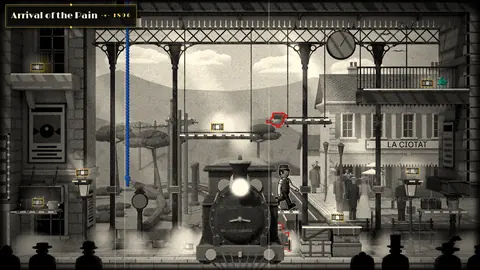 1896
Arrival of a Train at La Ciotat
Our room: Arrival of the Pain
-
 1902
A Trip to the Moon
Our room: A Trip to the Moan
-
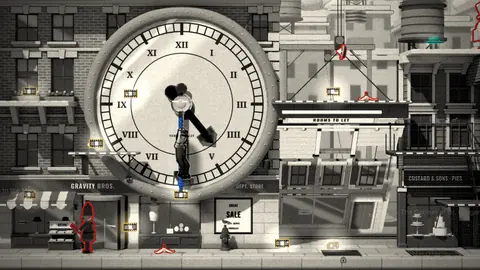 1923
Safety Last!
Our room: Safety Second
Free, in a desktop browser or as a download for Windows, Mac and Linux.
Quick answers
Who directed Hell's Angels (1930)?
Howard Hughes is the credited director. Marshall Neilan left early, Luther Reed and Edmund Goulding were involved for a time, and James Whale was brought in to direct the dialogue scenes when the film was turned into a talkie.
Why was Greta Nissen replaced by Jean Harlow?
Nissen played the leading lady in the silent version. Once the film was reshot with sound, her Norwegian accent was judged wrong for a British role, and Hughes recast. She was paid for her work. Harlow was 18.
How many people died making Hell's Angels?
Four: three pilots and a mechanic, by most accounts. They were Al Johnson, C. K. Phillips, Rupert Syme Macalister and the mechanic Phil Jones. Some older accounts speak of two stunt pilots and a mechanic.
How much did Hell's Angels cost?
It is often said to have cost $4 million, which made it the most expensive film of its time. A figure of $2.8 million is also given, and one account calls the $4 million a publicity number. Sources differ.
Is there colour in Hell's Angels?
Mostly it is black and white, with some scenes tinted one colour. A ball scene is in a two-colour process and is said to be the only colour footage of Jean Harlow. The flames on the Zeppelin are in part-screen colour.
Was Hell's Angels a silent film?
It began as one. Filming started on 31 October 1927, and a silent version was previewed in March 1929. Hughes then had most of the dialogue scenes reshot with sound, and it was released as a talkie in 1930.
Is Hell's Angels in the public domain?
In the United States, yes: Duke's Center for the Study of the Public Domain lists it among the films that entered the public domain on 1 January 2026. Other countries have their own terms.
Where did Hell's Angels premiere?
At Grauman's Chinese Theatre in Hollywood on 27 May 1930. Some web pages give other dates, but archive and museum accounts agree on 27 May.
Sources and further reading
- Hell's Angels (film), Wikipedia, for the production, the cast changes, the deaths and the cost figures
- Public Domain Day 2026, Jennifer Jenkins and James Boyle, Duke Center for the Study of the Public Domain
- Hell's Angels (1930), Turner Classic Movies
- Collections Highlight: Hell's Angels Premiere Program, George Eastman Museum
- Hell's Angels, Smithsonian National Air and Space Museum
- Hell's Angels (1930), Ferdy on Films, on Whale, the Zeppelin raid, the colour scene and the box office
- How a hundred takes got Hughes his nickname, HistoryNet, on the deaths, the aircraft and Hughes's crash