
Palace Picture House · Programme note
Kalidas 1931
Eight days in a Bombay studio produced a film billed as the first Tamil and Telugu talkie, which Madras queued to hear on Diwali and no one can now see.
By HertzyPertzy · Updated · 5 minute read
In short
Kalidas is an Indian sound film of 1931, directed by H. M. Reddy and produced in Bombay for Ardeshir Irani. It reached Madras on Diwali that year, advertised as the first Indian Tamil and Telugu talkie, with T. P. Rajalakshmi as the heroine. Historians still argue over its languages, its cast, its number of songs and whether it deserves the "first". What is not disputed is that the songs made it a hit and that no print, record or songbook is known to survive. It is one of the films that the arrival of sound in India left behind only as stills and advertisements.
Watch the film
There is no clean free copy to play or link to here.
Kalidas
1931
- Original title
- Kalidas; the Tamil press printed it as "Kalidasa"
- Released
- Madras, on Diwali, advertised for 31 October 1931, at the Kinema Central cinema (the exact advertisement date is itself disputed)
- Made by
- Produced by Ardeshir Irani (credited to Imperial Movi-Tone; some lists give his Sagar Movietone). Director H. M. Reddy, once Irani's assistant
- Cast
- T. P. Rajalakshmi (the heroine), P. G. Venkatesan (usually billed as Kalidas, but disputed), L. V. Prasad in a comic part. Sources differ on who played the hero
- Filmed
- In Bombay, in about eight days, reportedly on the sets of Alam Ara; the sound was recorded by German technicians on German equipment, as one account tells it
- Length
- Given as 6,000 or 10,000 feet depending on the source; one account puts it at roughly an hour and a half
- Format
- Sound, black and white, with songs and dialogue in more than one language: Tamil, Telugu and some Hindi, in proportions sources dispute
- Copyright
- Lost, so there is nothing to watch. By the text of India's Copyright Act, a film's term runs 60 years from the start of the year after publication, long past for a film of 1931. Due to enter the public domain in the United States on 1 January 2027 with the other works of 1931, as the usual 95-year rule would have it
The story
Vidhyadhari is the daughter of King Vijayavarman of Thejavathi. She refuses to marry the minister's son, and the minister takes his revenge: he has her married to an illiterate cowman. She prays to the goddess Kali, who names the man Kalidas and gives him a gift for poetry. The tale is the legend of the Sanskrit poet Kalidasa, told as a devotional romance with songs.
The plot was the least of it. In 1931 people went to hear their own language come out of the screen.
Who made it, and how fast
Sound arrived in Indian cinema in 1931. Alam Ara, a Hindustani film made by Ardeshir Irani, opened at the Majestic Cinema in Bombay on 14 March and is widely called India's first sound feature. Kalidas followed within months, again from Irani's circle. It was directed by H. M. Reddy, a Telugu speaker who had studied in Bangalore, had been Irani's assistant and later became a leading figure in Telugu cinema.
It was made in Bombay, in about eight days, reportedly on the sets of Alam Ara, for a budget given as 8,000 rupees. By one account the sound was recorded by German technicians on German equipment. The company is usually named as Imperial Movi-Tone, though some lists credit Sagar Movietone, a company Irani had started and then left. Sources differ on its length, from 6,000 to 10,000 feet.
The cast came from the southern stage. T. P. Rajalakshmi, born around 1911 and then a stage singer in a drama troupe, played the heroine. Billing gives P. G. Venkatesan as Kalidas, and L. V. Prasad is said to have played a comic priest. A study of the songbooks argues that the hero was in fact V. R. Gangadhar, so the cast is another point sources dispute.
Diwali in Madras
The film reached Madras by train on Diwali day. The Hindu carried an advertisement, dated 31 October 1931, that invited readers to come and hear the first Indian Tamil and Telugu talkie, and a Tamil paper called it the first Tamil-Telugu talking picture. It was screened at the Kinema Central. One account adds that crowds followed the reels from the station to the cinema.
The box office was good. One estimate puts the gross at over 75,000 rupees against the 8,000 spent. The critics were less kind. The writer Randor Guy dismissed it as a crude experiment with poor lip sync, while the magazine writer Kalki praised the leading lady's acting and faulted her singing, and another paper praised her singing. Audiences came anyway.
The quarrel over "first"
The word on the poster has been argued over ever since. Which language was it? Some accounts say the dialogue was mostly Tamil, others mostly Telugu, with Hindi mixed in and Tamil songs at the beginning, middle and end. The songbooks came in Tamil, English and Telugu. Historians such as Randor Guy, Birgit Meyer and Film News Anandan declined to call it the first Tamil talkie. Theodore Baskaran has argued that a short film, Kurathi Paatum Dansum from Sagar Movietone, came first. In the other language, the first full-length Telugu talkie is usually said to be Bhakta Prahlada, also directed by Reddy, with dates that sources give differently.
The songs have a similar quarrel. A figure of fifty songs is often repeated. A close reading of the songbooks says there were eight, all sung by women, probably all by Rajalakshmi, taken from stage favourites rather than written for the film. One, "Manmada Baanamadaa", is named in several accounts as the hit.
What survives
Nothing that moves or sounds. No print, no gramophone record and no songbook is known to survive, only stills, advertisements and a songbook cover. A newspaper account says the film had turned to dust before the National Film Archive of India was founded, in 1964. That is also the story of Alam Ara, whose last print was reportedly lost long before the archive existed.
The film is often confused with a later Tamil film of 1936, Kavirathina Kalidas, so some of what is said about "Kalidas" belongs to another picture.
Why it matters
It put a regional language on the sound screen. Hindustani had had its talkie in March. This was the answer for the south, in songs a Madras audience knew.
It made a star. Rajalakshmi became a bankable singing star, produced films through her own company and in 1936 directed Miss Kamala, regarded as a milestone for a woman director in South India. Her film career began with this film.
It started a flow of stage artists into the studios. Theatre people from the southern stage moved into cinema after it, and later films retold the poet's legend, including Mahakavi Kalidasa in 1955.
It is a reminder of how much is gone. The film cannot be seen, and the copyright question is academic. India's Copyright Act gives a film 60 years from the start of the year after it was published, a term that ran out long ago for a film of 1931. In the United States, the works of 1931 are due to enter the public domain on 1 January 2027. What remains to read is what people wrote about it at the time, and the stills.
On the same programme
Some of these films are rooms you can play
These notes come from Reel Trouble, a comedy platformer through film history. Every room in it is a movie set, built from scratch as a parody of a real film, and a fall is never a death: it is a retake.
-
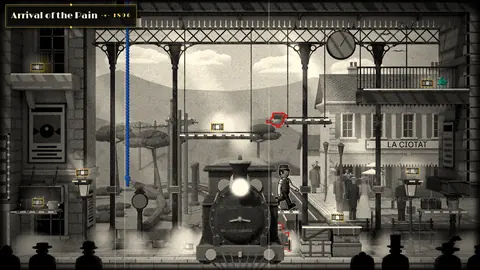 1896
Arrival of a Train at La Ciotat
Our room: Arrival of the Pain
-
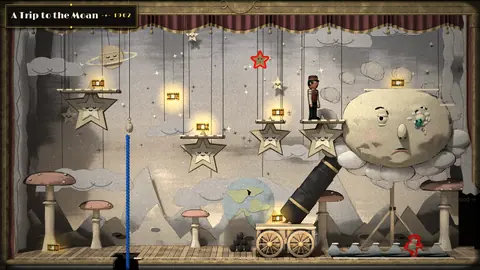 1902
A Trip to the Moon
Our room: A Trip to the Moan
-
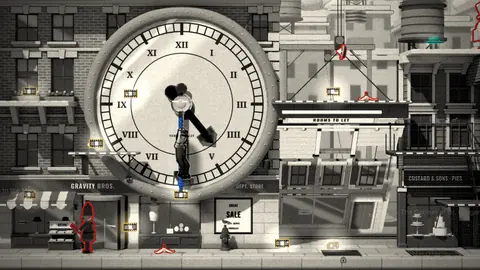 1923
Safety Last!
Our room: Safety Second
Free, in a desktop browser or as a download for Windows, Mac and Linux.
Quick answers
Was Kalidas the first Tamil talkie?
It is the film most often given that title, and its Madras advertisements billed it as the first Tamil and Telugu talkie. The film historian Theodore Baskaran argues instead that a short film, Kurathi Paatum Dansum from Sagar Movietone, came first, so the claim is disputed.
Was Kalidas the first Telugu talkie?
It is sometimes called one, since much of its dialogue is reported to have been in Telugu. The title of first full-length Telugu talkie is usually given to Bhakta Prahlada, also directed by H. M. Reddy, whose dates sources give differently, from 1931 to early 1932.
Who was in Kalidas?
T. P. Rajalakshmi played the heroine, and the usual billing gives P. G. Venkatesan as Kalidas, with L. V. Prasad in a comic role. One study of the songbooks argues that V. R. Gangadhar was the hero, so the cast list is not settled.
What language is Kalidas in?
Sources disagree. Some describe it as mainly Tamil and others as mainly Telugu in its dialogue, with Tamil songs and a little Hindi. It was made for audiences in both languages, which is why it is called Tamil-Telugu, or multilingual.
How many songs does Kalidas have?
One often-repeated figure is fifty songs. A careful reading of the surviving songbook covers argues for eight, all sung by women and probably all by Rajalakshmi, taken from stage favourites.
Does a print of Kalidas survive?
No. No print is known, and no gramophone record or songbook is known to survive either. Only a few stills, advertisements and the image of a songbook cover remain.
Is Kalidas in the public domain?
India's Copyright Act gives a film 60 years from the start of the year after it was published, a term long over for 1931. In the United States works of 1931 are due to enter the public domain on 1 January 2027, though the film cannot be found to watch.
Sources and further reading
- Kalidas (film), Wikipedia: cast, plot, release, languages, songs, reception and the lost print, with the disputes between historians as reported
- How Kalidas, the "first Indian Tamil & Telugu talkie", was made, Madras Courier, on the film's production, languages and Diwali release in Madras
- More on the film Kalidas, Madras Musings, vol. 33 no. 12, on the songbooks, the cast and the claim of fifty songs
- Alam Ara, Wikipedia: the March 1931 Bombay sound film and its loss
- H. M. Reddy, Wikipedia: the director's life and career
- T. P. Rajalakshmi, Wikipedia: the actress's career; some of its details are flagged there as weakly sourced and are used with care
- Sagar Movietone, Wikipedia: the company and its credit for Kalidas
- The Copyright Act, 1957, Chapter V: Section 26, term of copyright in cinematograph films, Legal Service India, reproducing the Act
- 2027 in public domain, Wikipedia: the terms of different countries, as reported