
Palace Picture House · Programme note
Kid Auto Races at Venice 1914
Chaplin's Tramp was filmed in one comedy, but the public met him in this one: a few minutes of a pest who will not stay out of a newsreel camera's shot.
By HertzyPertzy · Updated · 6 minute read
In short
Kid Auto Races at Venice is a Keystone comedy of 1914, directed by Henry Lehrman, in which Charlie Chaplin plays a pest who keeps wandering into the picture of a newsreel cameraman at a children's cart race. It was released on 7 February 1914, two days before Mabel's Strange Predicament, which had been filmed first, and so it is the film in which the public first saw the Tramp. It was shot among a real crowd, in a rush, and the Library of Congress added it to the National Film Registry in 2020.
Watch the film
There is no clean free copy to play or link to here.
Kid Auto Races at Venice
1914
- Released
- 7 February 1914, on a split reel with a short documentary, Olives and Their Oil
- Made by
- Keystone Film Company; Mack Sennett, producer; Henry Lehrman, director and co-writer
- Cast
- Charlie Chaplin (the pest), Henry Lehrman (the film director), Frank D. Williams (the cameraman), local children and spectators
- Filmed
- At a children's "pushmobile" race in Venice, California, on 10 or 11 January 1914 (sources differ), in about 45 minutes by one account
- Length
- A split reel, 500 feet or less; about six minutes in the prints now seen
- Format
- Black and white, silent, 35 mm, with intertitles
- Honours
- Selected for the US National Film Registry in 2020
- Copyright
- In the public domain in the United States, as an American film of 1914. Chaplin's family company, Roy Export, asserts rights in his films and holds trade marks in the Little Tramp and his name. Modern restorations have rights of their own
The film
A race of homemade carts for children is being filmed in Venice, California. A newsreel cameraman stands at the roadside, and a director fusses beside him. A man in a tight coat, baggy trousers, a small bowler hat and very large shoes strolls in front of the lens. He is moved on. He comes back. He lights a cigarette, leans on a cart, and nearly gets hit by a soapbox. The director grows more furious, and the man keeps smiling at the camera.
That is all there is. The film runs about six minutes in the prints seen today, and it was a split reel of 500 feet or less, sharing its reel with a short documentary, Olives and Their Oil. The gag is also a trick of the eye. The camera we watch through is taken for the spectator's own, and a second camera is seen in the shot, filming the first.
One Tramp, two films
Charlie Chaplin was a young English stage comedian. He signed with Keystone in the autumn of 1913, at $150 a week, to replace a star who was leaving. Mack Sennett, who ran the studio, is said to have worried that he looked too young. Chaplin reached Los Angeles in December and began at the studio on 5 January 1914.
His first film, Making a Living, was released on 2 February 1914 by most accounts. In it he is not the Tramp. He plays a dandy in a top hat, frock coat and monocle, with a drooping moustache. He disliked the result.
Then came the muddle. By the account of Chaplin's official archive he first wore the Tramp's clothes in Mabel's Strange Predicament, a comedy set in a hotel, filmed a few days before the Venice shoot. Kid Auto Races at Venice was released first, on 7 February, and Mabel's Strange Predicament followed on 9 February. So the Tramp was filmed in one picture and first seen in another. That is why careful writers say "first seen" here, and why the popular line, that he was born in this film, is wrong.
A race, a crowd, forty-five minutes
The film was shot at the second annual "Pushmobile Parade", a children's car race, on Sunday 11 January 1914 by the Chaplin archive's date, or on 10 January by another account. The event was a junior version of the Vanderbilt Cup, sponsored by the city of Santa Monica.
Lehrman and the cameraman Frank Williams posed as a newsreel crew on Westminster Avenue, while a second camera filmed them. Sennett, by one account, simply sent Lehrman and Chaplin to improvise comedy against a race that was happening anyway, and the film is said to have been shot in about 45 minutes.
The crowd is real. The Keystone historian Brent Walker counts Chaplin, Lehrman and Williams as the only professional performers. The boys and spectators laugh, poke out their tongues and stare into the camera, and appear not to know they are in a comedy. The local paper reported the race winners and did not mention Chaplin.
Whose costume was it?
The best-known account is Chaplin's own. In a 1933 interview he said he was hurriedly told to put on a funny make-up for the Mabel Normand picture, and chose baggy trousers, a tight coat, a small derby and large shoes, to make "a mass of contradictions", with a small moustache that would not hide his expression. In My Autobiography (1964) he tells it again, by his own later account: once he was dressed, the clothes made him feel the person he was.
Others tell it differently. Sennett's version, in his book King of Comedy (1954), reaches us through the recollection of the Keystone player Chester Conklin. Jon Boorstin, writing in the Los Angeles Review of Books, calls it hearsay that serves Sennett's picture of himself. A popular legend has Chaplin borrowing each piece from a different Keystone player. Boorstin concludes that no one person invented the Tramp alone, and that the accounts cannot all be true.
The director
Henry Lehrman, born in 1881 in what was then Austria-Hungary, was one of Keystone's first directors. He directed Chaplin's first two films to reach the public, Making a Living and this one. He is said to have cut some of Chaplin's best material from the first, and Chaplin later wrote that Lehrman admitted it was deliberate. He is also said to have held actors in low regard, and the two did not get on.
Lehrman left Keystone in February 1914 to found a company of his own, and later became a producer and director at Fox. He died in Hollywood on 7 or 8 November 1946: sources differ.
Who owns it
This is a 1914 American film. Duke's Center for the Study of the Public Domain counts American works of 1925 and earlier as public domain, which covers it. Elsewhere the position differs: the Chaplin archive says that photographs from his films made from 1918 onward are the property of his family's company, Roy Export, and that the Little Tramp, Chaplin's name and certain film titles are trade marks of Roy Export or Bubbles Inc.
A trade mark is not a copyright. It covers using the character and the name, not copying a film that is out of copyright. Modern restorations and new scores have rights of their own, so which print you watch matters.
Why it matters
It is where the public first met the Tramp. Everything that came later, from The Gold Rush on, starts with the man in the borrowed-looking clothes who will not leave the frame.
It was made out of nothing. A real race, a real crowd, a camera and a character, put together in under an hour by one account. Critics noticed at once: the British Cinema is quoted as calling him "a born screen comedian".
It plays with the camera itself. The pest ruins a film by being in it, and the joke is that we are watching the ruin. In 2020 the Library of Congress chose it for the National Film Registry.
On the same programme
Some of these films are rooms you can play
These notes come from Reel Trouble, a comedy platformer through film history. Every room in it is a movie set, built from scratch as a parody of a real film, and a fall is never a death: it is a retake.
-
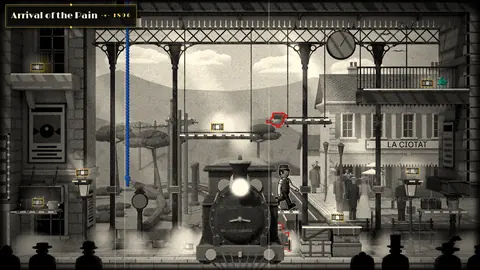 1896
Arrival of a Train at La Ciotat
Our room: Arrival of the Pain
-
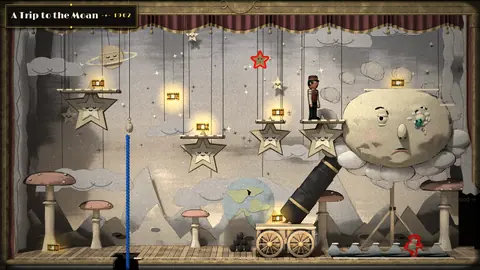 1902
A Trip to the Moon
Our room: A Trip to the Moan
-
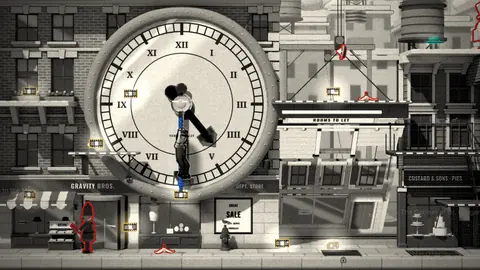 1923
Safety Last!
Our room: Safety Second
Free, in a desktop browser or as a download for Windows, Mac and Linux.
Quick answers
What is Kid Auto Races at Venice about?
A man in baggy trousers and a tight coat keeps walking into the shot of a newsreel cameraman filming a children's cart race. The director shoves him aside, and he keeps coming back. That is the whole plot.
Was Kid Auto Races at Venice the first Tramp film?
It was the first released, on 7 February 1914. Chaplin first wore the costume for Mabel's Strange Predicament, filmed a few days earlier but released on 9 February.
When and where was Kid Auto Races at Venice filmed?
At a children's race on Westminster Avenue in Venice, California. Chaplin's official archive gives Sunday 11 January 1914; another account gives 10 January.
Were the crowd in Kid Auto Races at Venice real?
Yes. Apart from Chaplin, Lehrman and the cameraman, the people on screen are said to have been real spectators and children, some of whom stare at the camera and seem unaware they are in a comedy.
How did Chaplin choose the Tramp costume?
By his own later account he picked baggy trousers, a tight coat, a small hat and big shoes so that everything contradicted everything else. Others tell the story differently, and no one account is settled.
Who directed Kid Auto Races at Venice?
Henry Lehrman, with Mack Sennett as producer. Lehrman also appears in the film as the director who tries to push Chaplin out of the picture.
Is Kid Auto Races at Venice in the public domain?
In the United States, yes: American works of 1925 and earlier are in the public domain there. Roy Export asserts rights in Chaplin's films elsewhere, and restorations have rights of their own.
Why is Kid Auto Races at Venice important?
It is where audiences first saw the Tramp, in a film made in a few minutes. The Library of Congress chose it for the National Film Registry in 2020.
Sources and further reading
- Kid Auto Races at Venice, Cal. (1914), Charlie Chaplin official archive (Roy Export), on the release, the shoot date, the split reel and the rights notice
- Charlie Chaplin at Keystone, Charlie Chaplin official archive, on Making a Living, Lehrman, Sennett and the Tramp's first costume
- Film: Charlie Chaplin and the 1914 Vanderbilt Junior Cup, Vanderbilt Cup Races historical site, on the race, the street, the crowd and the local newspaper
- Kid Auto Races at Venice, Wikipedia, on the cast, running time, reviews, the BFI's Brent Walker and the 2020 Registry selection
- Mabel's Strange Predicament, Wikipedia, on the order of filming and release
- Charlie Chaplin, Wikipedia, on his signing, his arrival at Keystone and Making a Living
- The Tramp, Wikipedia, on Chaplin's 1933 account of the costume
- Who Invented Chaplin's Tramp?, Jon Boorstin, Los Angeles Review of Books, on the competing accounts of Chaplin and Sennett
- Henry Lehrman, Wikipedia, on his career, his Chaplin films and his death
- Public Domain Day 2021, Jennifer Jenkins, Duke Center for the Study of the Public Domain, on works of 1925 and before