
Palace Picture House · Programme note
Never Weaken 1921
Harold Lloyd's last short film sends him out on a girder above a Los Angeles street, two years before he climbed the clock.
By HertzyPertzy · Updated · 5 minute read
In short
Never Weaken is a three-reel American silent comedy released in October 1921, starring Harold Lloyd and Mildred Davis and directed by Fred Newmeyer. It was Lloyd's last short before he moved permanently to feature films, and one of his "thrill comedies", in which the laughs come from a man who is plainly too high up. Its building-site finale is generally seen as a rehearsal for the techniques of Safety Last! (1923). It is in the public domain in the United States.
Watch the film
The whole film: 29 minutes, silent, with no music.
Played from Wikimedia Commons, which hosts this copy as a public-domain work. Nothing is fetched from there until you press play. If it will not play here, it will on their page.
- Released
- 22 October 1921, United States
- Directed by
- Fred C. Newmeyer (some listings add Sam Taylor, who co-wrote the scenario)
- Produced by
- Hal Roach; distributed by Pathé Exchange
- Starring
- Harold Lloyd (The Boy), Mildred Davis (The Girl), Roy Brooks (The Other Man), Mark Jones (The Acrobat)
- Camera
- Walter Lundin
- Length
- Three reels: about 20 to 28 minutes, depending on the source and the projection speed
- Format
- Silent, 35 mm, 1.33:1, black and white
- Copyright
- Public domain in the United States, where works published before 1923 are out of copyright. It may still be protected in other countries, and newer musical scores have rights of their own
The story
The Boy works in an office next door to The Girl. She is a secretary to an osteopath who has no patients and plans to let her go. The Boy saves her job by a trick: he knocks a man down in the street, "treats" him, and hands out the doctor's business card. Trade picks up.
Then he sees her in the arms of another man, and takes the worst. In despair he sets up his own end, one scheme after another, each more elaborate than the last. In the best known, he rigs a gun to go off when the office door opens, and blindfolds himself. A light bulb bursts, and he decides it is over.
It is not. A steel girder from the building site next door swings into the office, and his chair carries him out with it. By one account he takes a statue for an angel, until a jazz band on a roof shows him how high he is. He works his way down through loose beams and hot rivets. On the ground he learns the truth: the other man is her brother, a newly ordained minister, and the two of them can be married.
The suicide plot is the film's device and nothing more. It exists to put a man where he cannot be, and the comedy begins when he is in real danger and finds that he would rather live.
The last short
The film was made at the Hal Roach studio and released by Pathé on 22 October 1921. The credited director is Fred Newmeyer, and some listings add Sam Taylor, who wrote the scenario with Roach. Walter Lundin was the cameraman. Mildred Davis plays The Girl, Roy Brooks the other man and Mark Jones the acrobat.
It runs to three reels, which is about twenty to twenty-eight minutes depending on the source and the speed of the projector. It is described as Lloyd's last short before he moved permanently to feature-length films, and it is usually counted among his thrill comedies, the films in which the danger is the joke.
Lloyd and Davis married on 10 February 1923, and she left the screen that year. They stayed married until her death in 1969.
How the height was made
The high gag is usually traced to Look Out Below (1919), shot over a Los Angeles tunnel. A tunnel is not a skyscraper, but from the right angle the camera cannot tell. Accounts of the thrill comedies describe the method: careful framing and false perspective to make low set-ups look high, mattress platforms and safety nets just outside the picture, and Lloyd doing much of his own stunt work, with doubles for the most extreme wide shots. Much of the action was not faked.
Never Weaken was shot among the streets of Bunker Hill, and uses the corner of Olive and 3rd above the Angels Flight railway. The building-site finale rests on the same logic as the later climb: the real city lies behind and below the actor, and the camera is placed so that the safe ground under his feet stays out of the picture.
The lessons carried over. By most accounts the crew refined these stunt techniques in the short and used them again in Safety Last!, two years later. There the wall was a set on the roof of 908 South Broadway, and the distant shots of a climber were made on a taller building.
Eight fingers
In August 1919 Lloyd was posing for a publicity photograph with what he took to be a prop bomb. It had a real charge. The explosion took the thumb and forefinger of his right hand and part of his palm, and he was blinded for a time. The date usually given is 24 August 1919; one account places the accident during the making of Haunted Spooks (1920). Sources differ on the details, not on the injury.
From then on he wore a tightly fitted glove over a false thumb and finger. He also staged scenes to favour his left hand and used doubles for some close-ups. So when the Boy hangs from a girder in 1921 he is holding on with eight fingers, and audiences generally did not notice.
Why it matters
It is the short that leads to the clock. The gags climb the same ladder as Safety Last!: one danger after another, with a street far below, in the shorter form that Lloyd was about to leave.
It marks the end of a stage. After it, Lloyd and Roach made features. Lloyd later left Roach and formed his own company, and kept close control of his films.
It shows how a thrill comedy is built. A hero who is plainly in the wrong place, a real drop behind him, and a camera that hides the safe ground. The comedy lies in how far he will go before he admits he is frightened.
It can be shown freely in the United States. Duke's Center for the Study of the Public Domain states that works published before 1923 are clearly in the US public domain. Protection elsewhere may differ, and a restoration or a newer score can have rights of its own.
On the same programme
Some of these films are rooms you can play
These notes come from Reel Trouble, a comedy platformer through film history. Every room in it is a movie set, built from scratch as a parody of a real film, and a fall is never a death: it is a retake.
-
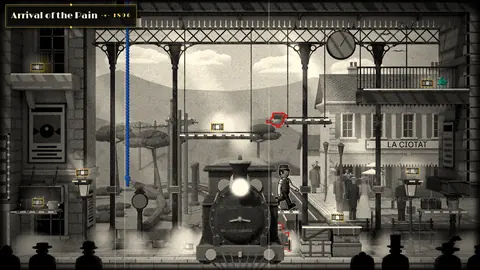 1896
Arrival of a Train at La Ciotat
Our room: Arrival of the Pain
-
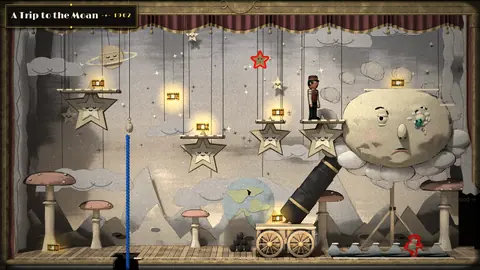 1902
A Trip to the Moon
Our room: A Trip to the Moan
-
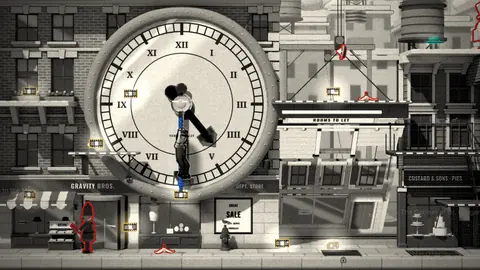 1923
Safety Last!
Our room: Safety Second
Free, in a desktop browser or as a download for Windows, Mac and Linux.
Quick answers
What is Never Weaken about?
A young man believes the girl he loves has accepted another man, and in despair arranges his own end in a blindfolded scheme. A steel girder swings into his office and carries him out over the street, and he has to find his way down a building site. The other man turns out to be her brother.
Was Never Weaken Harold Lloyd's last short film?
Yes. It is described as his last short before he moved permanently to feature-length films.
Who is the girl in Never Weaken?
Mildred Davis, Lloyd's regular leading lady. She married him on 10 February 1923 and left the screen that year.
Did Harold Lloyd do his own stunts in Never Weaken?
By most accounts he did much of his own stunt work in the thrill comedies, with doubles for the most extreme wide shots, and much of the action in them was not faked.
How did Harold Lloyd lose his thumb and finger?
In 1919, by most accounts in August, a prop bomb he was holding for a publicity photograph proved to be live and exploded. It cost him the thumb and forefinger of his right hand. He wore a glove with a prosthesis in his films afterwards.
Where was Never Weaken filmed?
In Los Angeles. The film shows streets of the Bunker Hill district, and the corner of Olive Street and 3rd Street above the Angels Flight railway.
Is Never Weaken the same as Safety Last?
No. It is a three-reel short from 1921; Safety Last! is a feature of 1923. The short is seen as a step towards the longer film, because the stunt techniques were refined in it and used again there.
Is Never Weaken in the public domain?
In the United States, yes: Duke's Center for the Study of the Public Domain states that works published before 1923 are clearly in the US public domain. It may still be protected in other countries.
Sources and further reading
- Never Weaken, Wikipedia: plot, cast, release date and place in Lloyd's career
- Never Weaken, Turner Classic Movies: the stunts, the false perspective, Lloyd's accident and career context
- Never Weaken, Viennale, Vienna International Film Festival: plot, locations in Los Angeles, last two-reeler
- Never Weaken (1921), Silent Era, Progressive Silent Film List: credits, three reels, release date, survival, rights
- Harold Lloyd: Lasting Impressions, John Bengtson, Silent Locations, 2011, on the 1919 accident and the glove
- How Harold Lloyd Filmed Safety Last!, John Bengtson, Silent Locations, 2012, on the climbing sets and the sister film
- Harold Lloyd, Wikipedia: the accident of 24 August 1919, the marriage to Mildred Davis, the move to features
- Public Domain Day 2017, Duke Center for the Study of the Public Domain: works published before 1923 in the United States