
Palace Picture House · Programme note
L'Âge d'Or 1930
A rich couple paid for a birthday present and got a riot, a police ban and a film that stayed out of sight for about half a century.
By HertzyPertzy · Updated · 6 minute read
In short
L'Âge d'Or (The Golden Age) is a French film of 1930, the first feature directed by Luis Buñuel, credited as written by Buñuel and Salvador Dalí. Paid for by Charles de Noailles, it follows a couple whose desire is blocked at every turn by family, church and polite society. Within days of its Paris opening, far-right groups wrecked the screening, and the police banned it. It was withdrawn for decades and returned in 1979 and 1980. It is now counted among the great surrealist films and entered the United States public domain on 1 January 2026.
Watch the film
It is not played on this page: see where to watch it.
Find where to stream, rent or buy it, on JustWatch.
- Original title
- L'Âge d'Or ("The Golden Age")
- Released
- Public premiere at Studio 28, Paris, on 28 November 1930 by most accounts (some give 29 November); banned in December 1930
- Made by
- Charles and Marie-Laure de Noailles, producers; France; sound by Tobis-Klang
- Written by
- Luis Buñuel and Salvador Dalí (credited); Buñuel directed
- Cast
- Gaston Modot (the man), Lya Lys (the young woman), Caridad de Laberdesque, and the painter Max Ernst as a bandit leader
- Length
- 63 minutes
- Format
- 35 mm, black and white, early sound film: music and effects, a little speech, and many title cards
- Copyright
- In the public domain in the United States since 1 January 2026 (Duke's Center for the Study of the Public Domain lists it; later restorations with new material stay protected). In France and the EU, protection runs for 70 years after the death of the last of the director, writers and composer
The story
The film opens with a documentary about scorpions. It then moves to a rocky seashore, where a gang of bandits, led by the painter Max Ernst, is visited by chanting bishops and dignitaries. The story proper is a love affair that cannot be completed. A man and a woman keep trying to be together, and family, church and social rules keep getting in the way. A phone call interrupts; a garden statue draws the woman's attention at a bad moment, and during a concert of Wagner a good deal else goes on.
Around this thread hang cruel and absurd episodes. A man kicks a small dog, crushes a beetle and strikes a blind man. At a smart party a boy is shot for a minor prank, and the guests carry on. The ending alludes to the Marquis de Sade's The 120 Days of Sodom, and the film closes on a cross hung with women's scalps. It is not a film that explains itself, and its makers did not intend it to be.
Who made it
Charles de Noailles, a vicomte, paid for it. By one account he had commissioned a film a year from 1928 as a birthday gift to his wife, Marie-Laure. The budget is given as a million francs, a lot at the time. The couple had a private cinema in Paris and had backed other artists' films before this one.
Buñuel, then a first-time director, had made Un Chien Andalou with Dalí the year before. For this second film they were commissioned together, but by the time of production they had fallen out. Dalí is credited as co-writer, yet sources say his share amounted to a few suggestions, and that he dismissed most of the ideas in Buñuel's notebook. Buñuel prepared the shooting script and controlled the shoot. Dalí later claimed a large part in both early films; Buñuel said only that one of his ideas at least found its way into this one.
The film is an early sound picture, made with Tobis-Klang equipment, but much of it is carried by title cards. Wagner, Debussy, Mendelssohn and the drums of Good Friday in Calanda are set against one another on the soundtrack. Buñuel is credited for the music with Georges van Parys. The scorpions are a small legend. Fifty of them were reportedly collected for the opening, but the sequence was never shot, and the film uses footage from a 1912 nature film, Le scorpion languedocien.
The riot at Studio 28
The public premiere was at Studio 28, a Paris cinema devoted to avant-garde films, after a private showing. The date is usually given as 28 November 1930, which is how Buñuel's biographer Aranda dates it; others say 29 November.
The trouble came on 3 December. Far-right groups, named as the League of Patriots and the Anti-Jewish League, threw ink at the screen, assaulted spectators and destroyed works of art that had been hung in the foyer, among them pieces by Dalí, Miró, Man Ray and Tanguy. Some accounts add rotten eggs, tear gas and stink bombs, and report antisemitic shouting. The League of Patriots, by one account, distanced itself from the worst of the damage while condemning the film.
The authorities then turned on the film, not on the rioters. Two scenes with bishops were cut within days. The film was banned in mid-December: 10 December by one account, 11 December by another. Police are reported to have seized copies and searched Studio 28 and Buñuel's home. The press campaign called it an exercise in Bolshevism. The offence was religious and social: the film attacks church, army-minded patriots and the respectable classes alike, and does so with its tongue only partly in its cheek.
Fifty years out of sight
The Noailles family withdrew the film from commercial showing. Sources give the length of its absence as four decades, more than forty years or about fifty. It was shown privately at the Museum of Modern Art in New York in 1933, and a single print is reported to have been shown in London in January 1931. The legal American premiere was at the Roxie Cinema in San Francisco in November 1979. Another account has it re-released in New York in 1980 and in Paris a year later. By then, one source notes, its power to shock had faded, and it was read as the root of Buñuel's later career. A restored version was shown at Cannes Classics in 2019.
Copyright
Duke's Center for the Study of the Public Domain lists L'Âge d'Or among the films that entered the US public domain on 1 January 2026, and adds that only the original 1930 versions are covered: later restorations with new material stay protected. The film was made in France, and in France and the EU a film is protected for 70 years after the death of the last of its director, screenwriters, dialogue writers and composer. Buñuel died in 1983 and Dalí, a credited co-writer, in 1989, so on that rule the film is not free there. A recorded score or a restoration has rights of its own.
Why it matters
It is one of the first true surrealist films. The critic Philip French is reported as describing it that way, and a 2012 Sight & Sound poll saw 15 critics and six directors put it among their ten favourites. The dreamlike logic is not decoration but argument.
It shows how an art film could be killed without being answered. The attackers were never the ones banned. The film paid the price.
It set Buñuel's course. His hostility to church and middle-class manners, and his faith in desire as a force that breaks rules, run through the rest of his long career.
It outlasted its ban. A film that was written off for half a century is now on the list of 1930 works open to everyone in the United States.
On the same programme
Some of these films are rooms you can play
These notes come from Reel Trouble, a comedy platformer through film history. Every room in it is a movie set, built from scratch as a parody of a real film, and a fall is never a death: it is a retake.
-
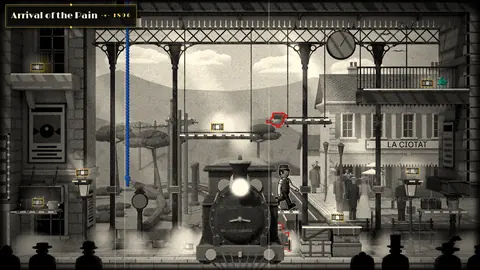 1896
Arrival of a Train at La Ciotat
Our room: Arrival of the Pain
-
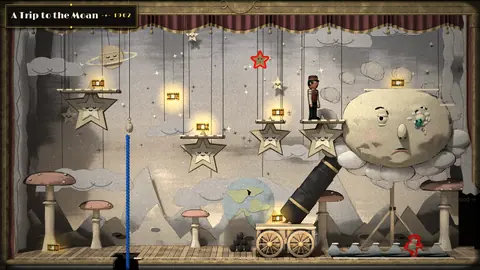 1902
A Trip to the Moon
Our room: A Trip to the Moan
-
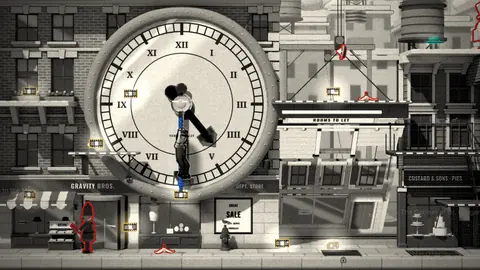 1923
Safety Last!
Our room: Safety Second
Free, in a desktop browser or as a download for Windows, Mac and Linux.
Quick answers
What is L'Âge d'Or about?
A man and a woman try again and again to come together, and family, church and the rules of polite society stop them. Along the way the film runs through a string of savage and absurd scenes, from a bishop-haunted seashore to a party where a boy is shot over a prank.
Who made L'Âge d'Or?
Luis Buñuel directed it, in his first feature. Salvador Dalí is credited as co-writer, though several sources say his share was small. Charles and Marie-Laure de Noailles paid for it.
Why was L'Âge d'Or banned?
After far-right groups attacked a screening at Studio 28 on 3 December 1930, the police had the film cut and then banned it in mid-December. The press campaign against it called it a Bolshevik spectacle; its attack on church and middle-class morals was the main complaint.
How long was L'Âge d'Or banned for?
Sources give four decades, more than forty years or about fifty. The Noailles family withdrew it, and it came back to cinemas at the end of the 1970s: a legal American premiere in San Francisco in November 1979, by one account.
Is L'Âge d'Or a talkie?
Partly. It is described as one of the first French sound films, but a good deal of it is told with title cards in the manner of a silent film.
Did Dalí direct L'Âge d'Or?
No. Buñuel directed it and prepared the shooting script. Dalí shares the writing credit, but by several accounts the two had fallen out, and his contribution amounted to a few suggestions.
How long is L'Âge d'Or?
About 63 minutes.
Is L'Âge d'Or in the public domain?
In the United States, yes: works from 1930 entered the public domain on 1 January 2026, and Duke's list names this film. In France and the EU protection lasts 70 years after the death of the last contributor named, so it is not yet free there. Restorations and recorded scores are separate work with rights of their own.
Sources and further reading
- L'Age d'Or, Wikipedia: credits, funding, the December 1930 events, circulation
- L'Âge d'or (1930, France, 63 mins), Senses of Cinema, 2000
- Surrealist film L'Age d'Or provokes French rioting, EBSCO Research Starters
- L'Âge d'or, British Film Institute
- L'Age D'Or, Encyclopedia.com
- L'Âge d'or: film record, Berkeley Art Museum and Pacific Film Archive
- Public Domain Day 2026, Duke Center for the Study of the Public Domain