
Palace Picture House · Programme note
King of Jazz 1930
Universal gave a bandleader a crown, a cartoon, a giant piano and a fortune in colour film, and the public stayed home.
By HertzyPertzy · Updated · 6 minute read
In short
King of Jazz is a 1930 American musical revue directed by John Murray Anderson for Universal, built around the bandleader Paul Whiteman and his orchestra. It has no story, only songs, sketches and big staged numbers, all shot in two-colour Technicolor, and it carries Bing Crosby's first appearance in a feature film. It cost a great deal, arrived as the public tired of musicals, and lost money. Its title is the part historians now question most, since jazz was made by Black musicians. A digital restoration in 2016 brought it back.
Watch the film
The whole film: 98 minutes, from Universal's 4K restoration, with its sound. Where the picture is lost, four stretches have sound only.
Played from Wikimedia Commons, which hosts this copy as a public-domain work. Nothing is fetched from there until you press play. If it will not play here, it will on their page.
- Released
- Premiere on 19 April 1930 at the Criterion Theatre, Los Angeles
- Made by
- Universal Pictures; producer Carl Laemmle Jr.; director John Murray Anderson; written by Charles MacArthur and Harry Ruskin; art director Herman Rosse
- Starring
- Paul Whiteman and his orchestra, with John Boles, Laura La Plante, Jeanie Lang, Jeanette Loff, and the Rhythm Boys (Bing Crosby, Al Rinker, Harry Barris)
- Cost and result
- About $3 million by one production history, $2 million by another; it lost more than $1.2 million by the first account. It did not turn a profit until 1933, by one source
- Length
- 105 minutes as released; shortened for a reissue in 1933; the 2016 restoration runs 98 minutes
- Format
- Sound, in two-colour Technicolor (red and green tones); 35 mm
- Honours
- Academy Award for art direction (Herman Rosse); added to the US National Film Registry in 2013
- Copyright
- In the public domain in the United States since 1 January 2026, as Duke's Center for the Study of the Public Domain lists it. A restoration can carry rights of its own
A revue without a story
King of Jazz was released by Universal in April 1930, with its Los Angeles premiere on 19 April at the Criterion Theatre. It is a revue: no plot, only numbers and sketches strung together with a master of ceremonies. The bandleader Paul Whiteman and his orchestra are the draw, and around them come singers, dancers and comedians. Contemporaries called it the Paul Whiteman film without a story, and the story is said to have been dropped when Anderson came in. Whiteman is reported to have insisted on him.
John Murray Anderson was a Broadway and nightclub director, and the film plays like a stage show with a very large budget. The producer was Carl Laemmle Jr.; the cast includes John Boles, Laura La Plante and Jeanie Lang.
Two colours and a cartoon
The whole film was shot in two-colour Technicolor, which records reds and greens and has no true blue. Anderson and the art director Herman Rosse worked round the missing blue with grey and silver backgrounds and filters. Rosse won the Academy Award for art direction.
The film opens with a cartoon by Walter Lantz and Bill Nolan, which ends by explaining how Whiteman came to be crowned. It is often described as the first Technicolor animated cartoon segment, a claim easy to overstate. Careful accounts stop short of anything wider.
The King, and the crown
Whiteman was a household name by 1930. By most accounts the press began calling him the King of Jazz in 1923, after the Buescher instrument company put a crown on his head. His idea was to improve jazz by orchestrating it, with written arrangements and a smooth sound. The guitarist Eddie Condon complained that he was trying to \"make a lady\" of it.
Jazz was created by Black musicians, and that is why the title is now a problem. Detractors called his music jazz in name only and said he took credit for Black musicians' work. Others, the critic Scott Yanow among them, hold that his orchestra did play very good jazz, and that his fondness for the music was real. By one account he wanted to hire Black musicians, and his management persuaded him it would ruin his career. He commissioned Gershwin's Rhapsody in Blue, which the orchestra premiered in 1924 with Gershwin at the piano.
The film does not engage with any of this. Andy Senior, reviewing the restoration for The Syncopated Times, wishes that Black jazz musicians had been invited to take part, and notes that Duke Ellington's orchestra appeared in another studio's film later in 1930. In the same review he reports Whiteman's introduction to the Rhapsody in Blue number, which says jazz was born from the African jungle to the beating of voodoo drums, with a dancer in witch doctor dress to illustrate it. Senior writes that it left him cringing. The accounts of the film that describe it scene by scene mention no blackface number, but they are reviews, not a full inventory.
Rhapsody, the Rhythm Boys and the Melting Pot
The Rhapsody in Blue number is the centrepiece: Whiteman's orchestra plays the piece on a vast stage dominated by a gigantic teal-green piano. Senior, who did not like it, calls it a rhapsody in bloat.
The film is also Bing Crosby's first appearance in a feature. He sings with the Rhythm Boys, the trio he formed with Al Rinker and Harry Barris. One account says he was jailed after a motor accident and that John Boles took over \"Song of the Dawn\". Senior has him sentenced to thirty days for drunk driving and breaking the Volstead Act, yet still allowed to work, so the details differ by source.
The finale is the Melting Pot. Immigrant groups in national costume sing songs of their homelands, and are then lowered into a giant cauldron. They come out as Americans, with the earlier performers as fuel. Senior finds it absurd and overlong. What it leaves out is plain: the groups are European, and the Black musicians who made the music in the title are not in the pot.
A fortune, and a flop
Production ran long and the money ran out faster. One production history, which is the basis of Layton and Pierce's book, puts the investment at about $3.019 million and the loss at over $1.2 million. Another account gives the cost as $2 million and says the film was not in profit until 1933. Either way it was a flop: audiences had tired of musical revues, while All Quiet on the Western Front, the same year, earned almost $4.1 million. Hollywood called it \"Universal's Rhapsody in the Red\". It did better abroad, and at least nine foreign-language versions were made.
Lost, and restored
A reissue of 1933 cut it back, and for years that was the version people saw. One account gives the reissue 65 minutes, and UCLA calls it 30 minutes shorter than the original 105, so sources differ. From the mid-1930s to the early 1960s, one account says, nobody could see it. In the 1970s the collector Philip Jenkinson assembled a 93-minute version, and a copy made on 16 mm kept the film in view.
Universal approved a digital restoration in early 2015. The team used the 1933 two-strip camera negative, a surviving 1930 nitrate print of 83 minutes, now at the Library of Congress, and a sound negative of the longer version. It premiered at the Museum of Modern Art on 13 May 2016 and runs 98 minutes. The Library of Congress had added it to the National Film Registry in 2013. The historians James Layton and David Pierce published King of Jazz: Paul Whiteman's Technicolor Revue in 2016.
Why it matters
It is a record of the colour process at its height. Two-colour Technicolor lasted a few years, and this is among its most lavish uses.
It shows what a crown meant in 1930. The film is a snapshot of how a white bandleader came to stand for a Black art form, and of what that picture left out.
It is a story of a film that came back. Cut, forgotten and then rebuilt from four sources, it is back on screen and, since 1 January 2026, its original 1930 form is out of copyright in the United States, as Duke's Center for the Study of the Public Domain lists it. Only the restoration may carry rights of its own.
On the same programme
Some of these films are rooms you can play
These notes come from Reel Trouble, a comedy platformer through film history. Every room in it is a movie set, built from scratch as a parody of a real film, and a fall is never a death: it is a retake.
-
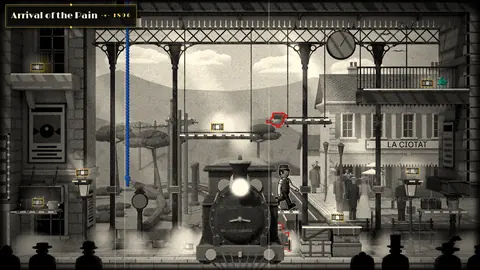 1896
Arrival of a Train at La Ciotat
Our room: Arrival of the Pain
-
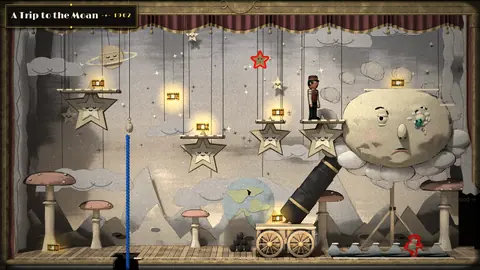 1902
A Trip to the Moon
Our room: A Trip to the Moan
-
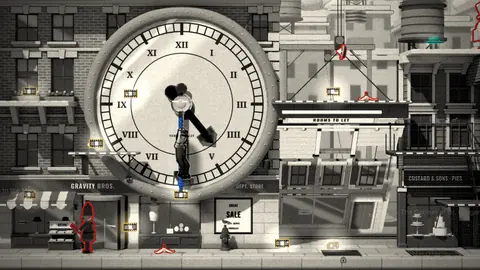 1923
Safety Last!
Our room: Safety Second
Free, in a desktop browser or as a download for Windows, Mac and Linux.
Quick answers
What is King of Jazz (1930) about?
It has no plot. It is a revue: a string of songs, comic sketches and large staged numbers built around Paul Whiteman and his orchestra, from a cartoon prologue to a finale called the Melting Pot.
Why was Paul Whiteman called the King of Jazz?
From 1923, by most accounts, after an instrument maker crowned him with a prop crown, the press used the title. Historians now note that jazz was created by Black musicians, and that Whiteman's orchestrated style was jazz only in part.
Was King of Jazz the first cartoon in Technicolor?
Its opening cartoon by Walter Lantz and Bill Nolan is often described as the first Technicolor animated cartoon segment. Claims of this kind depend on how careful the wording is.
Was this Bing Crosby's first film?
Sources give it as his first appearance in a feature film. He sings with the Rhythm Boys, the trio he formed with Al Rinker and Harry Barris.
Why did King of Jazz flop?
It cost far too much, took far longer to make than planned, and came out when audiences had tired of musicals. By one production history it lost more than $1.2 million.
Is King of Jazz in the public domain?
Duke's Center for the Study of the Public Domain lists it among the films entering the United States public domain on 1 January 2026. The 2016 restoration may have rights of its own.
Was King of Jazz restored?
Yes. Universal approved a digital restoration in 2015 from a 1933 camera negative, a surviving 1930 nitrate print and a sound negative. It premiered at the Museum of Modern Art in May 2016 and runs 98 minutes.
Were there foreign-language versions?
Yes: at least nine, by one count. Layton and Pierce's book covers them.
Sources and further reading
- King of Jazz, Wikipedia: credits, dates, the numbers, the foreign versions and the reception
- King of Jazz: Paul Whiteman's Technicolor Revue, UCLA Film and Television Archive, on the book by James Layton and David Pierce and the restoration
- Public Domain Day 2026, Duke Center for the Study of the Public Domain
- 1930 King of Jazz Film Restored, The Syncopated Times, 2016
- A Rhapsody in Blah: Notes Concerning the Extraordinary Restoration of The King of Jazz, Andy Senior, The Syncopated Times, 1 September 2016
- Jazzed about the King of Jazz, Leonard Maltin
- Paul Whiteman, Wikipedia: the title and how historians judge it