
Palace Picture House · Programme note
The Passion of Joan of Arc 1928
Dreyer filmed a trial almost entirely in close-up, the negative burned, and a complete print turned up decades later in a hospital closet near Oslo.
By HertzyPertzy · Updated · 6 minute read
In short
La Passion de Jeanne d'Arc (The Passion of Joan of Arc) is a French silent film of 1928, directed by the Dane Carl Theodor Dreyer, with Renée Falconetti as Joan. Its script is drawn from the records of the real trial of 1431, and it is shot largely in close-up, with no make-up on the faces. The original negative was destroyed by fire, Dreyer's own cut was mutilated by censors, and a print of that cut was found in 1981 at a psychiatric hospital near Oslo. It is a regular on critics' lists of the greatest films.
Watch the film
It is not played on this page: see where to watch it.
Find where to stream, rent or buy it, on JustWatch.
- Original title
- La Passion de Jeanne d'Arc ("The Passion of Joan of Arc")
- Released
- Copenhagen, 21 April 1928 (Palads Teatret); Paris, 25 October 1928 (Cinéma Marivaux)
- Made by
- Société Générale des Films, Paris. Director Carl Theodor Dreyer; script Dreyer and Joseph Delteil; camera Rudolph Maté; sets Hermann Warm and Jean Hugo
- Cast
- Renée Falconetti (Joan), Eugène Silvain (Bishop Cauchon), André Berley (Jean d'Estivet), Maurice Schutz (Nicolas Loyseleur), Antonin Artaud (Jean Massieu)
- Country
- France; the director was Danish
- Length
- About 110 minutes at 20 frames a second, about 82 at 24
- Format
- Silent, 35 mm, black and white, intertitles; the first Paris showings had a score by Léo Pouget and Victor Alix
- Copyright
- Public domain in the United States since 2024. Still protected in France and the EU, for decades yet: the term runs from the death of the last of its authors (Dreyer died in 1968, his co-writer Joseph Delteil in 1978)
The story
Rouen, 1431. Joan of Arc, a girl of nineteen in the film, is held in an English-controlled castle and questioned by a panel of churchmen led by Bishop Pierre Cauchon. They try to trap her into a heresy. She will not sign a recantation, then she does, then she takes it back. She is condemned and burned in the market place, and the crowd, which has come to watch, turns into a riot.
The film is built from the trial records themselves. Dreyer and the poet and novelist Joseph Delteil wrote the script, and the credits, as one critical account reads them, say it rests on the original records, with Delteil's books on Joan as a further source. By most accounts Dreyer spent a year and a half researching. The script squeezes what sources describe as 29 interrogations spread over months into one day.
A film of faces
Dreyer was a Dane, invited to France by the Société Générale des Films after his Master of the House. He considered a film on Marie Antoinette or Catherine de Medici before settling on Joan. Rudolph Maté shot it, and the method is the film's fame: almost everything is a close-up. The British Film Institute notes that Dreyer avoids the establishing shot, sets his figures against plain white backgrounds, and gives the viewer no sense of where anyone sits. Actors are often filmed from below, so the judges loom over Joan. Citing the scholar David Bordwell, the BFI notes that fewer than thirty of the film's roughly fifteen hundred cuts carry a figure or object from one shot into the next, so the viewer is dropped from face to face.
None of the cast wore make-up, and the film leaves them lined, pitted and perspiring. The sets, by Hermann Warm and the painter Jean Hugo, were another matter. By one account Dreyer had a huge octagonal castle of concrete built for a reported seven million francs, and then showed only fragments of it. The hours of work went into a place the audience is never allowed to see whole.
Falconetti, and the legends
Renée Falconetti, born in 1892, had been on the Paris stage since the First World War, mostly in light comedies and musicals. Dreyer is said to have noticed her in an amateur production of a boulevard play. It is not wholly clear that Passion was her first film, though it is the one that counts, and she is usually described as having made no other major screen appearance. She returned to the stage and died in Buenos Aires in 1946.
Her performance is the reason people still talk about the film, and a pile of stories has grown around it. It is said that Dreyer made her kneel on stone floors until she was in real pain, reshot scenes again and again, and pushed her to collapse. These are told as set legend. Dreyer's biographers Jean and Dale Drum call them rumour, and say there is no evidence that he could be called a sadist; they describe the two of them studying rushes together and Dreyer explaining scenes to her. What can be said is that the camera stays on her face long enough to make the question beside the point.
Censors, fire and a closet near Oslo
The film opened in Copenhagen on 21 April 1928, and in Paris on 25 October. French nationalists had objected to a Dane, and not a Catholic, making a film about their saint. Before the Paris opening the Archbishop of Paris and the government censors ordered cuts, which angered Dreyer; the film was also reported banned in Britain for its portrait of English soldiers. Critics divided. The New York Times praised it, Variety called it tiresome, it did not make its money back, and Dreyer's contract was cancelled.
On 6 December 1928 a fire at the UFA studios in Berlin destroyed the original negative. Dreyer rebuilt the film from alternative takes, and according to some accounts that version burned too, in a laboratory fire in 1929. Later releases circulated in cut and altered forms: a 1933 sound version of 61 minutes, and a version found by Joseph-Marie Lo Duca in the Gaumont vaults in the early 1950s, to which he added a Baroque score; Dreyer objected to it.
Then, in 1981, a worker clearing a closet at Dikemark Hospital, a psychiatric institution near Oslo, found film cans. They went to the Norwegian Film Institute, sat there for about three years, and were then recognised as a print of Dreyer's original cut, from before the censors. Accounts differ on small points, such as whether it was a janitor's closet or an attic, and how the print got to the hospital. Sources agree on the rest: the film that Dreyer made had survived, and it is the basis of the versions seen today.
Why it matters
It is on the critics' lists. In the Sight & Sound polls it has stood as high as seventh, in 1952 and 1972, and in the critics' poll of 2012 it came ninth.
It argues for the face. The BFI quotes Dreyer saying that the close-ups were absolutely necessary to tell the story. Dreyer is also quoted calling the face the mirror of the soul.
It keeps being scored. Richard Einhorn's oratorio Voices of Light (1994), built on medieval texts and the words of Joan's accusers, was written to accompany it, and live performances have been paired with screenings. Other modern scores exist, each a separate work with its own rights.
It shows what a lost film is. The negative burned twice, by one account, the cuts were made by others, and a complete print waited in Norway.
On the same programme
Some of these films are rooms you can play
These notes come from Reel Trouble, a comedy platformer through film history. Every room in it is a movie set, built from scratch as a parody of a real film, and a fall is never a death: it is a retake.
-
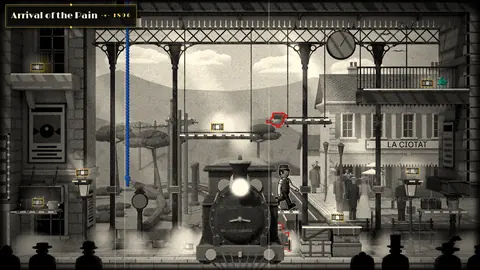 1896
Arrival of a Train at La Ciotat
Our room: Arrival of the Pain
-
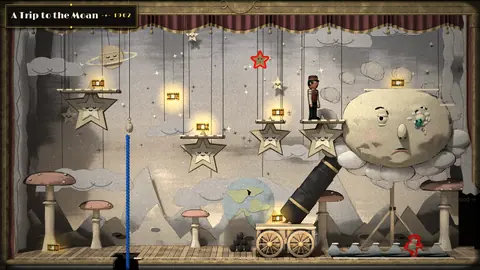 1902
A Trip to the Moon
Our room: A Trip to the Moan
-
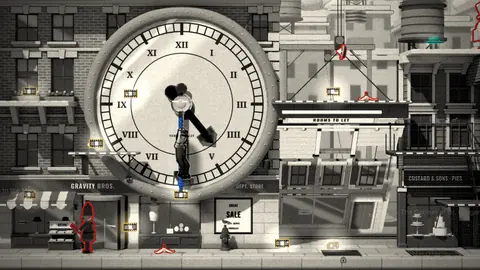 1923
Safety Last!
Our room: Safety Second
Free, in a desktop browser or as a download for Windows, Mac and Linux.
Quick answers
Is The Passion of Joan of Arc a true story?
It is based on the records of Joan's real trial at Rouen in 1431. Dreyer and his co-writer condensed what sources describe as 29 interrogations over many months into a single day.
Who plays Joan in The Passion of Joan of Arc?
Renée Falconetti, a Parisian stage actress, who is often described as having made her only major screen appearance here. Dreyer reportedly saw her in a light comedy before casting her.
Why is The Passion of Joan of Arc all close-ups?
Dreyer chose to tell the trial through faces, with few establishing shots and plain backgrounds, so that the viewer has no map of the room and nowhere to look but at the people. He is quoted as calling the close-ups necessary to the story.
Was the original negative of The Passion of Joan of Arc lost?
Yes. A fire at the UFA studios in Berlin on 6 December 1928 destroyed the original negative. Dreyer assembled a second version from alternative takes, which, according to some accounts, was also destroyed by fire in 1929.
Where was the lost cut of The Passion of Joan of Arc found?
A print of Dreyer's original, uncensored cut was found in 1981 in a closet at Dikemark Hospital, a psychiatric institution near Oslo. It was handed to the Norwegian Film Institute, which identified it some years later.
Is Falconetti's suffering on screen real?
Stories say Dreyer made her kneel on stone floors for hours to wring out her expression. They are told as set legend: one biography calls them rumour and finds no evidence that Dreyer was cruel.
Is The Passion of Joan of Arc in the public domain?
In the United States, yes, since 2024, as a work published in 1928. In France and the rest of the EU it is still protected, for decades yet.
What is Voices of Light?
An oratorio by the American composer Richard Einhorn, first performed in 1994, written to accompany the film. It is a modern work with its own rights, not part of the 1928 film.
Sources and further reading
- The Passion of Joan of Arc, Wikipedia: credits, runtime, premieres, censorship, fires, the 1981 find and the polls
- The Passion of Joan of Arc, University of Notre Dame course site: cuts, the fires and the later versions
- Cinema lost and sometimes found, Danish Film Institute, on the burned negative and the Oslo print
- La Passion de Jeanne d'Arc, Senses of Cinema: the credits, the trial records, Delteil, the kneeling story
- 4 hard-and-fast rules of filmmaking... and how The Passion of Joan of Arc breaks them, British Film Institute, on the close-ups and the flattened space
- Maria Falconetti, Wikipedia, on her career and the rumours about the shoot
- Voices of Light, Wikipedia, on Richard Einhorn's oratorio
- Carl Theodor Dreyer, Wikipedia, on his dates and later films
- The Passion of Joan of Arc (1928), Medieval Hollywood, Fordham University, on the trial records as source