
Palace Picture House · Programme note
Laborer's Love 1922
A carpenter turned fruit seller wins a doctor's daughter by sending the doctor patients, in the earliest complete Chinese film that survives.
By HertzyPertzy · Updated · 6 minute read
In short
Laborer's Love (Láogōng zhī àiqíng, also called Romance of a Fruit Peddler) is a Chinese silent comedy short of 1922, directed by Zhang Shichuan and written by Zheng Zhengqiu for the Mingxing Film Company of Shanghai. A fruit seller wins a doctor's daughter by arranging for the doctor's clinic to fill with patients. Reference works call it the earliest complete Chinese-made film that survives, though not the first Chinese film. It borrows from Chaplin, Keaton and Lloyd, carries Chinese and English intertitles, and its premiere date is disputed.
Watch the film
There is no clean free copy to play or link to here.
Laborer's Love
1922
- Original title
- 勞工之愛情 / 劳工之爱情 (Láogōng zhī àiqíng), "Laborer's Love"; English also Romance of a Fruit Peddler, and in some lists Love's Labor
- Released
- Usually dated 5 October 1922, at the Olympic Theatre, Shanghai; some accounts give 7 October, and one lists March 1922
- Made by
- Mingxing Film Company, Shanghai. Director Zhang Shichuan; writer Zheng Zhengqiu; camera Zhang Weitao
- Cast
- Zheng Zhegu (Zheng, the carpenter and fruit seller), Zheng Zhengqiu (Doctor Zhu), Yu Ying (Miss Zhu)
- Length
- A short: about 22 minutes in the surviving print; one listing gives 30 minutes
- Format
- Silent, black and white, 35 mm, 1.33:1; Chinese and English intertitles
- Held by
- A print is listed at the China Film Archive (Zhongguo Dianying Ziliaoguan); the surviving copy is incomplete in places, with cut margins and missing frames
- Copyright
- In the public domain in the United States, as a work first published before 1931. Modern restorations, subtitles and recorded scores can have rights of their own
Shanghai and the pictures
Shanghai was where Chinese cinema grew up. The traditional date for the first film show there is August 1896, at a teahouse in Xu Garden. Newspaper research suggests that show was a magic lantern display of still slides, and puts the first true moving pictures on 22 May 1897, at the Astor House Hotel. The cinemas that followed were largely foreign-owned and showed foreign films.
Chinese-made films came later. Zheng Zhengqiu and Zhang Shichuan, the two men behind this one, made The Difficult Couple in Shanghai in 1913, which some accounts call China's first feature. Zhang founded a Chinese-owned production company in 1916. By the late 1920s Hollywood films are said to have filled about 90 per cent of screen time in the better theatres. A Chinese comedy had to find room beside Chaplin.
Mingxing, and why comedy
The Mingxing Film Company ("Star") was founded in Shanghai in February 1922 by five men: Ren Jinping, Zhang Shichuan, Zheng Zhegu, Zheng Zhengqiu and Zhou Jianyun. They are said to have turned to film after a stock-market bubble burst and they wanted a less risky investment. They largely paid for the first films themselves.
Its first fiction films were short slapstick comedies. The one that opened with Laborer's Love, The King of Comedy Visits Shanghai, had a Chaplin impersonator in the lead and is lost. Why the studio began with comedy is not on record, but comedy made up almost half of Chinese film production in 1922, and Chaplin's films were popular in China. The audience was not won over: both films are said to have been poorly received, and the company was losing money.
The story
A carpenter named Zheng, out of work, becomes a fruit seller. He falls for Miss Zhu, whose father is a doctor with no patients. The two lovers talk across the street by sending baskets of fruit along a string. The doctor will consent to a marriage only if the young man can save his clinic.
The young man's answer is to make business. He rigs a nightclub's staircase into a slide, and the customers who tumble down are carried to the doctor's door. One writer sums it up more bluntly: he sets out to injure as many people as possible. The clinic fills, and the doctor relents. Zheng Zhegu plays the carpenter, Yu Ying plays Miss Zhu and Zheng Zhengqiu, who wrote the script, plays the doctor.
What is borrowed, and what is its own
The borrowings are open. Reference works name Charlie Chaplin, Buster Keaton and Harold Lloyd, and point to Lloyd-style glasses and a trick staircase in the manner of Keaton. The scholar Xuelei Huang, in the abstract of her article, reads such Hollywood references in the Mingxing comedies as allusion, in the sense of the classical Chinese poetic device: borrowing a familiar image gave the young industry some authority. The film also plays tricks with the camera: undercranked, speeded-up action, double exposures for daydreams, and out-of-focus shots for a character's point of view.
The rest is local. The fruit passed along the string draws on a folktale of fruit thrown between lovers, and a split watermelon is another traditional image. The plot is a young couple against a father's authority, and so belongs to its decade: Historians tie the story to changing attitudes to marriage and class after the May Fourth movement of 1919. Its translators faced wordplay that does not cross languages, such as the emperors' names in the scene of the antique vase, and the English titles smooth it over.
Critics have disagreed about the taste. Some later called it full of poor taste, others replied that it was simply meant as a comedy.
Premiere and survival
The film is usually said to have premiered on 5 October 1922 at the Olympic Theatre in Shanghai, as half of a double bill with The King of Comedy Visits Shanghai. Sources do not agree: 7 October is also given, and one film database lists 8 March 1922, which nothing else supports. The planned run of two days was extended to four. 5 October is the common date, not a settled one.
It survives in a print listed at the China Film Archive. It is a complete film, but not a perfect copy: its margins are cut, the celluloid is poorly preserved and some frames are missing. The careful phrase is "earliest complete surviving Chinese-made film"; "oldest surviving" claims more. Earlier Chinese films were made, and the same company's The King of Comedy Visits Shanghai is lost.
The film has Chinese and English intertitles, which suggests that Mingxing had foreign viewers in Shanghai in mind. In 2005 it was named among a hundred Chinese film classics of the century.
What came next
The comedies did not save the company. Facing insolvency, Mingxing turned in 1923 to a serious family drama stressing education, Orphan Rescues Grandfather, directed by Zhang. It ran about 100 days in Shanghai and gave the company the money to grow. Mingxing went on to make The Burning of the Red Lotus Temple (1928), which popularised the swordplay picture, and Sing-Song Girl Red Peony (1931), often called China's first sound film. Zhang is credited with about 150 films.
Zheng Zhengqiu, a dramatist, led the company's push for films with a social message, wrote early scripts and directed dozens of films, among them Twin Sisters (1934). He died in July 1935. Japanese bombing destroyed Mingxing's studio in 1937. Zhang worked under the Japanese occupation for a studio the Japanese controlled, and was accused of treason afterwards, though never officially indicted. Sources give his death as 1953 or 1954.
Why it matters
It is the earliest complete Chinese film that can still be watched. Most of what Chinese cinema made before it is gone.
It shows a young industry borrowing and adapting. The gags are Hollywood's, the folktale and the family quarrel are not, and the English titles show who was expected in the audience.
It is a record of what failed. The comedy was a modest success at best, and Mingxing's rescue was a sober family drama. The film that survives is the one the studio moved on from.
On the same programme
Some of these films are rooms you can play
These notes come from Reel Trouble, a comedy platformer through film history. Every room in it is a movie set, built from scratch as a parody of a real film, and a fall is never a death: it is a retake.
-
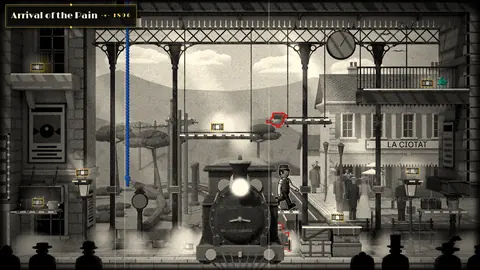 1896
Arrival of a Train at La Ciotat
Our room: Arrival of the Pain
-
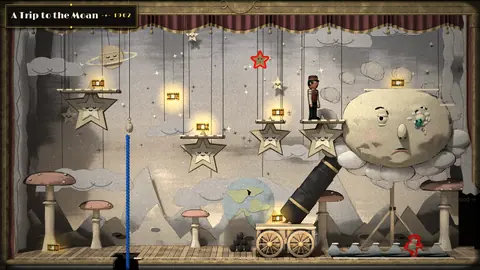 1902
A Trip to the Moon
Our room: A Trip to the Moan
-
 1923
Safety Last!
Our room: Safety Second
Free, in a desktop browser or as a download for Windows, Mac and Linux.
Quick answers
Is Laborer's Love the oldest Chinese film?
Not quite. Careful sources call it the earliest complete Chinese-made film that survives. Earlier Chinese films were made, but this is the earliest complete one known to survive.
What is Laborer's Love about?
A carpenter turned fruit seller falls for the daughter of a struggling doctor. The doctor will consent to the marriage if the suitor can save his clinic, so the suitor sets out to send him patients.
Who made Laborer's Love?
Zhang Shichuan directed it and Zheng Zhengqiu wrote it, both co-founders of the Mingxing Film Company in Shanghai. Zheng Zhengqiu also plays Doctor Zhu.
When did Laborer's Love premiere?
Sources differ. The usual date is 5 October 1922, at the Olympic Theatre in Shanghai, but 7 October is also given, and one film database lists 8 March 1922.
Is Laborer's Love really influenced by Charlie Chaplin?
Yes, by most accounts. Reference works name Chaplin, Buster Keaton and Harold Lloyd, and point to Lloyd-style glasses and a trick staircase in the Keaton manner.
Does Laborer's Love have English subtitles?
The film has both Chinese and English intertitles. That suggests it was meant for foreign audiences in Shanghai as well as Chinese ones.
How long is Laborer's Love?
About 22 minutes in the surviving print. One listing gives 30 minutes: figures vary with the copy and the projection speed.
Where is Laborer's Love kept?
A print is held at the China Film Archive, by the usual listing. The surviving copy is imperfect: its margins are cut, the celluloid is poorly preserved and some frames are missing.
Sources and further reading
- Laborer's Love, Wikipedia: credits, plot, intertitles, premiere, reception and the reference list behind them
- Mingxing Film Company, Wikipedia: the founding in 1922, the first comedies and Orphan Rescues Grandfather
- List of Mingxing films, Wikipedia: the two premiere dates and the surviving films
- Cinema of China, Wikipedia: film shows in Shanghai, the first Chinese films and the studios of the 1920s
- Zhang Shichuan, Wikipedia: his career, Mingxing and the war years
- Zhi quo yuan (Laborer's Love), Silent Era, Progressive Silent Film List: cast, alternative titles and the print at the China Film Archive
- Lao gong zhi ai qing, AllMovie: the listed release date, running time and the Chaplin, Keaton and Lloyd influences
- Beyond Labourer's Love: Rethinking early Chinese film comedy, Xuelei Huang, Journal of Chinese Film Studies, 2022: abstract on Hollywood allusion in the comedies of 1922
- File:Laborer's Love (1922).webm, Wikimedia Commons: the public-domain statement and its reasoning