
Palace Picture House · Programme note
Nanook of the North 1922
Robert Flaherty lost his first Arctic footage to a fire, tried again with a fur company's money, and made a film that is part record and part reconstruction.
By HertzyPertzy · Updated · 6 minute read
In short
Nanook of the North is an American silent film of 1922, written, shot and edited by Robert J. Flaherty, about an Inuit hunter and his family in northern Quebec. It was paid for by the French fur company Revillon Frères and first shown in New York in June 1922. Much of it was staged for the camera, with a man called Nanook who was really Allakariallak, and its makers and critics have argued over that ever since. It is often called one of the first feature-length documentaries, and it was in the first group of films named to the National Film Registry in 1989.
Watch the film
The whole film: 78 minutes, silent, with no music.
Played from Wikimedia Commons, which hosts this copy as a public-domain work. Nothing is fetched from there until you press play. If it will not play here, it will on their page.
- Original title
- Nanook of the North
- Released
- New York, 11 June 1922, at the Capitol Theatre by most accounts; shown around the world through the summer
- Made by
- Robert J. Flaherty (director, writer, cameraman, editor), for the fur company Revillon Frères; distributed by Pathé Exchange
- Cast
- Allakariallak ("Nanook"), Nyla, Cunayou, and other Inuit people of the Itivimuit community
- Filmed
- August 1920 to August 1921, on the eastern shore of Hudson Bay in northern Quebec, Canada
- Length
- About 79 minutes in the usual versions
- Format
- Silent, black and white, with intertitles
- Copyright
- In the public domain in the United States, where works of 1926 and earlier are free; Flaherty died in 1951. Restorations and modern scores added to them are separate works with rights of their own
The fire, and a second try
Robert Flaherty was not a filmmaker first. In 1910 he was hired as a prospector by the railway builder Sir William Mackenzie, and later learned the basics of filming on a short course. By 1916 he had a large pile of footage of Inuit life.
It did not survive. By most accounts Flaherty was editing the footage when a cigarette fell on the nitrate film, and about 30,000 feet of it burned. The Library of Congress blog tells it that way, with the cigarette landing on the outtakes. Other tellings say it was the original negative, and the Canadian Encyclopedia says only that the footage was destroyed in a fire. The story is Flaherty's own, so treat the details as his.
He was said to be unhappy with that first attempt anyway, and thought it too much like a travelogue. His next idea was to follow one man and his family through a year. It took years to find the money. In the end the French fur company Revillon Frères paid for the expedition, and the film was shot between August 1920 and August 1921 on the shore of Hudson Bay. The company was a trader in furs, and a film about the people who hunted them was good publicity.
Nanook, and the people who played his family
The star was Allakariallak, a hunter of the Itivimuit people, respected in his district. "Nanook" was a name Flaherty gave him, because it seemed more authentic and easier to sell. The cast list names two women, Nyla and Cunayou, who play his wives. The women and the children were not his family, by most accounts. Charlie Nayoumealuk, interviewed for the documentary Nanook Revisited (1990), said they were Flaherty's own partners, and Nyla is later named as Maggie Nujarluktuk. That is one person's account, and it is repeated rather than settled.
The people on screen had names and skills, and the film depended on them. By one account Inuit collaborators worked as the crew, and many knew the camera better than Flaherty did. An Inuit assistant is also recorded working with him.
What was staged
Most of the film was arranged, and scholars take that as a fact rather than a charge. By the 1920s the Inuit near Hudson Bay used rifles and Western clothes. Allakariallak normally hunted with a gun, but Flaherty encouraged him to hunt in the older way, and the film shows spears and harpoons. The clothes were traditional ones that had gone out of everyday use. The Library of Congress blog says that the hunting and igloo scenes were staged. The Canadian Encyclopedia says the same, and adds that the walrus hunt was filmed in one take and was not staged in the same way.
The igloo is the plainest case. Flaherty's camera would not fit a normal one. Allakariallak and the others built a larger one, and it fell down more than once. The light inside was too dim, so the interior scenes were shot in a special igloo with one side missing. The household was also an arrangement, as above. Flaherty defended the method: one often has to distort a thing, he said, to catch its spirit.
Historians judge this in two ways. Some see a collaboration, in which the Inuit chose what to show and shaped the film. Others, among them the scholar Fatimah Tobing Rony, set it in the Western habit of showing native peoples as living in an earlier time. Both views are held. What the film cannot be is a plain record of how the family lived in 1921.
The reports of his death
An intertitle is reported to say that Nanook starved on a hunt. Flaherty also said it, often, and told people that Allakariallak starved less than two years after the filming. Later scholars doubt it. One account says he died at home, most likely of tuberculosis, citing Pamela Stern's Historical Dictionary of the Inuit (2004) and Robert Christopher's Robert and Frances Flaherty: A Documentary Life (2005). Another account says scholars suspect an illness. No date is settled, and the cause is given as likely, not certain. The starvation story is the filmmaker's, and the tuberculosis account the biographers'.
The premiere, and the claim to be first
The Library of Congress blog says the film opened at the Capitol Theatre in New York, and gives 11 June 1922 as the date. The distributor was Pathé Exchange. It was a commercial success in the United States and abroad, which was unusual for a film with no stars and no story in the usual sense.
It is now often called the first feature-length documentary. Careful sources phrase this differently. One account calls it the first feature-length documentary to succeed commercially. The Library of Congress blog says "one of the first", the Canadian Encyclopedia says Flaherty was the first to combine documentary footage with storytelling, and Tobing Rony notes that it has also been called the first ethnographic film and the first art film. John Grierson is credited with using the word "documentary" in a review of Flaherty's next film, Moana (1926), made in Samoa.
Why it matters
It put one family at the centre of a non-fiction film. Flaherty chose a hunter, a household and a year, and built the film round them. That was a new way to make a record, and many later films follow it.
It is a standing argument about truth in film. The staging is why the film is taught as often as it is shown. Anyone who asks what a documentary owes its subjects can start here.
It made a hunter famous, and it is hard to separate him from his name. The Canadian Encyclopedia says Allakariallak became internationally famous. The fame was the film's, and the name was Flaherty's.
It is recognised as a national treasure. It was in the first 25 films added to the Library of Congress's National Film Registry in 1989.
Anyone can use it. The film is in the public domain in the United States, as Duke's Center for the Study of the Public Domain counts works of 1926 and earlier. Flaherty died in 1951. A recorded score added to a restoration is a separate work.
On the same programme
Some of these films are rooms you can play
These notes come from Reel Trouble, a comedy platformer through film history. Every room in it is a movie set, built from scratch as a parody of a real film, and a fall is never a death: it is a retake.
-
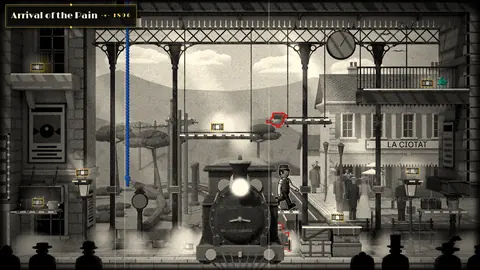 1896
Arrival of a Train at La Ciotat
Our room: Arrival of the Pain
-
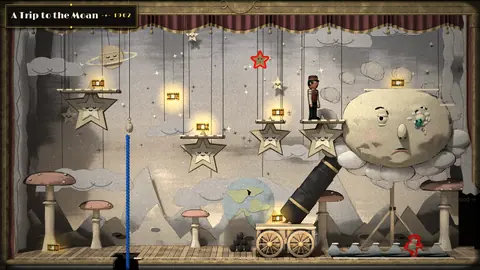 1902
A Trip to the Moon
Our room: A Trip to the Moan
-
 1923
Safety Last!
Our room: Safety Second
Free, in a desktop browser or as a download for Windows, Mac and Linux.
Quick answers
Is Nanook of the North a true story?
It is real people in a real place, but much of it was arranged for the camera. Historians generally describe it as a mix of observation and staging, built round a family chosen for the film.
Who played Nanook in Nanook of the North?
Allakariallak, a respected hunter of the Itivimuit people. Flaherty chose the name "Nanook" for the film, because it seemed more authentic and easier to sell.
Were the people in Nanook of the North a real family?
No, by most accounts. The woman called Nyla and the other woman, Cunayou, were not Allakariallak's wives, and the children were not his. One later account, from Charlie Nayoumealuk, says the two women were Flaherty's own partners.
What was staged in Nanook of the North?
Scenes were set up for the camera, among them the hunting and the building of the igloo. By the 1920s the Inuit used rifles and Western clothes, and the film shows older ways.
How did Allakariallak die?
Flaherty said he starved less than two years after the filming. Later scholars say he died at home, most likely of tuberculosis. Sources differ, and no date is settled here.
Was Nanook of the North the first documentary?
It is often called the first, or one of the first, feature-length documentaries, and the first to succeed commercially. Careful writers add that other non-fiction films came earlier.
Did Flaherty lose an earlier version of the film?
Yes. In 1916 a fire destroyed about 30,000 feet of his first Arctic footage. Most tellings blame a dropped cigarette on the nitrate film.
Is Nanook of the North in the public domain?
In the United States, yes: Duke's Center for the Study of the Public Domain notes that works of 1926 and earlier are free. Flaherty died in 1951. A modern score on a restoration is a separate work.
Sources and further reading
- Nanook of the North, Wikipedia: the cast, the funding, the staging, the registry date
- Allakariallak, Wikipedia: his life, the credited cast and the accounts of his death
- From the National Film Registry: Nanook of the North, released 100 years ago, Library of Congress blog, Now See Hear, June 2022
- Nanook of the North, The Canadian Encyclopedia
- Reality Iced: Robert J. Flaherty's Nanook of the North (1922), The Public Domain Review, 2025
- Nanook of the North (1922), Turner Classic Movies
- Public Domain Day 2022, Duke Center for the Study of the Public Domain