
Palace Picture House · Programme note
Little Caesar 1931
A Warner Bros. gangster picture of January 1931 turned Edward G. Robinson into a star, started a cycle and gave the censors a long winter.
By HertzyPertzy · Updated · 5 minute read
In short
Little Caesar is an American gangster film of January 1931, directed by Mervyn LeRoy for First National and Warner Bros. It follows Rico Bandello, a small-time crook who rises to the top of a Chicago gang and falls again, and it is based on W. R. Burnett's novel of 1929. Edward G. Robinson played Rico and was a star afterwards, and for the rest of his career an expected gangster. Most sources treat the film as the start of the early sound gangster cycle, and it is on the National Film Registry.
Watch the film
It is not played on this page: see where to watch it.
Find where to stream, rent or buy it, on JustWatch.
- Released
- Opened in New York in January 1931: 9 January 1931 by most accounts, with other dates given in other sources
- Made by
- First National Pictures, released by Warner Bros. Producers Hal B. Wallis and Darryl F. Zanuck
- Director and writers
- Mervyn LeRoy. Screenplay by Francis Edward Faragoh and Robert N. Lee, from W. R. Burnett's novel (1929)
- Cast
- Edward G. Robinson (Rico Bandello), Douglas Fairbanks Jr. (Joe Massara), Glenda Farrell (Olga Strassoff)
- Length
- 79 minutes in the most quoted listing; one reference work gives 77
- Cost and takings
- A budget of $281,000 and a box office of $752,000, as one reference work gives them
- Honours
- Nominated for the Academy Award for adapted screenplay (the 4th Academy Awards); added to the National Film Registry in 2000
- Copyright
- Sources differ. By one account it was registered for copyright late in 1930, which would have put it in the US public domain on 1 January 2026; works first published in 1931 enter on 1 January 2027. The release and registration dates are discussed below
The story
Rico Bandello, "Little Caesar" to the neighbourhood, is a small-time crook who wants more. He leaves a Midwestern town for Chicago with his friend Joe Massara. Rico joins a gang. Joe would rather be a dancer, and gets a job in a nightclub and a girlfriend, Olga.
Rico climbs fast, over the bodies of the men above him. He ends up near the top of the city's underworld, then loses his nerve and his place, and retreats to the gutter he came from. He dies in a flophouse, after he has telephoned the police and a sergeant shoots him from behind a billboard. His last words are "Mother of mercy, is this the end of Rico?" The American Film Institute ranks the line 73rd among movie quotations.
From novel to screen
W. R. Burnett moved to Chicago in 1928 and wrote Little Caesar from what he saw and read there. It appeared in 1929. Darryl F. Zanuck, then Warner Bros.' head of production, is reported to have bought the film rights for $15,000. Burnett later said that, ending apart, the script was taken straight from his book.
Sources name the real men behind the characters, and they do not all agree. Rico is generally described as a composite, not a portrait of Al Capone, though Filmsite says Capone, the Brooklyn gangster Buggsy Goldstein and the Chicago criminal Sam Cardinella all contributed. Pete Montana is said to be based on "Big Jim" Colosimo, and the politician called the Big Boy on Chicago's mayor "Big Bill" Thompson. Some historians suggest that Joe Massara owes something to the actor George Raft.
The credited writers were Francis Edward Faragoh and Robert N. Lee. The director was Mervyn LeRoy, and the producers Hal B. Wallis and Zanuck. The Mob Museum notes that Rico's gang is explicitly Italian, and that many viewers, the novelist among them, read Rico as gay.
Edward G. Robinson and Douglas Fairbanks Jr.
Robinson had played gangsters on the stage, in The Racket and The Widow from Chicago. Wallis offered him a supporting part, Otero, and he refused: it was the title role or nothing. He got it. By most accounts the performance made him a major film star at once, and Filmsite describes him as typecast in tough-guy parts afterwards.
Douglas Fairbanks Jr. played Joe, the friend who wants out. Glenda Farrell was Olga. Clark Gable was sought for a part, but Jack L. Warner turned him down; memoirs disagree about which part LeRoy had in mind.
A new kind of hit
The film opened in New York in January 1931. Dates vary: most accounts give 9 January, the New York Times review is dated 10 January, and one account places the opening near the end of 1930. Encyclopedia.com lists reviews in the New York Times, Variety and The New Yorker within the month. It is reported to have cost $281,000 and taken $752,000, and critics and audiences praised it.
Gangster films were not new: Underworld (1927) and the 1930 picture The Doorway to Hell came first. But most accounts treat Little Caesar as the film that launched the early sound cycle, with The Public Enemy (1931) and Scarface (1932) close behind. One count puts the gangster releases at nine in 1930 and 26 in 1931. Other studios copied Warner Bros.: The Secret Six at MGM, Quick Millions at Fox, City Streets at Paramount.
The censors and the press
Hollywood's own office, under Will Hays, had never asked studios to ban violence in the 1920s, only to handle it with care. The state boards were less relaxed. One account says that James Wingate's New York board and the Pennsylvania board both edited Little Caesar heavily, and that the New York board cut some 2,200 crime scenes from films between 1930 and 1932. The same account quotes newspapers that called such pictures bad for the young, and reports complaints of children applauding the gang leader as a hero.
Jack L. Warner announced in 1931 that his studio would stop making gangster pictures. After the Production Code was enforced in 1934, the genre was largely curtailed. Filmsite says Little Caesar and The Public Enemy were withdrawn and not reissued until 1953.
Prizes, and the copyright question
Little Caesar was nominated for the Academy Award for adapted screenplay at the 4th Academy Awards, and did not win. The Library of Congress added it to the National Film Registry in 2000.
Its copyright is a puzzle of dates. The film opened in January 1931, and works first published in 1931 enter the US public domain on 1 January 2027. But by one account it was registered for copyright late in 1930, which would have put it in the public domain on 1 January 2026. Whether that makes a difference depends on rules that sources describe differently, and nothing here settles it. Other countries count differently again.
Why it matters
It made a star and a type. Robinson's Rico became the model for the screen gangster, and Robinson spent years playing variations on him.
It started a cycle. By most accounts it set off the first wave of sound gangster pictures, and rival studios rushed out their own.
It put the censors to work. The row over gangsters on screen fed the pressure that ended in the Production Code of 1934.
It still gets quoted. The Registry lists it and the American Film Institute ranks Rico's dying words among the great movie lines.
On the same programme
Some of these films are rooms you can play
These notes come from Reel Trouble, a comedy platformer through film history. Every room in it is a movie set, built from scratch as a parody of a real film, and a fall is never a death: it is a retake.
-
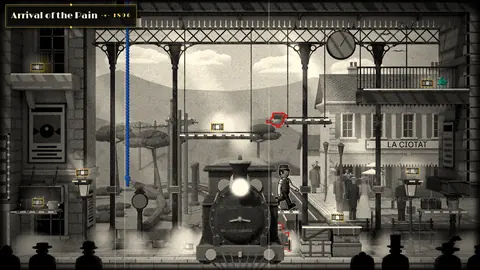 1896
Arrival of a Train at La Ciotat
Our room: Arrival of the Pain
-
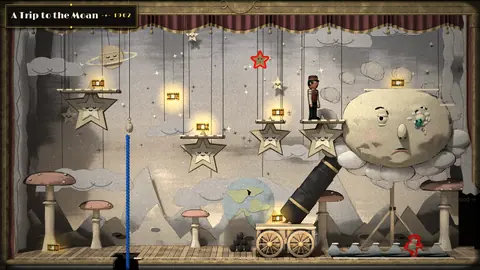 1902
A Trip to the Moon
Our room: A Trip to the Moan
-
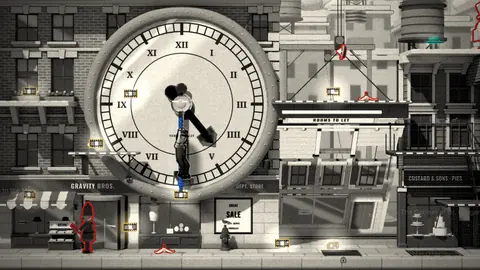 1923
Safety Last!
Our room: Safety Second
Free, in a desktop browser or as a download for Windows, Mac and Linux.
Quick answers
What is Little Caesar about?
It follows Caesar Enrico "Rico" Bandello, a small-time criminal who joins a Chicago gang, rises towards the top and ends hiding in a flophouse, where a policeman shoots him.
Who played Rico in Little Caesar?
Edward G. Robinson. He had asked for the title part after being offered a smaller one, and the film made him a major star.
Was Little Caesar based on a true story?
No. It is based on W. R. Burnett's novel of 1929. Sources name several Chicago models for its characters, but Rico is described as a composite rather than a portrait of Al Capone.
What are Rico's last words in Little Caesar?
"Mother of mercy, is this the end of Rico?" The line ranks 73rd on the American Film Institute's list of movie quotations.
Did Little Caesar win an Oscar?
No. It was nominated for the Academy Award for adapted screenplay, for Francis Faragoh and Robert N. Lee, at the 4th Academy Awards, but did not win.
Was Little Caesar censored?
Yes, by the state boards. One account says the New York board, under James Wingate, and Pennsylvania's board edited it heavily. The Production Code came later, in 1934.
Is Little Caesar in the National Film Registry?
Yes, it was one of the films added in 2000.
Is Little Caesar in the public domain?
Sources differ. By one account a late-1930 registration put it in the US public domain on 1 January 2026; works first published in 1931 enter on 1 January 2027. Other countries have their own rules.
Sources and further reading
- Little Caesar (film), Wikipedia: credits, production, casting, honours and the copyright statement
- Pre-Code crime films, Wikipedia, citing Vieira, Black, Doherty and others on the censors, the Hays Office and the cycle
- Little Caesar (1931), film review, Tim Dirks, Filmsite
- Little Caesar, Encyclopedia.com, with the dates of the first reviews and the film's place in the gangster cycle
- Little Caesar, The Mob Museum, on the film's Italian gang
- File:Little Caesar (1931 film poster - Style B).jpg, Wikimedia Commons, on the poster's copyright notice and the film's release date
- Public Domain Day 2026, Duke Center for the Study of the Public Domain
- List of films in the public domain in the United States, Wikipedia, on the entry of 1931 films in 2027