Palace Picture House · Programme note
The Public Enemy 1931
Warner Bros made a quick, cheap gangster picture, wrapped it in a moral warning, and turned James Cagney into a star by accident.
By HertzyPertzy · Updated · 6 minute read
In short
The Public Enemy is a 1931 American gangster film directed by William A. Wellman for Warner Bros. It follows Tom Powers, a Chicago boy who goes from petty theft to bootlegging during Prohibition and meets a violent end. James Cagney, who was not meant to play him, became a star in the part. A foreword and an epilogue tell the audience the film is a warning, not an advertisement. It was nominated for an Academy Award for its story, is on the National Film Registry, and is due to enter the US public domain on 1 January 2027.
Watch the film
It is not played on this page: see where to watch it.
Find where to stream, rent or buy it, on JustWatch.
- Released
- 23 April 1931, United States. Filming took place in January and February 1931
- Made by
- Directed by William A. Wellman. Produced by Darryl F. Zanuck. Story by Kubec Glasmon and John Bright, from their unpublished novel Beer and Blood; screenplay by Harvey F. Thew
- Cast
- James Cagney (Tom Powers), Edward Woods (Matt Doyle), Jean Harlow (Gwen Allen), Mae Clarke (Kitty), Donald Cook (Mike Powers)
- Studio
- Warner Bros. Pictures
- Budget
- $151,000 by one count, $230,000 by another
- Takings
- $557,000 on Warner Bros' own figures: $464,000 at home and $93,000 abroad
- Honours
- Nominated for Best Story at the 4th Academy Awards, which went to The Dawn Patrol. Added to the National Film Registry in 1998. Eighth in the American Film Institute's gangster top ten, 2008
- Copyright
- Due to enter the US public domain on 1 January 2027, as works of 1931 do under the 95-year term. Until then it is protected, so this page links to no free copy. Titles and characters can carry trade marks, which are a separate matter
The story
Tom Powers and Matt Doyle grow up in Chicago in the 1900s. As boys they steal for a fence called Putty Nose. The story runs on through the First World War and into 1920, when Prohibition begins. As young men Tom and Matt work as enforcers for the bootlegger Paddy Ryan.
Tom is quick to hit, and he hits the people closest to him. His brother Mike stays outside it. A rival gang, the Burns gang, machine-guns Tom and Matt, and Matt dies. Tom survives, is taken from hospital, and is delivered to his family's door, tied up and bandaged. Mike opens it, and the body falls into the hall.
How Cagney got the part
The story came from two former newspapermen, Kubec Glasmon and John Bright, who are said to have seen some of Al Capone's gang rivalries at first hand. It began as an unpublished novel, Beer and Blood. Warner Bros made it, Darryl Zanuck produced, and William Wellman directed.
James Cagney was first cast as Matt, the nice one, and Edward Woods as Tom. The swap itself is well attested. Turner Classic Movies tells it this way: after three days of shooting, and with the writers pressing, Wellman saw the mistake and Zanuck let the two men change parts. Other accounts differ on the detail. Some say the early rushes showed it, some that the writers had Cagney read Tom's lines to Wellman, and the biographer Patrick McGilligan is reported to doubt the rushes story. Sources also differ on who had the idea. The childhood scenes had already been shot, so the boy who plays Tom as a child looks like Woods, and the boy who plays Matt looks like Cagney.
The grapefruit
At breakfast in a hotel, Tom loses patience with his girlfriend Kitty, played by Mae Clarke. He pushes half a grapefruit into her face, and the relationship ends. It is the film's best-known image. It is also a man hurting a woman who has done nothing to him, and the camera does not look away.
How planned it was is disputed. Bright and Glasmon are said to have based it on a story about the Chicago gangster Earl "Hymie" Weiss and an omelette. Wellman thought an omelette too messy. Wellman later said the idea came from his own marriage. Clarke said that Cagney was meant only to shout at her, that the grapefruit surprised her, and that it hurt. Cagney said it was planned and was meant to pass her at an angle. The critic Ben Mankiewicz has argued that her surprise on screen is real. Another account, drawn from her autobiography, has Cagney telling her beforehand, and her real surprise coming when she saw the finished film. Sources differ, and the film cannot settle it.
Jean Harlow plays Gwen Allen, the society woman who takes Tom up. She was under contract to Howard Hughes and was not praised for it. Louise Brooks was the first choice and refused the part. Her biographer later called that refusal the real end of her film career.
Made fast and cheap
Filming took place in January and February 1931. One reference work says it was done in under a month for just over $150,000. Budgets are given as $151,000 and as $230,000. Warner Bros recorded $557,000 in takings. Some of the violence was done for real: live bullets were fired at a wall just behind Cagney's head, a practice said to have been common then, and Donald Cook, playing his brother, knocked out one of Cagney's teeth in a fight.
A warning, not an advertisement
The film opens with a foreword. It says the makers set out to show an environment that exists, not to glorify the criminal. It ends with a caption saying Tom Powers is a problem for the public to solve. At the New York opening, a stage tableau showed a puppet gangster shooting another in the back. The trade paper Variety described such framing as an attempt to square everything.
Why the studio added them is not on record, and the effect is argued over: one critic calls the epilogue ineffective. The film's own story pulls the other way. The Production Code existed on paper by 1930, but it had little force until 1934.
The cycle and the Code
Little Caesar came first, on 9 January 1931, with Edward G. Robinson. The Public Enemy followed in April. Scarface, directed by Howard Hawks and released on 9 April 1932, was last of the three. The Hays Office objected to its sympathy for a criminal. It demanded cuts, added scenes condemning gangsterism and a new ending, and Hawks refused to shoot them. The film was given a foreword and the subtitle The Shame of the Nation. Several states and cities banned it, and Chicago kept it out until 1941.
From 1 July 1934 every film needed the Production Code Administration's seal, and under the Code all criminal action had to be punished. One account says gangster films became scarce for about thirty years. Studios turned to stories of FBI agents hunting criminals. In 1941 three scenes were cut from The Public Enemy, and later restored. In 1954 a written prologue was added warning against gangsters.
Why it matters
It made Cagney. A swap of parts three days into the shoot gave American film a new star. Cagney himself sent the grapefruit up in One, Two, Three (1961).
It shows what the cinema could do before enforcement. The film was made in the pre-Code years, and its violence and its view of women, which are hard to watch, are part of why it is studied.
It is recognised. It was nominated for Best Story, entered the National Film Registry in 1998, and is eighth in the AFI's gangster list.
It is about to be free to use. Works of 1931 enter the United States public domain on 1 January 2027, after 95 years, and it is one of them.
On the same programme
Some of these films are rooms you can play
These notes come from Reel Trouble, a comedy platformer through film history. Every room in it is a movie set, built from scratch as a parody of a real film, and a fall is never a death: it is a retake.
-
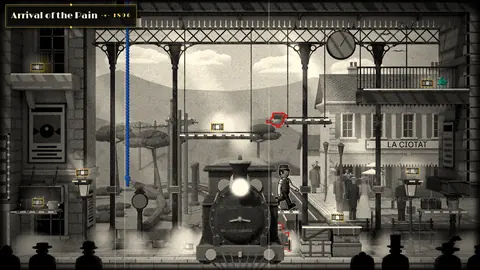 1896
Arrival of a Train at La Ciotat
Our room: Arrival of the Pain
-
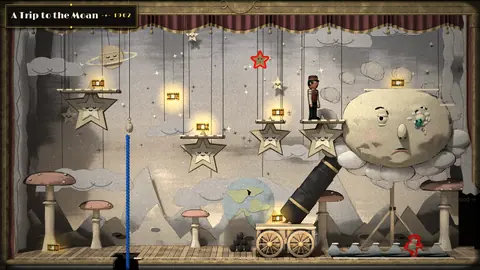 1902
A Trip to the Moon
Our room: A Trip to the Moan
-
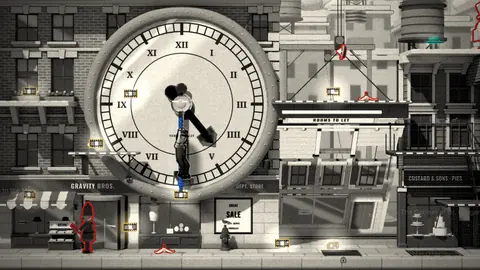 1923
Safety Last!
Our room: Safety Second
Free, in a desktop browser or as a download for Windows, Mac and Linux.
Quick answers
What is The Public Enemy (1931) about?
Two Chicago boys, Tom Powers and Matt Doyle, grow from small-time thieves into enforcers for a bootlegger during Prohibition. Tom rises, quarrels, and is shot in a gang war. His bound body is delivered to his family's door.
Who played Tom Powers in The Public Enemy?
James Cagney. He was first cast as Matt Doyle and Edward Woods as Tom, and the two swapped early in the shoot. Accounts differ on who decided it, but Cagney's performance made his name.
Was the grapefruit scene in The Public Enemy improvised?
Sources differ. Mae Clarke said Cagney was only meant to shout at her and the grapefruit surprised her. Cagney said it was planned. Wellman later claimed the idea came from his own marriage.
Was Jean Harlow in The Public Enemy?
Yes. She played Gwen Allen, a society woman who takes up with Tom. She was under contract to Howard Hughes at the time, and critics were not kind to her performance.
Why does The Public Enemy begin and end with a warning?
The foreword says the film shows a real environment and does not glorify criminals, and the ending says the gangster is a problem for the public to solve. The trade paper Variety called such additions attempts to square everything. The studio's exact reasons are not documented here.
Did The Public Enemy win an Oscar?
No. Kubec Glasmon and John Bright were nominated for Best Story at the 4th Academy Awards and lost to The Dawn Patrol. Cagney was not nominated.
Is The Public Enemy in the public domain?
Not yet in the United States. Works of 1931 are due to enter it on 1 January 2027, 95 years after publication. Other countries have their own terms.
Sources and further reading
- The Public Enemy, Wikipedia, for the cast, dates, budget, takings, censorship and honours
- The Public Enemy, Rob Nixon, Turner Classic Movies, on the casting swap, the grapefruit scene and Harlow
- The Public Enemy (1931), Tim Dirks, Filmsite, on the foreword, the epilogue and the plot
- The Public Enemy (film), EBSCO Research Starters, on the schedule, the cost and the nomination
- Little Caesar (film), Wikipedia, for its date, cost, nomination and registry year
- Scarface (1932 film), Wikipedia, on the Hays Office and the state bans
- Gangster film, Wikipedia, on the cycle and what followed the Code
- Motion Picture Production Code, Wikipedia, for the Code's dates and its rule on crime
- 2027 in public domain, Wikipedia, which lists the film among those due on 1 January 2027
- Public Domain Day 2026, Duke Center for the Study of the Public Domain, for the 95-year term