
Palace Picture House · Programme note
M 1931
Fritz Lang's first sound film hunts a child killer through Berlin, with the police and the underworld both on his trail and a whistled tune as his signature.
By HertzyPertzy · Updated · 6 minute read
In short
M is a 1931 German film directed by Fritz Lang, his first with sound. In a Berlin frightened by the murder of children, the police and the city's criminals both hunt the killer, played by Peter Lorre, who is known by the tune he whistles. Lang used sound, silence and sounds from off screen to build dread, and his killer is allowed to speak for himself at the end. It is regularly ranked among the great films of the early sound era, and later films about serial killers are often compared with it.
Watch the film
It is not played on this page: see where to watch it.
Find where to stream, rent or buy it, on JustWatch.
- Premiere
- 11 May 1931, Ufa-Palast am Zoo, Berlin
- Made by
- Directed by Fritz Lang. Written by Thea von Harbou and Lang. Photographed by Fritz Arno Wagner, edited by Paul Falkenberg. Produced by Seymour Nebenzal
- Cast
- Peter Lorre (Hans Beckert), Otto Wernicke (Inspector Lohmann), Gustaf Gründgens (the Safecracker)
- Studio and shoot
- Nero-Film, Berlin. Shot in about six weeks at the Zeppelinhalle studio at Staaken, just outside the city, by most accounts
- Length
- 117 minutes at the premiere. The surviving original negative is a 96-minute version; modern restorations run about 109 to 111 minutes
- Format
- Black and white, sound, in German. An English-language version was also made in 1932
- Honours
- Voted the best German film in a 1994 poll of 324 German film figures. Added to Roger Ebert's Great Movies list in 1997
- Copyright
- Due to enter the public domain in the United States on 1 January 2027, when works of 1931 reach the end of their 95-year term. Lang died in 1976, so it is protected in Germany and the rest of the European Union until the end of 2046, and this page links to no free copy
The story
Berlin is afraid. Children are disappearing, and the newspapers and the neighbours talk of nothing else. The police, led by Inspector Lohmann (Otto Wernicke), raid every night and find nothing. The killer is a quiet man, Hans Beckert (Peter Lorre), who whistles a tune as he chooses his next child.
The raids have a side effect. They disturb the city's thieves, and the criminals decide that the murderer is bad for business. They organise the beggars and the street watchers, and the underworld and the police search the same streets for the same man, each knowing nothing of the other's progress. A criminal marks Beckert's coat with a chalked letter, the M of the title, and the hunt closes in.
A title, and a killer
Lang announced the film in a newspaper advertisement in 1930 under the title Mörder unter uns, "Murderers Among Us". Then, the story goes, the trouble started. He received threatening letters, and a studio at Staaken refused him space. Its head, a member of the Nazi party, is said to have told him that the party suspected the film was about them, and that the party calmed down once it heard the plot. It is a good story and a widely repeated one, but it rests on retelling rather than on a document, so take it as a story. Other working titles were Eine Stadt sucht einen Mörder ("A City Hunts a Murderer") and Dein Mörder sieht dich an. The film was shot in about six weeks in the Zeppelinhalle at Staaken, for the producer Seymour Nebenzal's company Nero-Film.
Critics often link the killer to Peter Kürten, the "Vampire of Düsseldorf", and Lang met several murderers while preparing the film, Kürten among them by some accounts. Lang denied the link in a 1963 interview, naming other killers instead. The inspector is usually said to be based on a real man, Ernst Gennat of the Berlin criminal police, and the underworld on the real gangs of the day. On screen, Lang showed no violence against a child, reportedly so that the audience would imagine it.
Whistling, noise and silence
M was Lang's first sound film. Yale's film notes say about two thirds of it was shot with sound and one third silent. He used the new medium with restraint. Ordinary city noises, car horns and clocks, mix with long stretches of silence, and the film often cuts to a sound that comes from somewhere off screen. Lang could use fewer cuts because a sound could do the work of a shot.
The famous trick is the tune. Beckert whistles "In the Hall of the Mountain King" from Grieg's Peer Gynt, and the audience learns to dread it before they see him. It is one of the first uses of a leitmotif in a talkie by most accounts. Lorre could not whistle, and Lang is said to have done it for him. The critic Siegfried Kracauer judged that the film's use of sound to build terror was unparalleled in the talkies, though that is one critic's verdict.
The court, and the plea
Peter Lorre was in his first major film role. He is reported to have played the film by day while performing in a play at night. The film shows him as hunted before it shows him as guilty.
The underworld catches Beckert and holds a mock trial. Lang does something unusual here: he lets the accused speak. Beckert pleads that he is driven, and asks the court to understand his point of view. The scene turns the film's question on the audience, whether cruelty comes from a person or from a society that makes him. The BFI reads this as a hint at the murky morality of the underworld and at how righteous anger can become a witch-hunt.
Versions
The film passed the Berlin censors in a 117-minute version and opened on 11 May 1931 at the Ufa-Palast am Zoo. The original negative survives only in a 96-minute version, held by the German federal film archive. A 1960 re-release was cut to 98 minutes. A restoration of 2000 gave a 109-minute version, which Criterion released, and a later digital version of 2013 runs 111 minutes. One source says even the longest restoration is a few minutes short of the premiere.
There was also a 1932 English-language version, with Lorre speaking his own English, and a French one in which his part was dubbed. The English version, long lost, survives in a nitrate print kept by the British Film Institute and has been issued with the film. The United States saw the film in April 1933, first in German with subtitles and then in an English re-dubbed version.
Why it matters
It is a landmark of early sound. The BFI calls its use of sound inventive and sophisticated, and one of the most influential among early talkies.
It is rated among the great German films. A 1994 poll of 324 German film figures voted it the best German film, and Roger Ebert added it to his Great Movies in 1997. Lang called it his favourite of his own films.
It set a pattern for films about killers. The BFI calls it the blueprint of the serial-killer film's psychological approach, and Turner Classic Movies credits Lorre's ordinary-looking killer as a precedent for the killer next door. Who began the police procedural is argued over; what M plainly does is show the police and the underworld hunting the same man in parallel.
It is about to be free to copy in America. Works of 1931 are due to enter the United States public domain on 1 January 2027, after 95 years. In Germany and the rest of the European Union it stays protected until the end of 2046.
On the same programme
Some of these films are rooms you can play
These notes come from Reel Trouble, a comedy platformer through film history. Every room in it is a movie set, built from scratch as a parody of a real film, and a fall is never a death: it is a retake.
-
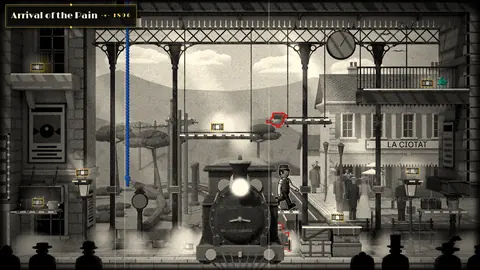 1896
Arrival of a Train at La Ciotat
Our room: Arrival of the Pain
-
 1902
A Trip to the Moon
Our room: A Trip to the Moan
-
 1923
Safety Last!
Our room: Safety Second
Free, in a desktop browser or as a download for Windows, Mac and Linux.
Quick answers
What is M (1931) about?
A killer is murdering children in Berlin. The police cannot find him, and their raids are bad for business among the city's criminals, so the underworld sets out to catch him as well. He is seized and put in front of a court of criminals, where he pleads his case.
Who plays the killer in M?
Peter Lorre plays Hans Beckert. It was his first major film role, and by most accounts it led to years of casting as villains.
What is the tune the killer whistles in M?
"In the Hall of the Mountain King" from Grieg's Peer Gynt. The film uses it as a leitmotif, a tune that stands for the man. Lorre could not whistle, and Lang is said to have whistled it himself.
Was M based on a real killer?
It is often linked to Peter Kürten, the "Vampire of Düsseldorf", and Lang met several murderers while preparing it, Kürten among them by some accounts. In a 1963 interview Lang denied that link and named other killers as his models.
Why was M first called Murderers Among Us?
Lang announced the film in 1930 under the title Mörder unter uns. The story goes that Nazi party members suspected the title was aimed at them, and that they relented once they heard the plot. It rests on retelling more than on documents, so it is best taken as a story.
Is M Fritz Lang's first sound film?
Yes. After a long career in silents, including Metropolis (1927), Lang made M as his first film with sound. He later called it his favourite of his own films.
How long is M?
The premiere version ran 117 minutes. The original negative survives only in a 96-minute version, and the restorations of recent decades run about 109 to 111 minutes. A 1960 re-release was cut to 98 minutes.
Is M in the public domain?
Not yet. In the United States, works of 1931 are due to enter the public domain on 1 January 2027. In Germany and the rest of the European Union it is protected until the end of 2046, seventy years after Lang's death.
Sources and further reading
- M (1931 film), Wikipedia, on the production, sound, versions, reception and copyright
- 2027 in public domain, Wikipedia, on works entering the public domain and the European term of seventy years after the author's death
- Public Domain Day 2026, Duke Center for the Study of the Public Domain, on the 95-year term of works published before 1978
- Film Notes: M, Yale University Library
- M (Fritz Lang, 1931), Digby Houghton, Senses of Cinema, 2022
- M (1931), Felicia Feaster, Turner Classic Movies, 2003
- Fritz Lang's M: the blueprint for the serial killer movie, British Film Institute