
Palace Picture House · Programme note
Metropolis 1927
The costliest German film of its day drew the city of the future, flopped, lost a quarter of its length, and took more than eighty years to put back together.
By HertzyPertzy · Updated · 7 minute read
In short
Metropolis is a 1927 German silent film directed by Fritz Lang and written by Thea von Harbou, made by the Ufa company in Berlin. In a city of the future where the rich live in towers and the workers tend machines underground, an inventor gives a robot the face of the workers' gentle leader and turns it loose. It was the most expensive film Germany had made and it failed, and within months about a quarter of it had been cut out. Its city and its robot have been copied ever since, and most of the missing footage turned up only in 2008, in Buenos Aires.
- Premiere
- 10 January 1927, Ufa-Palast am Zoo, Berlin. A shortened version opened in New York in March 1927
- Made by
- Directed by Fritz Lang. Written by Thea von Harbou, who also wrote the novel, with Lang uncredited. Photographed by Karl Freund and Günther Rittau; sets by Otto Hunte, Erich Kettelhut and Karl Vollbrecht; robot and sculptures by Walter Schulze-Mittendorff; music by Gottfried Huppertz
- Cast
- Brigitte Helm (Maria and the machine-human), Gustav Fröhlich (Freder), Alfred Abel (Joh Fredersen), Rudolf Klein-Rogge (Rotwang), Fritz Rasp (the Thin Man), Theodor Loos (Josaphat), Heinrich George (Grot)
- Studio and cost
- Universum-Film AG (Ufa), Berlin; producer Erich Pommer. Filmed from 22 May 1925 to 30 October 1926. The cost is usually given as about 5 million Reichsmarks against a budget of 1.5 million; some sources say 6 or 7 million
- Length
- Premiere version: 4,189 metres, about 153 minutes at 24 frames a second. American version: about 3,100 m. German re-release of August 1927: 3,241 m. 2010 restoration: 3,945 m, 145 to 150 minutes
- Format
- 35 mm, black and white, silent, 1.33:1, with an orchestral score written for it
- Honours
- UNESCO Memory of the World register, 2001, for that year's restoration: by most accounts the first film on it. 35th in the 2012 Sight and Sound critics' poll and 67th in 2022
- Copyright
- Public domain in the United States since 1 January 2023. Still protected in Germany and the rest of the European Union until the end of 2046, so this page links to no free copy
The story
Metropolis is a city of the future, ruled from the New Tower of Babel by Joh Fredersen (Alfred Abel). The rich live high up among pleasure gardens. The workers live underground and tend the machines.
His son Freder (Gustav Fröhlich) sees Maria (Brigitte Helm), a young woman from the workers' city, and follows her down. He watches a machine explode and sees it as Moloch swallowing men. In the catacombs Maria preaches patience: a mediator will come.
Fredersen turns to the inventor Rotwang (Rudolf Klein-Rogge), once his rival for Hel, who died giving birth to Freder. Rotwang has built a machine in human form. Fredersen wants it given Maria's face, to discredit her. Rotwang agrees, and means to destroy him with it. The false Maria talks the workers into smashing the machines, and their own city floods with their children in it. Freder and the real Maria save the children, the mob burns the robot at the stake, and Rotwang falls from the cathedral roof. Freder joins his father's hand to the foreman's, under the film's motto: the mediator between head and hands must be the heart.
Seventeen months of shooting
The script was by Thea von Harbou, Lang's wife, who wrote the novel alongside it. (Klein-Rogge was her previous husband.) Lang liked to say that the idea came to him at the sight of New York by night, in October 1924. A Berlin trade paper had reported the script nearly finished that June. New York gave him the look.
Shooting ran from 22 May 1925 to 30 October 1926 at Ufa's studios in and near Berlin. Karl Freund and Günther Rittau photographed it, and Otto Hunte, Erich Kettelhut and Karl Vollbrecht designed the city. Ufa had budgeted 1.5 million Reichsmarks. It spent about 5 million by most accounts, 6 or 7 by some: more than any German film before it. The producer, Erich Pommer, left Ufa before it was finished. Counts of the extras run from 27,000 to more than 35,000.
Lang was not gentle. For the flood, Helm and, by most accounts, some 500 children from Berlin's poorest districts worked for fourteen days in cold water. Helm, who played both Marias and the robot, had never been in a film.
Mirrors, models and a robot
The effects, Lang said, were all made in the camera. The best known is the process named after the cameraman Eugen Schüfftan. A mirror at 45 degrees to the lens reflects a miniature placed to one side. Part of the silvering is scraped off, and through the gap the camera sees actors on a full-size set. The stadium is a real running track under a painted model.
The street traffic is stop motion: model cars moved a little between exposures. For the Tower of Babel, 1,000 men with shaved heads were filmed six times on one strip of film, to make 6,000.
The robot, the Maschinenmensch, was a costume. The sculptor Walter Schulze-Mittendorff took a plaster cast of Helm and built armour on it from a new wood filler, sprayed with silver-bronze lacquer. Its change into Maria was made by exposing the same film again and again: first the robot, then each ring of light. The original has not survived.
Cut, lost and found
The film opened at the Ufa-Palast am Zoo in Berlin on 10 January 1927: 4,189 metres, about two and a half hours, with an orchestral score by Gottfried Huppertz. Most critics admired the pictures and not the story, and the public stayed away. H. G. Wells, who will have seen a shortened export version, wrote in the New York Times:
I have recently seen the silliest film. I do not believe it would be possible to make one sillier.
H. G. Wells, The New York Times, 17 April 1927
The cutting began before the premiere. Ufa was in debt to Paramount and Metro-Goldwyn-Mayer, which had lent it four million dollars in December 1925 under the Parufamet agreement. For America, Paramount had the playwright Channing Pollock take out about a quarter of the film and rewrite the titles. Hel went, and with her Rotwang's reason for building a robot in a woman's shape. In Berlin the full version ran for four months without success. Ufa then released its own cut, 3,241 metres, in August 1927. No complete negative survived.
For eighty years every version was a short one, including Giorgio Moroder's of 1984, tinted and set to pop songs. A restoration shown in Berlin in 2001 went onto UNESCO's Memory of the World register. A quarter was still missing.
It turned up in Buenos Aires. An Argentine distributor, Adolfo Z. Wilson, had bought a print in Berlin in January 1927, before the cuts. It passed to a collector and then to the Museo del Cine, and in the 1970s was copied onto 16 mm stock, scratches and all. In 2008 Fernando Martín Peña and the museum's director, Paula Félix-Didier, found the cans. About 25 minutes went back in, and the restoration was first shown in Berlin on 12 February 2010. Two short scenes were too damaged to use.
The handshake, and after
Nothing in Metropolis changes at the end: master and foreman shake hands. In 1947 the critic Siegfried Kracauer read that ending as a foretaste of Nazi rule. Lang rejected the charge, but he later called the moral a fairy tale, and said the thesis was von Harbou's and half the blame his.
The two divorced in April 1933. Lang's story was that Goebbels offered him the top job in German film and that he left for Paris the same evening. His passport shows him going in and out of Germany for months, and biographers date his final departure to the end of July. He died in California in 1976. Von Harbou stayed, wrote for the Third Reich's cinema and joined the Nazi party, in 1940 according to filmportal.de.
Why it matters
It drew the city of the future. Towers, canyon streets and traffic stacked in layers: the Cinémathèque française calls it the archetype, and Blade Runner (1982) is among the films regularly named as its heirs.
Its robot started a line. The same archive calls it the cinema's first android, and C-3PO of Star Wars (1977) its most famous descendant. Queen used the film's footage in the video for "Radio Ga Ga" (1984), and David Fincher rebuilt the city for Madonna's "Express Yourself" (1989).
It is the classic case of a film lost and found. It took four restorations, from 1972 to 2010, to get this close to what Berlin saw in 1927.
On the same programme
Some of these films are rooms you can play
These notes come from Reel Trouble, a comedy platformer through film history. Every room in it is a movie set, built from scratch as a parody of a real film, and a fall is never a death: it is a retake.
-
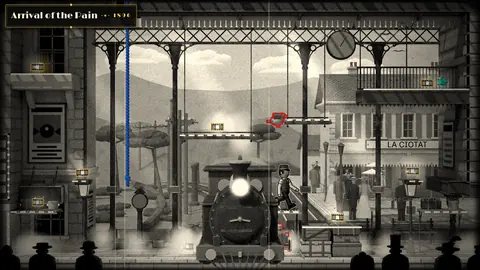 1896
Arrival of a Train at La Ciotat
Our room: Arrival of the Pain
1896
Arrival of a Train at La Ciotat
Our room: Arrival of the Pain
-
 1902
A Trip to the Moon
Our room: A Trip to the Moan
1902
A Trip to the Moon
Our room: A Trip to the Moan
-
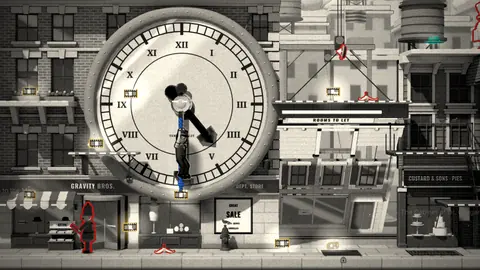 1923
Safety Last!
Our room: Safety Second
1923
Safety Last!
Our room: Safety Second
Free, in a desktop browser or as a download for Windows, Mac and Linux.
Quick answers
What is Metropolis (1927) about?
A city of the future is divided between the rich in its towers and the workers who run its machines underground. The ruler's son falls in love with Maria, who preaches to the workers, and an inventor builds a robot double of her that leads them to wreck the city. The film ends on its motto: the mediator between head and hands must be the heart.
How long is Metropolis?
The premiere version of 1927 was 4,189 metres long, about 153 minutes at 24 frames a second. The cut versions shown for most of the twentieth century ran from under 90 minutes to about two hours. The 2010 restoration is 3,945 metres, just under two and a half hours.
Who played the robot in Metropolis?
Brigitte Helm, who had never been in a film before, played both Maria and the robot. The robot was a costume, not a machine: a suit of armour moulded on a plaster cast of her body by the sculptor Walter Schulze-Mittendorff.
Where was the lost footage of Metropolis found?
In 2008 at the Museo del Cine in Buenos Aires, as a 16 mm copy made in the 1970s from a print that an Argentine distributor had bought in Berlin in 1927, before the cuts. It restored about 25 minutes. A print in New Zealand's national film archive also supplied material.
Is Metropolis complete now?
Nearly. The 2010 restoration is 3,945 metres long against the 4,189 of the premiere. Two short scenes, a monk preaching and a fight between Rotwang and Fredersen, were too damaged to restore and are summarised in title cards.
What did H. G. Wells say about Metropolis?
He called it "the silliest film" in a long review in the New York Times of 17 April 1927. He found it unoriginal, said Karel Čapek's robots had been "lifted without apology", and saw bits of his own early novel The Sleeper Awakes floating about in it.
Did the Metropolis robot inspire C-3PO?
By most accounts, yes. Ralph McQuarrie's first design paintings of C-3PO for Star Wars (1977) are generally said to be based on Lang's robot, in a male version, and the Cinémathèque française calls C-3PO its most famous descendant.
Is Metropolis in the public domain?
In the United States, yes, since 1 January 2023. In Germany and the rest of the European Union it is protected until the end of 2046, seventy years after Fritz Lang's death. New title cards and modern recordings of the score have rights of their own.
Sources and further reading
- Metropolis (1927/2010): programme for the premiere of the restored version, Berlin, 12 February 2010, Friedrich-Wilhelm-Murnau-Stiftung, in German
- Metropolis: credits, dates and lengths, filmportal.de
- Close-up on the robot of Metropolis, La Cinémathèque française, 2011, on the robot, the effects, the versions and the film's descendants
- The Complete Metropolis, Deutsche Kinemathek, Berlin, on its 2010 exhibition
- Metropolis: Sicherungsstück Nr. 1, negative of the restored and reconstructed version 2001, UNESCO, Memory of the World
- Public Domain Day 2023, Jennifer Jenkins, Duke Center for the Study of the Public Domain
- Mr. Wells Reviews a Current Film, H. G. Wells, The New York Times, 17 April 1927, reprinted in full by Picturegoing
- Metropolis at 90: 5 early sci-fi films that paved the way for Fritz Lang's classic, Pamela Hutchinson, British Film Institute, 2017
- Thea von Harbou: biography, filmportal.de
- Metropolis (1927 film), Wikipedia, with its German edition and its articles on Fritz Lang, Parufamet and the Maschinenmensch, for the points given here as "by most accounts"