
Palace Picture House · Programme note
Monkey Business 1931
Four stowaways, one liner, a barrel of gags and a customs hall full of Maurice Chevaliers: the Marx Brothers' third film, and their first from Hollywood.
By HertzyPertzy · Updated · 5 minute read
In short
Monkey Business is an American comedy of 1931, directed by Norman Z. McLeod for Paramount, in which the four Marx Brothers stowaway on an ocean liner and tangle with two rival gangsters. It was their third film, their first written directly for the screen rather than taken from a stage show, and the first they made in Hollywood. The plot is thin on purpose: it exists to hang gags on. Its best-known scene has all four brothers trying to pass through immigration as Maurice Chevalier. Sources say it was a hit, and it is still counted among their best.
Watch the film
It is not played on this page: see where to watch it.
Find where to stream, rent or buy it, on JustWatch.
- Original title
- Monkey Business
- Released
- 19 September 1931 in the United States (Paramount); one account gives a New York opening on 7 October 1931
- Made by
- Paramount Publix. Director Norman Z. McLeod; producer Herman J. Mankiewicz (uncredited); screenplay credited to S. J. Perelman and Will B. Johnstone, with additional dialogue by Arthur Sheekman; camera Arthur L. Todd
- Cast
- Groucho, Harpo, Chico and Zeppo Marx; Thelma Todd (Lucille), Harry Woods (Alky Briggs), Rockliffe Fellowes (Big Joe Helton), Ruth Hall (Mary), Maxine Castle
- Filmed
- In Hollywood: the first Marx Brothers film made there. Their first two were shot at Paramount's Astoria studio in New York
- Length
- About 77 to 78 minutes, depending on the source
- Format
- Sound, black and white, 35 mm
- Copyright
- By one account the copyright was renewed in 1959, and the film is due to enter the public domain in the United States on 1 January 2027, with the other works of 1931. Rights elsewhere differ; the names and likenesses of the performers are a separate matter
The story
The film opens on a ship's forward hatch. Four men sit hidden in barrels, harmonising, until a crew member tells the captain that there are stowaways on board. The credits call them only "the stowaways", and so, for a while, does the film.
What follows is a run of turns more than a plot. Groucho poses as the captain, telephones for meals and tangos with Lucille, the wife of a bootlegging gangster called Alky Briggs. Harpo plays a puppet in a Punch and Judy show for children. Harpo and Chico, as barbers, shave the long moustache off a crew member. Zeppo, the straight man, has the least to do: he steals a passport.
Ashore, the brothers are drawn into a quarrel between Briggs and a rival boss, Big Joe Helton. Zeppo falls for Helton's daughter Mary. The climax comes at her party and in a barn, where Zeppo does the rescuing and Groucho gives a ringside commentary. At the party Harpo also plays the harp, and accompanies the singer Maxine Castle in "O Sole Mio".
Their first from Hollywood
The brothers had come to the screen by way of Broadway. The Cocoanuts (1929) and Animal Crackers (1930) were stage shows, filmed at Paramount's Astoria studio in Queens, New York. Monkey Business was the first of their films written for the screen and the first shot in Hollywood. It began, in the words of one Turner Classic Movies article, their long association with Southern California.
It was directed by Norman Z. McLeod, and Herman J. Mankiewicz produced it without credit. Mankiewicz is said to have warned the writers that the brothers were hard to work with. By most accounts the brothers did not much like the first script either, and it took about five months of rewriting, with help from gag writers and from McLeod, before the film was ready.
Who wrote it
The credits give the screenplay to S. J. Perelman and Will B. Johnstone, with additional dialogue by Arthur Sheekman. Perelman was a humorist and magazine writer, and Groucho is said to have thought him too intellectual for the brothers' style. Groucho later insisted that little of Perelman's work survived. Perelman left for New York before the film was done, and the argument over credit ran for decades.
Others had a hand. One TCM account lists different story credits again, and says that further gags came from other writers, among them Groucho's uncle, Al Shean. It is also said that McLeod let the cameras run while the brothers ad-libbed, since the results were often better than the script. Treat any single list of authors, this one included, as a best guess.
The passport scene
The best-known scene comes at the end of the voyage. To get past immigration in New York, the brothers use a passport Zeppo has stolen: the passport of the French singer Maurice Chevalier, then a Paramount star. Each of them has a go at being Chevalier, and none of them is any good. Harpo, mute as ever, comes closest, by one account with a gramophone strapped to his back playing a Chevalier song while he mouths along.
It is the sort of joke that only works if the audience knows the original, and in 1931 it did. A brisk, flat-footed official, who keeps asking whether this really is Chevalier, is the only person on screen with any sense, and the film does not let him keep it.
How it was received
Critics were mostly kind. Time grumbled that the film made as little sense as possible, then added that admirers of the brothers would find it marvellously funny. It singled out Harpo as the funniest and most versatile of them, and thought Zeppo more active than usual but a dullard beside his brothers. Sources describe the film as a box-office success; none of those opened here give figures.
Censors were less amused. Cuts were demanded to lines with sexual innuendo, and Ireland is said to have refused the film at first for fear it would encourage anarchy, then passed it in January 1932 with sixteen cuts. In 2000 the American Film Institute placed it 73rd on its list of the hundred funniest American films.
Why it matters
It moved the brothers west. After two films adapted from their own Broadway shows, they were given an original screenplay and a Hollywood lot. Their next films, Horse Feathers and Duck Soup, followed the same road.
It made a plot optional. The gangster story is mostly an excuse. What the film trusts is the set piece: the barrel, the barber's chair, the passport queue. Later comedies built on the same bargain.
Its stowaway idea came back. The notion of the brothers hiding on a liner is said to have been reused in A Night at the Opera (1935), where they again hide aboard a ship.
Its copyright date is close. Works first published in 1931 are due to enter the public domain in the United States on 1 January 2027, after the 95-year term that freed the Marx Brothers' Animal Crackers on 1 January 2026. One account says this film's copyright was renewed in 1959, which gives the same date. The brothers' names and likenesses are a separate matter, and a modern print or score has its own rights.
On the same programme
Some of these films are rooms you can play
These notes come from Reel Trouble, a comedy platformer through film history. Every room in it is a movie set, built from scratch as a parody of a real film, and a fall is never a death: it is a retake.
-
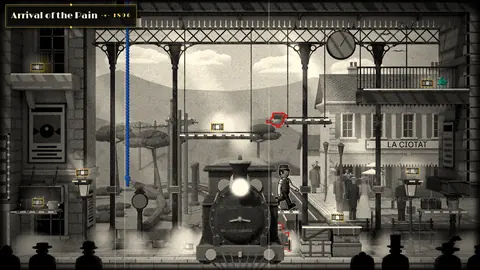 1896
Arrival of a Train at La Ciotat
Our room: Arrival of the Pain
-
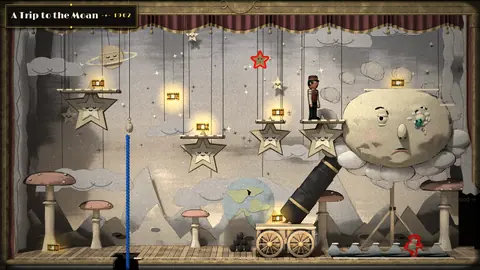 1902
A Trip to the Moon
Our room: A Trip to the Moan
-
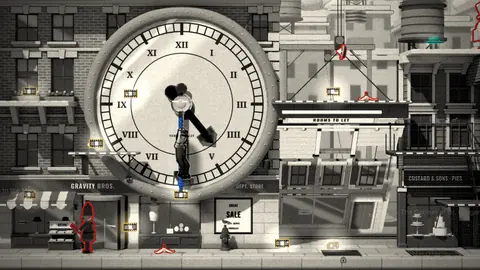 1923
Safety Last!
Our room: Safety Second
Free, in a desktop browser or as a download for Windows, Mac and Linux.
Quick answers
When was Monkey Business released?
Paramount released it in the United States on 19 September 1931. One filmography gives a New York opening on 7 October 1931.
What is Monkey Business (1931) about?
Four stowaways hide on an ocean liner bound for America, dodge the crew, and get mixed up with two rival gangsters and the daughter of one of them. The plot is a frame for the brothers' gags.
Who wrote Monkey Business?
The credited screenwriters are S. J. Perelman and Will B. Johnstone, with additional dialogue by Arthur Sheekman. Many others are said to have added gags, and sources differ on who wrote what.
Is Monkey Business the first Marx Brothers film?
No. It is their third, after The Cocoanuts (1929) and Animal Crackers (1930). It was the first written for the screen and the first made in Hollywood.
What is the Maurice Chevalier scene in Monkey Business?
At immigration the brothers each try to pass as the French singer, using a passport Zeppo has taken. Harpo, by one account, nearly gets through with a gramophone strapped to his back playing a Chevalier song.
Was Monkey Business banned?
Not widely, but censors did object. Cuts were demanded to lines with sexual innuendo, and Ireland is said to have refused it at first for fear it would encourage anarchy, then passed it in January 1932 with cuts.
Is Monkey Business in the public domain?
Works first published in 1931 are due to enter the public domain in the United States on 1 January 2027. One account says this film's copyright was renewed in 1959, which fits that date. Check the current position before reusing it.
Sources and further reading
- Monkey Business (1931 film), Wikipedia: release, credits, production, plot, reception and copyright points given here as reported
- Monkey Business (1931), Tim Dirks, Filmsite: scenes and the passport sequence
- Monkey Business (1931), Turner Classic Movies, article on the production
- Cinema: The New Pictures: Oct. 19, 1931, Time, contemporary review
- Monkey Business, marx-brothers.org: cast, crew, release dates, running time
- Monkey Business 1931, Encyclopedia.com: credits, cast and the Chevalier impersonation
- Public Domain Day 2026, Duke Center for the Study of the Public Domain: the 95-year term and the Marx Brothers' earlier film